
Books / Corrections and additions
Corrections and additions
The second editions of Volumes One, Two and Three, of September 2026, supersede the first editions of 2014 and 2015 where the two differ. This page says what changed and why, so that anyone who owns or cites the printed set knows.
Citing the first edition? Each chapter archive prints the whole of the first-edition chapter, with a table matching the notes of the new edition to the pages of the first, so every change can be seen.
Every chapter rewritten
The first editions were written for lawyers and scholars, and quoted their sources in full in the text. Every chapter of the second editions has been rewritten to be read by everyone, on the model of Michael King’s Penguin History of New Zealand: rigorous history told as a story, in plain English, and fair to every side. The test is whether a grandmother in Tupapa, a teenager in Ōtara and a judge in Avarua can all read it without stopping.
In practice that means:
- Short, active sentences, with one idea to a sentence where possible, and no legal or academic jargon in the story.
- The argument told once, with the people who made the history and the people who gave the evidence at the front of it.
- Cook Islands Māori words used where they are the right words, with the sentence around them saying what they mean.
- Every tradition printed in full, in Cook Islands Māori and in English where both were recorded, and credited to the family that told it.
- Every genealogy from the first edition printed complete, as a table.
- Quotations that correct a long-held mistaken view kept whole in the text.
- Every side’s case put at its strongest before it is answered, and no scolding: the documents do the work.
- Everyone named in full the first time, and every judge given the title he held.
- One name for each person and each place, and the same words for the same thing in every volume: customary law for the law of the people before the courts came, and invented tradition for a story made to support a claim.
- Section numbers, minute-book references and case citations kept out of the story and put in the notes.
Nothing has been dropped. The full quotations and sources have been moved to the chapter archives.
The new chapter format
Every chapter of the second editions is built in the same three tiers, so that a reader who wants the story can read it without interruption, and a reader who wants the evidence can find every piece of it.
1. The chapter
Written to be read, as a story. Each chapter says on its opening page that it is the second edition of September 2026, so it cannot be mistaken for the first.
2. The notes and tables
At the end of the chapter, every step of the argument carries a numbered note, such as 18.1, giving its source and the page where the passage stood in the first edition. The genealogies, lists and comparisons are printed complete in tables.
3. The archive
Online, one for each chapter. It holds the whole first-edition chapter, the table matching the new notes to the old pages, the documents the chapter quotes, printed whole, and Ron Crocombe’s comments that bear on it. The QR code at the end of each chapter leads there.
The longest chapters, in parts
Chapters 18 and 19 of Volume Two, and Chapters 25 and 26 of Volume Three, are each the length of a short book. Each is now one chapter in three parts. A short passage before Part One says what the parts are and why. Each part has its own notes and its own archive, so a reader can take it on its own, like a separate book.
Within each part, the evidence is set out so the reader can see it before reading it. Each part opens with a list of the people who appear in it and a chart or a map: a family tree of the title, a chart of how each holder came to it, or a map of the island with the places marked. Each section is headed by the question it answers, and opens with the answer in a sentence. Each part closes with the evidence in tables, witness by witness.
Hello, World!
The evidence read again
- Ron Crocombe’s comments. He wrote them on the manuscript in 2008: three sequences of typed commentary and more than 390 annotated pages. They came from his son Graeme Crocombe only after the first editions were published. Every chapter has been revised in their light, and each chapter archive prints the comments that bear on it and says what was done about each.
- The Appellate Minute Books. The minutes of the Native Appellate Court have been read, and their evidence and decisions considered in the chapters where they are relevant. They are also the source of the Index of Cases.
- The Rarotonga minute books. Rarotonga Minute Books 1 to 9 were read again in the originals, and they changed the chapters in places the reader will see.
- Judge MacCauley’s genealogy books. Every genealogy in the chapters has been checked against the four books of genealogies Judge MacCauley copied from the Land Court minute books. Each of his entries is cited with his page and the minute-book page it came from, and is treated as a copy of the evidence, not a finding. Where the genealogies differ, the book shows them side by side.
Volume by volume
| Where | What changed |
|---|---|
| Volume One, all chapters | Rewritten in the new style and format. |
| Volume Two, Chapter 18 | Now in three parts. The chapter asks where the chiefly titles came from and how they passed, and traces the Makea Nui title back to the men who made it. The case for the Makea Nui is put at its strongest, in the Court of Appeal’s own words of 2016, before it is answered. The genealogies are checked against Judge MacCauley’s books. |
| Volume Two, Chapter 19 | Now in three parts, on the war that ended in 1823 and the drawing of the lines between the three vaka, with a map of the vaka in 1814 and in 1823 in Part Three. |
| Volume Three, Chapter 25 | Now in three parts: “The coming of the gospel”, “The people” and “The new order”. Three pages of the manuscript left out of the printed book are restored (see below). |
| Volume Three, Chapter 26 | Now in three parts. Five pages of the manuscript left out of the printed book are restored (see below). Tinomana’s kōutu is Taputapuātea, not Ārai-te-Tonga as the first edition printed at page 200. |
The pages missing from the printed first edition
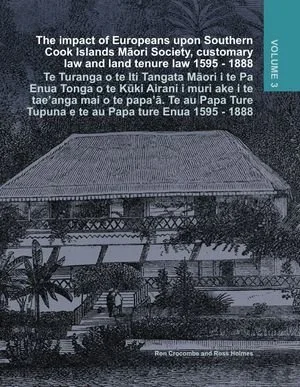
When Volume Three was printed in 2015, some pages of the manuscript did not reach the printed book. The second edition restores them. If you have the printed set, you will be able to download them here, free, and keep them with your copy.
- Chapter 25
- Manuscript pages 54 to 56: Maretu’s account of the Matavera church and the war party, and Pa’s restatement of the boundaries of the vaka at Ārai-te-Tonga, together with the passages on Aratangi, from James Baltaxe, and from Walter Gudgeon on the secession. Restored in Part Two.
- Chapter 26
- Manuscript pages 50 to 54: Walter Gudgeon’s letter of 24 February 1905 and his report of 1908. Restored in Part Three.
Free
For owners of the printed first edition of Volume Three, please email us and we will email you the missing pages.
Ask us for a copy of the missing pagesFrom readers
Corrections and additions sent in by readers are listed here once the evidence has been checked, credited to the family that gave them if they wish.
None listed yet.
Found something?
If a name, a date, a genealogy or a fact in the books is wrong, or something is missing, tell us.