Books / Volume Two / the archive
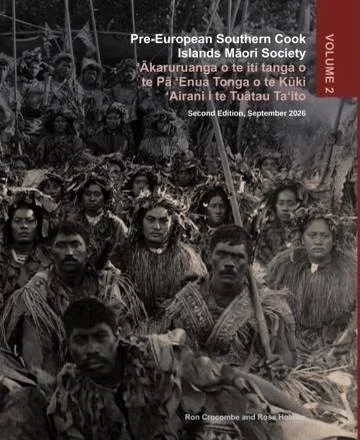
Volume Two archive
Volume Two: the passages, the tables and the notes, chapter by chapter
Chapters17 18 19 20 21 22 23 24 25 26 27
The chapters
- The division of Rarotonga after Karika Tara‘ape and Tangi‘ia-nui
- Southern Cook Islands social stratification
- Pre-European Southern Cook Islands social organisation
- Religion and gods in Southern Cook Islands society
- The “fearful season” in Rarotonga, 1700 to 1823, Part 1
- The “fearful season” in Rarotonga, 1700 to 1823, Part 2
- The “fearful season” in Rarotonga, 1700 to 1823, Part 3
- Succession to chiefly titles in the Southern Cook Islands, Part 1
- Succession to chiefly titles in the Southern Cook Islands, Part 2
- Succession to chiefly titles in the Southern Cook Islands, Part 3
- Rarotonga in 1823, before Christianity
The other volume archives
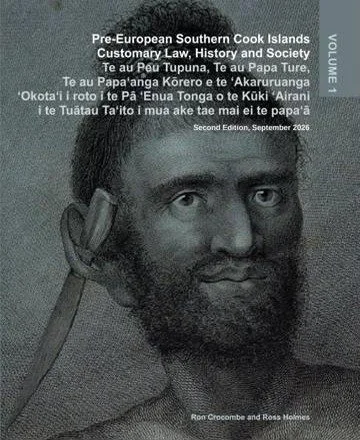
- Volume One: Pre-European Southern Cook Islands Customary Law, History and Society
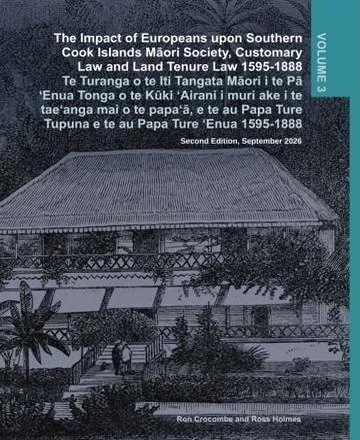
- Volume Three: The Impact of Europeans upon Southern Cook Islands Māori Society, Customary Law and Land Tenure Law 1595–1888
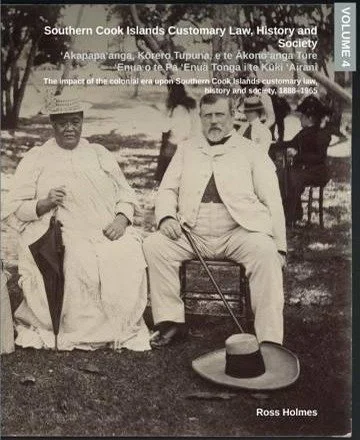
- Volume Four: Silenced Custom. The impact of the New Zealand Colonial era on Southern Cook Islands Customary Law, History and Society
Volume Two, Chapter 17
Chapter 17: The division of Rarotonga after Karika Tara‘ape and Tangi‘ia-nui
What this chapter rests on
- The manuscripts the notes cite (Manuscripts)
- The Land Court minute books the notes cite (Cook Islands Land Court Reports)
- The Native Appellate Court decisions the notes cite (Cook Islands Appellate Court Reports)
- The Journal of the Polynesian Society articles the notes cite
- The parliamentary papers (AJHR) the notes cite
- Every book and article the chapter cites (Bibliography)
- The Cook Islands Māori words used in the chapter (Glossary)
Parts1 2 3 4 5 6 7 8 9 10 11 12 13 14 D Notes
The parts of the chapter
- The opening of the chapter
- How Polynesians settled a high island
- How a family came to own its land
- Where people lived
- The ara metua
- How the island was divided
- Karika Tara‘ape’s coming, as the Makea Nui told it
- The two traditions of the division
- Who settled where
- The people who were already there
- What a tapere was
- Avaavaroa: the Tamarua manuscript
- How many ariki?
- Vaka: a canoe, a people, and only later a district
The documents and tables
- The chapter’s tables stand in the chapter.
1. The opening of the chapter
17.1 Peter Buck (Te Rangi Hiroa), MangaianSociety, Bernice P. Bishop Museum Bulletin 122, Honolulu, 1934, p. 4. First edition, Volume 2, p. 12.
17.2 Encyclopaedia Britannica, “Marquesas Islands”. First edition, Volume 2, p. 12; Volume 1, Chapter 11 is at first edition pp. 416 to 435.
17.3 Ron Crocombe, Land Tenure in the Cook Islands, thesis, Australian National University, 1961, p. 124, and the published edition, Oxford University Press, Melbourne, 1964, p. 64; the author’s editing is in square brackets. “1800s” for “nineteenth century”, on Ron Crocombe’s standing advice for this series. First edition, Volume 2, p. 12.
2. How Polynesians settled a high island
17.4 Peter Buck, Arts and Crafts of the Cook Islands, Bernice P. Bishop Museum Bulletin 179, Honolulu, 1944, pp. 477 to 478. First edition, Volume 2, p. 13.
3. How a family came to own its land
17.5 Crocombe, thesis (1961), pp. 17 to 20 and 88 to 89; Land Tenure (1964), pp. 51 to 52. First edition, Volume 2, pp. 13 and 16.
17.6 Crocombe, thesis (1961), p. 89, note. First edition, Volume 2, p. 13.
4. Where people lived
17.7 G. R. Lewthwaite, “Man and Land in Early Tahiti: Polynesian agriculture through European eyes”, Pacific Viewpoint 5 (1964), p. 30; James Baltaxe, The Transformation of the Rangatira, thesis, University of Illinois, 1975, p. 52. First edition, Volume 2, p. 13.
17.8 Baltaxe, thesis, p. 47; Peter Buck, The Material Culture of the Cook Islands (Aitutaki), Thomas Avery, New Plymouth, 1927, pp. 211 to 212. First edition, Volume 2, p. 14.
17.9 Akaruke Canny Aratangi, TeAo Marama, 1986, p. 70, from an interview with Puati Mata‘iapo (Tere Ngapare) at Titikāveka on 23 November 1985. First edition, Volume 2, p. 14.
5. The ara metua
17.10 Jeffrey Sissons, “The Seasonality of Power: the Rarotongan legend of Tangi‘ia-nui”, Journal of the Polynesian Society 98 (1989), p. 332; Crocombe, Land Tenure (1964), p. 8; Stephenson Percy Smith, “Arai-te-Tonga, the ancient marae at Rarotonga”, JPS 12 (1903), p. 218. First edition, Volume 2, p. 14. The first edition gave the length as both “about 15 miles” and “24 kilometres”; the metric figure is kept.
17.11 Roger Duff, “The Canterbury Museum Expedition to Rarotonga”, New Zealand Archaeological Association Newsletter 8 (1965), p. 55, and his introduction to M. M. Trotter (ed.), Prehistory of the Southern Cook Islands, Canterbury Museum Bulletin 6, Christchurch, 1974, p. 13; Sissons (1989), pp. 335, 343 to 344. First edition, Volume 2, p. 14.
17.12 Sissons (1989), p. 335. Takurua akaau: Jasper Buse with Raututi Taringa, Cook Islands MaoriDictionary, gives “special feast”. First edition, Volume 2, p. 14.
17.13 Matthew Campbell, “Ritual Landscape in Late Pre-contact Rarotonga: a brief reading”, JPS 111 (2002), p. 149; the Parker reference is R. Hamilton Parker, “Survey of the Ara Metua”, in Trotter (ed.), 1974, p. 64, and the Bellwood reference is Peter Bellwood, “Varieties of ecological adaptation in the southern Cook Islands”, Archaeology and Physical Anthropology in Oceania 6 (1971), p. 149. First edition, Volume 2, pp. 14 to 15.
17.14 John Williams and Charles Barff, journal, Ra‘iatea to Huahine via the Cook Islands, 1830, microfilm, State Library of New South Wales, quoted in Campbell (2002), p. 150. First edition, Volume 2, p. 15.
17.15 John Williams, A Narrative of Missionary Enterprises in the South Sea Islands, John Snow, London, 1837, pp. 206 to 207. First edition, Volume 2, p. 15.
17.16 Buck, Material Culture of the Cook Islands (Aitutaki), 1927, pp. 211 to 212. First edition, Volume 2, p. 15.
17.17 Peter Bellwood, “Archaeology on Rarotonga and Aitutaki, Cook Islands: a preliminary report”, JPS 78 (1969), pp. 518 to 519. First edition, Volume 2, p. 16.
6. How the island was divided
17.18 Richard Gilson, The Cook Islands 1820–1950, Victoria University Press, Wellington, 1980, p. 7. First edition, Volume 2, p. 16.
17.19 Walter Gudgeon, report of 19 April 1906, Appendix to the Journals of the House of Representatives (AJHR) 1906 A-3, p. 80. First edition, Volume 2, p. 16.
17.20 Te Ariki Tara‘are, “The settlement of Tangi‘ia-nui at Rarotonga”, History and traditions of Rarotonga, part IX, JPS 29 (1920), pp. 1 to 19. First edition, Volume 2, p. 16.
17.21 Putua Ariki, translated by Arthur H. Browne, “E Tuatua no Karika Tara‘ape o Rarotonga”, JPS 6 (1897), p. 5; John A. Numa, A Pre-European History of Rarotonga, manuscript, 1954, Alexander Turnbull Library, Wellington, p. 3. First edition, Volume 2, p. 18.
17.22 Putua Ariki (1897), p. 5. First edition, Volume 2, p. 18.
7. Karika Tara‘ape’s coming, as the Makea Nui told it
17.23 Henry Nicholas and Stephenson Percy Smith (ed.), “The royal genealogy from Avaiki downwards, from Pāpā”, JPS 1 (1892), pp. 67 to 69 (Rarotongan) and 73 to 74 (English). Henry Nicholas was of the Makea Nui family; Ron Crocombe’s advice (12 October 2008) that the source and interest of every tradition be recorded is followed. First edition, Volume 2, pp. 18 to 21.
17.24 William Wyatt Gill’s editorial notes to Nicholas (1892), on Tākitumu, on Nina-‘enua (“a common expressive phrase; it is also common to the Māori, as is the custom of giving names to celebrated weapons”), on the two seers, on Tutapu as Tangi‘ia-nui’s elder brother, and on Te ara nui o Toi. First edition, Volume 2, pp. 18 to 19.
17.25 Baltaxe, thesis, p. 80. First edition, Volume 2, p. 21.
8. The two traditions of the division
17.26 Stephen Savage, “The history of Tangiia-nui, Tutapu-aru-roa and Atonga”, English typescript from Tamuera Terei, p. 1, Savage’s own note signed “S.S.”, Savage box, Cook Islands National Archives; Archives 25. Te Ariki-tara-are’s evidence of 1912 is at Chapter 24.
17.27 Henry Nicholas (translator), “Genealogies and historical notes from Rarotonga: genealogy of Pa, chieftainess of Tākitumu”, JPS 1 (1892), pp. 26 to 27, from a paper originally written by a Rarotongan in 1857 and given to him by Frederick Moss. Similar accounts in Nicholas and Smith (1892), p. 69; William Wyatt Gill, Myths and Songs from the South Pacific, 1876, p. 16, and The Genealogy of the Kings of Rarotonga and Mangaia, 1890, p. 631; Stephen Savage, “The period of Iro-nui-ma-oata and Tangi‘ia-nui-ariki”, JPS 26 (1917), p. 50. First edition, Volume 2, pp. 21 to 23.
17.28 Tuava, Minute Book 1, folio 96, 4 January 1904; Tamuera, Minute Book 1, folio 131, 6 January 1904; J. D. (Joe) Gray, A History of Rarotonga, 1800–1883, thesis, University of Otago, 1975, p. 167, Makea interview. Later, as a third vaka evolved, the mountain-peak boundaries were extended north-west to Maungaroa and Te Reinga-o-Pora. First edition, Volume 2, p. 23.
17.29 Crocombe, thesis (1961), pp. 17 to 20; Land Tenure (1964), pp. 9 to 11. First edition, Volume 2, p. 23.
9. Who settled where
17.30 Numa (1954), p. 5. John Numa was of Ngāti Arera of Avarua, which bears on his account of the Arera in Chapter 24 (Ron Crocombe, 12 October 2008, on note 521 of the manuscript). Four hundred is a conventional number. First edition, Volume 2, p. 22.
17.31 Leslie G. Kelly, “Cook Island origin of the Māori”, JPS 64 (1955), pp. 186 to 187. First edition, Volume 2, p. 22.
17.32 Stephen Savage, A Dictionary of the MaoriLanguage of Rarotonga, Department of Island Territories, Wellington, 1962, p. 95. First edition, Volume 2, p. 22.
17.33 Nicholas, “Genealogy of Pa”, JPS 1 (1892), p. 23. First edition, Volume 2, p. 22.
17.34 Stephen Savage and Tamuera Te Rei, An Ancient History of Tangi‘ia-nui, 1907, II, pp. 14 and 25; A. H. Browne (translator), Putua Ariki, “An account of some early ancestors of Rarotonga”, JPS 6 (1897), p. 4; Te Ariki Tara‘are, “Traditions of Rarotonga”, JPS 23 (1919), pp. 66 to 68; Numa (1954), pp. 3 and 5. First edition, Volume 2, pp. 22 to 23.
17.35 Te Ariki Tara‘are, “Traditions of Rarotonga”, JPS 28 (1919), pp. 183 to 208; Stephen Savage, Extracts, 1911, p. 218; Tamarua-nui-te-akaariki, The History of Tamarua-nuiof Pouara, p. 2; Te Pa, Minute Book 2, folios 53 and 57, 14 June 1905; Numa (1954), p. 5. First edition, Volume 2, p. 24; the Appellate Court’s finding is at Chapter 21, first edition pp. 214 to 215.
17.36 Willie Browne, Arekakaia section 50A5, Tākitumu, Appellate Minute Book 1, pp. 230–231 and 237, 12 August 1949; Cook Islands Native Appellate Court Reports, (1949) 1 AMB 264, published online at the series’ website.
17.37 In re Arekakaia section 50A5, Native Appellate Court (Morison, Beechey and Morgan JJ), 15 August 1949, Appellate Minute Book 1, p. 264.
10. The people who were already there
17.38 Crocombe, thesis (1961), pp. 17 to 20. First edition, Volume 2, p. 24.
17.39 Matthew Campbell, History in Prehistory: the oral traditions of the Rarotongan Land Court records, thesis, University of Sydney, 2002, p. 227. First edition, Volume 2, p. 24.
17.40 Cook Islands Herald, 29 June 2011. First edition, Volume 2, p. 24.
17.41 Baltaxe, thesis, p. 52. First edition, Volume 2, p. 24.
17.42 Crocombe, thesis (1961), pp. 17 to 20; the evidence of Patu Tita on the Uritaua is at Minute Book 19, p. 167. First edition, Volume 2, p. 24.
17.43 Charlie Tau-Puru-Ariki Cowan, Collection of Genealogies, Legends and Histories, “Arera: Akapapaanga no Ngāti Arera”, Church of Jesus Christ of Latter-day Saints film 1126511, pp. 12 to 14. Charlie Cowan was himself of Arera. First edition, Volume 2, p. 24.
17.44 Cowan, as above. The descent of the Makea title through Arera is set out with the genealogies in Chapter 24 (first edition pp. 50 to 63), and the killing of Putua in Chapter 21 (first edition pp. 192 to 199).
17.45 Henry Nicholas, “Nga tere i muri ake ia Tongaiti e te tere o Naea: the migration after Tongaiti, and that of Naea”, JPS 2 (1893), p. 277 (English), p. 275 (Rarotongan). First edition, Volume 2, p. 25.
17.46 Te Aia, translated by Stephenson Percy Smith, “Genealogies and historical notes from Rarotonga”, JPS 2 (1893), p. 277. First edition, Volume 2, p. 25.
17.47 A. R. Henry (ed.), TeAka Tauira, Rarotonga, 3 June 1939, p. 5, and 22 July 1939, p. 6; Numa (1954), p. 10; manuscript of Samuela Te Rei, 1909, Justice Department, Avarua, pp. 3 to 4. First edition, Volume 2, p. 25.
17.48 More-ta‘unga-o-te-tini, collected and translated by Stephen Savage, “The Rarotongan version of the story of Rata”, JPS 19 (1910), pp. 142 to 157. First edition, Volume 2, p. 25.
17.49 Tamuera Te Rei, translated by Stephen Savage, “The period of Iro-nui-ma-oata and Tangi‘ia-nui-ariki”, JPS 26 (1917), p. 58. First edition, Volume 2, p. 25.
11. What a tapere was
17.50 Baltaxe, thesis, pp. 50 to 51; John Williams, Narrative, 1837, p. 205. First edition, Volume 2, p. 26.
17.51 Gilson (1980), p. 7; Crocombe, Land Tenure (1964), p. 8. Four hundred acres is about 160 hectares. First edition, Volume 2, p. 26.
17.52 Josephine G. Baddeley, Rarotongan Society: the creation of tradition, thesis, University of Auckland, 1978, p. 298; the terms are from Buse’s dictionary, pp. 49, 242, 251, 383, 404, 411, 416 and 547. First edition, Volume 2, p. 26.
17.53 Baddeley (1978), p. 298; tu‘anga and kena, Buse, pp. 516 and 169. First edition, Volume 2, p. 26.
17.54 Baddeley (1978), pp. 299 to 300. Rarotongans use the phrase “blood right” to denote a consanguineal relationship to the landowners. First edition, Volume 2, pp. 26 to 27.
17.55 Baltaxe, thesis, p. 51. Tinomana’s years in Maungaroa are in Chapter 21 (first edition pp. 222 to 223). First edition, Volume 2, p. 27.
17.56 Crocombe, thesis (1961), pp. 17 to 20, with his note that the remains of large but now abandoned terraced taro patches in these valleys suggest that they did carry larger populations. First edition, Volume 2, pp. 27 to 29.
17.57 Nicholas, “Genealogy of Pa”, JPS 1 (1892), pp. 26 to 27; Stephen Savage, Notes on Cook Island Traditions, manuscript, Justice Department, Avarua, p. 7 ff. First edition, Volume 2, p. 29.
17.58 Frederick Moss, “The Maori polity of the island of Rarotonga”, JPS 3 (1894), pp. 21 to 24. First edition, Volume 2, p. 29.
17.59 Willie Browne, Tereora section 106B, Appellate Minute Book 1, p. 222, 3 August 1949; Tui Pori Makea, Te Kou and Takareu appeals, Appellate Minute Book 2, p. 107, 5 September 1951; Tuaine Nicholas, Te Koiti Raukura section 6C, Appellate Minute Book 1, p. 309, 22 August 1949.
17.60 The Appellate Court itself took the presumption that a customary title ran “from reef to ridge”, Savage J, Pokoinu sections 227 and 228, 22 May 2013, paragraph 9 (Archives 36).
12. Avaavaroa: the Tamarua manuscript
17.61 Tamarua, unpublished manuscript, English translation, undated, from Ron Crocombe’s collection, Rarotonga. First edition, Volume 2, pp. 28 to 31 (and again at pp. 173 to 175).
17.62 Numa (1954), p. 8. Takaia and Rongo‘oe: Chapter 19. First edition, Volume 2, p. 31.
17.63 Stephenson Percy Smith, Hawaiki: the whence of the Maori, 1899, pp. 37 to 39; Nicholas and Smith (1892), pp. 69 and 73; Putua Ariki (1897), pp. 5 and 8; History and Traditions of the Taranaki Coast, 1907, pp. 185 to 186 and 196 to 199; L. Browne, Legends and Customs of the Cook Islands, 1966, p. 25; Tui A‘ana (Matatia), “The history of the peopling of Rarotonga”, 1895, pp. 113 to 114; Peter Buck, The Coming of the Maori, 1958, p. 461; Smith, “The settlement of Rarotonga”, JPS 8 (1899), pp. 29 to 39, and the genealogies facing p. 48; Tivini Haueti and Tamuera Te Rei, genealogies of Titia-nui, Tinomana and Tangi‘ia-nui, JPS 26 (1917), pp. 60 to 65. First edition, Volume 2, p. 31.
13. How many ariki?
17.64 First edition, Volume 2, pp. 31 and 226 (the Te Au family and Tinomana, in Chapter 21).
17.65 Crocombe, thesis (1961), p. 33. First edition, Volume 2, p. 31.
17.66 Te Ariki Tara‘are, “History and traditions of Rarotonga”, translated by Stephenson Percy Smith and others, JPS 8 (1899), p. 62. First edition, Volume 2, p. 31.
17.67 Baddeley (1978), p. 337, quoting Douglas Oliver, Ancient Tahitian Society, University of Hawaii Press, Honolulu, 1974, p. 686. First edition, Volume 2, p. 31.
17.68 The Uriarau tradition as recorded in the first edition, Volume 2, p. 31.
17.69 Savage and Te Rei, An Ancient History of Tangi‘ia-nui, 1907, IV, p. 1; Tivini Haueti (Stephen Savage) and Tamuera Te Rei, E TuatuaTaito, Government Printer, Rarotonga, 1908, pp. 28 to 29. First edition, Volume 2, p. 32.
17.70 Numa (1954), pp. 11 to 12. The seventh name should be checked against the manuscript at the Turnbull Library. First edition, Volume 2, p. 32.
17.71 Minute Book 1, pp. 114 and 199. First edition, Volume 2, p. 32.
14. Vaka: a canoe, a people, and only later a district
17.72 Buse, Cook Islands MaoriDictionary, p. 554. First edition, Volume 2, p. 32.
17.73 David V. Williams, He Aha teTikanga Maori, unpublished revised draft of 10 November 1998 of Joseph Williams’s 1996 paper for the New Zealand Law Commission, p. 17. First edition, Volume 2, p. 32.
17.74 Williams, as above, p. 17; Manuka Henare, “Nga Tikanga me nga Ritenga o te Ao Maori: standards and foundations of Maori society”, in Royal Commission on Social Policy, The April Report, 1988, vol. III part 1, p. 13. First edition, Volume 2, p. 32.
17.75 Crocombe, thesis (1961), p. 32. First edition, Volume 2, pp. 32 to 33.
17.76 Marjorie Crocombe, “Rarotongan Sandalwood”, 1962, p. 351, and Crocombe, thesis (1961), p. 32. First edition, Volume 2, p. 33.
17.77 Richard Gilson, Administration of the Cook Islands (Rarotonga), thesis, University of London, 1952, p. 19. First edition, Volume 2, p. 33.
17.78 Atholl Anderson, Kin and Border: traditional land boundaries in East Polynesia and New Zealand, with particular reference to the northern boundary of NgāiTahu, revised edition, report commissioned by Te Rūnanga o Ngāi Tahu, 2003, p. 51, cited in Waitangi Tribunal, TeTau Ihu o teWaka a Maui: preliminary report 2, Wai 785, 2007, paragraph 2.2. First edition, Volume 2, pp. 16 and 33; the argument is completed in Chapter 21, first edition pp. 158 to 163 and 229 to 231.
17.79 Tivini Haueti (Stephen Savage) and Tamuera Terei, Tuatua no Tangiia Ariki, Rarotonga, 1907, PAE I, printed page 18; Archives 29a. The English rendering of the quoted sentence is the author’s.
Volume Two, Chapter 18
Chapter 18: Southern Cook Islands social stratification
What this chapter rests on
- The manuscripts the notes cite (Manuscripts)
- The Land Court minute books the notes cite (Cook Islands Land Court Reports)
- The Native Appellate Court decisions the notes cite (Cook Islands Appellate Court Reports)
- The Journal of the Polynesian Society articles the notes cite
- The parliamentary papers (AJHR) the notes cite
- Every book and article the chapter cites (Bibliography)
- The Cook Islands Māori words used in the chapter (Glossary)
Parts1 2 3 4 5 6 7 8 9 10 11 12 13 14 15 16 17 18 19 20 21 22 23 D Notes
The parts of the chapter
- The opening of the chapter
- The people in this chapter
- What did the missionaries see?
- Was rank a ladder, or a gradient?
- What were mana and tapu?
- How many ranks were there?
- Who was the ariki?
- Were all ariki alike?
- How sacred was the ariki?
- What could an ariki actually do?
- Whom did ariki marry?
- Did one ariki interfere with another?
- Who were the ta‘unga?
- Who were the mata‘iapo?
- Who were the rangatira?
- How were mata‘iapo and rangatira chosen?
- What were the kōmono and the kiato?
- How was a warrior made?
- Who were the ‘unga?
- Were there slaves?
- How was Mangaia different?
- Who said what, and when
- What this means
The documents and tables
- Document 18.D.1, The people in this chapter (in the chapter)
- Document 18.D.2, Rank in Rarotonga: who said what, and when (in the chapter)
- Table: The ranks of Rarotonga and Mangaia before Christianity (in the chapter)
- Table: Frederick Moss’s account of rank and power in Rarotonga, 9 September 1893 (in the chapter)
1. The opening of the chapter
18.1 David Chandler, A History of Cambodia, 4th edition, Boulder, 2008, p. 31. Variations between the islands: Volume 1, Chapters 12 to 16. First edition, Volume 2, p. 234.
2. The people in this chapter
3. What did the missionaries see?
18.2 John Williams, A Narrative of Missionary Enterprises in the South Sea Islands, London, 1837. First edition, Volume 2, p. 234.
18.3 William Gill, Gems from the Coral Islands, London, 1856. First edition, Volume 2, p. 234.
18.4 John Williams, Missionary Enterprises, 1837, pp. 215–216. First edition, Volume 2, p. 234.
18.5 John Williams, Missionary Enterprises, 1837, pp. 198–199. First edition, Volume 2, p. 234.
18.6 William Gill, Gems from the Coral Islands, 1856, pp. 26–27. First edition, Volume 2, p. 235.
18.7 John Williams, Missionary Enterprises, 1837, pp. 214–215. First edition, Volume 2, p. 235.
18.8 George Waldon, Missionary Labors and Results in the Hervey Islands, in a series of letters, Boston, 1838, p. 50. First edition, Volume 2, p. 235.
18.9 James Baltaxe, The Transformation of the Rangatira: a case of the European reinterpretation of Rarotongan social organization, PhD thesis, University of Illinois, 1975, pp. 12 and 14. The missionaries’ model is dealt with in Volume 3. First edition, Volume 2, p. 235.
18.10 Matthew Campbell, “History in Prehistory: the oral traditions of Rarotonga”, in History in Prehistory, 2002, pp. 223–224. First edition, Volume 2, p. 235.
18.11 Report of the Visit of the Members of the General Assembly to the Cook and Other Islands, Appendix B, “Social Distinctions, Rarotonga”, Appendix to the Journals of the House of Representatives (AJHR) 1903, A-3B, p. 42; compiled from an article by Frederick Moss and information from the Reverend Lawrence. Printed whole in the archive. First edition, Volume 2, pp. 235–237.
4. Was rank a ladder, or a gradient?
18.12 New Zealand Law Commission, Māori Custom and Values in New Zealand Law, 2003 printing, p. 33. Primogeniture: Volume 2, Chapter 18. First edition, Volume 2, p. 238.
18.13 The kinship terms tuakana (senior) and teina (junior) distinguished an older from a younger sibling of the same sex, so that within a set of siblings each sex had its own order of rank. For regional variations in New Zealand in the reckoning of tuakana and teina status see Anne Salmond, “Tipuna – Ancestors: aspects of Māori cognatic descent”, in Andrew Pawley (ed.), Man and a Half: essays in Pacific anthropology and ethnobiology in honour of Ralph Bulmer, Polynesian Society, Auckland, 1991, pp. 334–347. First edition, Volume 2, p. 238.
18.14 Stephen Savage, A Dictionary of the Māori Language of Rarotonga, Department of Island Territories, Wellington, 1962, p. 405. First edition, Volume 2, p. 238.
18.15 Stephen Savage, Dictionary, p. 373. First edition, Volume 2, p. 238.
18.16 “Of low birth”: Herbert W. Williams, A Dictionary of the Māori Language, 7th edition, Wellington, 1971, under tutua. First edition, Volume 2, p. 238.
18.17 New Zealand Law Commission, Māori Custom and Values in New Zealand Law, Study Paper 9, Wellington, 2001, paragraph 141; David V. Williams, He Aha Te Tikanga Māori, unpublished revised draft of 10 November 1998 of Joseph Williams, He Aha Te Tikanga Māori, paper for the New Zealand Law Commission, 1996, p. 12. First edition, Volume 2, p. 238.
5. What were mana and tapu?
18.18 New Zealand Law Commission, Māori Custom and Values, 2001, paragraph 137; David V. Williams, He Aha Te Tikanga Māori, 1998, p. 11. First edition, Volume 2, p. 239.
18.19 Stephen Savage, Dictionary, p. 137. First edition, Volume 2, p. 239.
18.20 Herbert W. Williams, A Dictionary of the Māori Language, under mana. First edition, Volume 2, p. 239.
18.21 New Zealand Law Commission, Māori Custom and Values, 2001, paragraph 137; David V. Williams, He Aha Te Tikanga Māori, 1998, p. 11. First edition, Volume 2, p. 239.
18.22 New Zealand Law Commission, Māori Custom and Values, 2001, paragraph 137; Mason Durie, letter to the New Zealand Law Commission on the draft of Māori Custom and Values in New Zealand Law, 19 February 2001, p. 1. First edition, Volume 2, p. 239.
18.23 New Zealand Law Commission, Māori Custom and Values, 2001, paragraph 137; Māori Marsden, “God, Man and Universe: a Māori view”, in Michael King (ed.), Te Ao Hurihuri: the world moves on, Hicks Smith, Wellington, 1975, p. 194. First edition, Volume 2, p. 239.
18.24 Waitangi Tribunal, Muriwhenua Land Report, Wai 45, GP Publications, Wellington, 1997, pp. 29–30. First edition, Volume 2, p. 239.
18.25 Frederick Moss, The Māori Polity in the Island of Rarotonga, paper dated 9 September 1893, Wellington, 1894; James Baltaxe, The Transformation of the Rangatira, 1975, pp. 134–146. First edition, Volume 2, pp. 239–240.
18.26 Frederick Moss, The Māori Polity in the Island of Rarotonga, 1894, p. 20. First edition, Volume 2, p. 240.
18.27 Frederick Moss, The Māori Polity in the Island of Rarotonga, 1894, p. 20. First edition, Volume 2, p. 240.
18.28 James Baltaxe, The Transformation of the Rangatira, 1975, pp. 134–146. First edition, Volume 2, pp. 240 and 244–245.
18.29 James Baltaxe, The Transformation of the Rangatira, 1975, pp. 134–146. First edition, Volume 2, p. 240.
18.30 Frederick Moss, The Māori Polity in the Island of Rarotonga, 1894, p. 21. First edition, Volume 2, pp. 240–241.
18.31 Josephine Baddeley, Rarotongan Society: the creation of tradition, PhD thesis, University of Auckland, 1978, p. 335. Rights to land: Volume 1, Chapter 10. First edition, Volume 2, p. 241.
18.32 Josephine Baddeley, Rarotongan Society, 1978, p. 336. First edition, Volume 2, p. 241.
6. How many ranks were there?
18.33 Tom Davis said that manu‘aitu was the Rarotongan word for high priest: Tom Davis, “Rarotonga Today”, Journal of the Polynesian Society, vol. 56, 1947, pp. 197–218, p. 198. First edition, Volume 2, p. 241.
7. Who was the ariki?
18.34 Stephen Savage, Dictionary, p. 45. First edition, Volume 2, p. 242.
18.35 Edward Taihakurei Durie, Custom Law, unpublished paper, 1994, p. 31. The evidence for more ariki before 1823: Volume 1, Chapter 5. First edition, Volume 2, p. 242.
18.36 Frederick Moss, The Māori Polity in the Island of Rarotonga, 1894, “Rank and Power”, paragraph 1, and on the ngāti united under the ariki of the vaka. Frederick Moss’s error about the vaka: Volume 2, Chapter 19. First edition, Volume 2, p. 242.
18.37 Frederick Moss, “A South Sea Island and Its People”, Fortnightly Review, vol. 54, 1893, p. 777. First edition, Volume 2, p. 244.
18.38 Raymond Firth, “Succession to Chieftainship in Tikopia”, in Tikopia Ritual and Belief and in Jack Goody (ed.), Succession to High Office, 1966, pp. 181–202. First edition, Volume 2, p. 244.
18.39 Raymond Firth, “Succession to Chieftainship in Tikopia”, especially pp. 193 ff. The Makea Ariki succession: Volume 2, Chapter 18. First edition, Volume 2, p. 244.
18.40 Reports of the Resident Commissioner, AJHR 1899 A-3, p. 23; 1902 A-3, p. 48; 1906 A-3, p. 81; 1908 A-3, pp. 5–6; Walter Gudgeon, A Journal of My Residence in the South Seas, pp. 56–57 and 62. Walter Gudgeon’s other views: Volume 4. First edition, Volume 2, p. 245.
18.41 AJHR 1906 A-3, p. 22. First edition, Volume 2, p. 245.
18.42 Richard Gilson, “The Background of New Zealand’s Early Land Policy in Rarotonga”, Journal of the Polynesian Society, vol. 64, 1955, pp. 276–277. First edition, Volume 2, pp. 245–246.
8. Were all ariki alike?
18.43 Stephen Savage, Dictionary, p. 45. First edition, Volume 2, p. 246.
18.44 Jasper Buse with Raututi Taringa, Cook Islands Māori Dictionary, Rarotonga, 1995, p. 531. First edition, Volume 2, p. 246.
18.45 Josephine Baddeley, Rarotongan Society, 1978, p. 340. No district vaka before the late 1700s: Volume 2, Chapter 19. First edition, Volume 2, p. 246.
18.46 Stephen Savage, Dictionary, p. 45. First edition, Volume 2, p. 246.
18.47 Stephen Savage, Dictionary, p. 45. First edition, Volume 2, p. 246.
18.48 Jasper Buse, Cook Islands Māori Dictionary, p. 374. Karika Tara‘ape as ariki pūtokotoko: Volume 2, Chapter 18. First edition, Volume 2, p. 246.
18.49 Stephen Savage, Dictionary, p. 45. First edition, Volume 2, pp. 246–247.
18.50 James Baltaxe, The Transformation of the Rangatira, 1975, p. 193. First edition, Volume 2, p. 247.
18.51 Josephine Baddeley, Rarotongan Society, 1978, p. 343, summarising James Baltaxe. First edition, Volume 2, p. 247.
18.219 Charlie Cowan, Rangatira title of Ngapu, Appellate Minute Book 2, p. 36, 9 August 1950; Mokoroa Love, Appellate Minute Book 2, p. 371, 26 September 1957.
9. How sacred was the ariki?
18.52 Charles Pitman, journal, 14 November 1830, South Seas Journals of the London Missionary Society. The ta‘unga stood between the ariki and the people. First edition, Volume 2, p. 247.
18.53 “Makea” means the headache and saliva of Rongo and Tane. First edition, Volume 2, p. 247.
18.54 William Wyatt Gill noted that a commoner would not look Makea in the face “lest the regal glance should devour (him)”: William Wyatt Gill, “Mangaia (Hervey Islands)”, Report of the Australasian Association for the Advancement of Science, vol. 2, 1890, p. 629. Heirs to an ariki title invariably had several wet nurses: John Williams, Missionary Enterprises, 1837, p. 515. The sacred nature of an ariki’s head: Tivini Haueti (Stephen Savage) and Tamuera Te Rei, E Tuatua Ta‘ito, Government Printer, Rarotonga, 1908, pp. 46–47. First edition, Volume 2, p. 247.
18.55 William Wyatt Gill, The Genealogy of the Kings of Rarotonga and Mangaia, 1890, pp. 629–631; William Gill, Jottings from the Pacific, London, 1885. First edition, Volume 2, p. 247.
18.56 Charles Pitman to the London Missionary Society, 1839, South Seas Letters of the London Missionary Society. First edition, Volume 2, p. 247.
18.57 Stephen Savage, Dictionary, p. 395. First edition, Volume 2, p. 247.
18.58 Richard Lovett, James Chalmers: his autobiography and letters, London, 1902, p. 80, recording Albert Henry. First edition, Volume 2, p. 247.
18.59 John Numa, A Pre-European History of Rarotonga, manuscript, 1954, p. 1. First edition, Volume 2, pp. 247–249.
18.60 Stephen Savage, Dictionary, p. 54; the apotheosis of Tangi‘ia-nui is in Te Ariki Tara‘are, “History and Traditions of Rarotonga”, part X, Journal of the Polynesian Society. First edition, Volume 2, p. 249.
18.61 Stephen Savage, Dictionary, p. 50. First edition, Volume 2, p. 249.
18.62 Stephen Savage, Dictionary, p. 51. First edition, Volume 2, p. 249.
18.63 Stephen Savage, Dictionary, p. 123. First edition, Volume 2, p. 249.
18.64 Joe Gray (J. D. Gray), A History of Rarotonga, 1800–1883, MA thesis, University of Auckland, 1975, p. 72, interview with Charlie Cowan. First edition, Volume 2, p. 249.
18.65 Joe Gray, A History of Rarotonga, 1975, p. 72, interviews with Charlie Cowan and George Tara‘are. First edition, Volume 2, p. 249.
18.66 Charlie Cowan, interviewed in Joe Gray, A History of Rarotonga, 1975, p. 59, where he also said the rangatira were very like those of Tahiti. First edition, Volume 2, p. 249.
18.67 Maretu, Maretu’s Journal on Cook Islands History, manuscript translation, p. 26. First edition, Volume 2, p. 249.
18.68 Maretu, Journal, p. 29. First edition, Volume 2, p. 249.
18.69 Maretu, Journal, p. 488. First edition, Volume 2, p. 249.
18.70 Maretu, Journal, p. 505. First edition, Volume 2, p. 249.
18.71 Marjorie Crocombe (ed.), Cannibals and Converts: Maretu’s narrative of Cook Islands history, 1974, p. 28; Maretu, Journal, p. 163. First edition, Volume 2, p. 249.
10. What could an ariki actually do?
18.72 House of Ariki, Recommendation to the Legislative Assembly, 1970, p. 1. First edition, Volume 2, p. 249.
18.73 Josephine Baddeley, Rarotongan Society, 1978, p. 341. First edition, Volume 2, p. 250.
18.74 Frederick Moss, Report No. 2 to His Excellency the Governor, 18 July 1892, AJHR 1893 A-6, p. 2. First edition, Volume 2, p. 250.
18.75 Stephen Savage, “Note on the Origin of Names of Rarotongan Ariki”, Journal of the Polynesian Society, vol. 18, 1909, p. 217. First edition, Volume 2, p. 250.
18.76 Stephen Savage, manuscript on Rarotongan traditions, Cook Islands Land Court, Avarua, undated. First edition, Volume 2, p. 250.
18.77 Aaron Buzacott, Mission Life in the Islands of the Pacific, London, 1866, pp. 208–212. First edition, Volume 2, p. 250.
18.78 Charles Pitman to the London Missionary Society, 26 August 1841, SSL. In missionary times the chief laboured “equal to his people”: Charles Pitman, journal, 12 October 1830, SSJ. First edition, Volume 2, p. 250.
18.79 Māori Customs Approved by the House of Ariki, mimeographed, Justice Department, Avarua, 1970, Part VII, p. 12. First edition, Volume 2, p. 250.
18.80 Albert Henry (ed.), Te Akatauira: Guiding Star, Rarotonga, 22 July 1939, p. 6, quoting Aaron Buzacott. Rongo‘oe’s flight and the formation of the vaka: Volume 2, Chapter 19. First edition, Volume 2, p. 250.
18.81 Frederick Moss, The Māori Polity in the Island of Rarotonga, 1894, p. 24. First edition, Volume 2, p. 250.
18.82 William Gill, Gems from the Coral Islands, 1856, p. 11. First edition, Volume 2, p. 251.
18.83 Walter Gudgeon, Report of the Resident Commissioner for the year ended 31 March 1908, dated 18 April 1908, AJHR 1908 A-3, p. 5; and AJHR 1907 A-3, p. 79. First edition, Volume 2, p. 251.
18.84 John Williams, Missionary Enterprises, 1837, pp. 164 and 169. First edition, Volume 2, p. 251.
11. Whom did ariki marry?
18.85 Josephine Baddeley, Rarotongan Society, 1978, p. 343. First edition, Volume 2, p. 251.
18.86 Josephine Baddeley, Rarotongan Society, 1978, pp. 141–142. First edition, Volume 2, p. 251.
18.87 Charles Pitman, journal, 29 June 1827, SSJ. First edition, Volume 2, p. 251.
18.88 Charles Pitman, journal, 9 November 1829, SSJ. First edition, Volume 2, p. 252.
18.89 Sarah Buzacott, journal, 16 August 1830, SSJ. First edition, Volume 2, p. 252.
18.90 Sarah Buzacott, journal, undated, SSJ. First edition, Volume 2, p. 252.
18.91 Makea Nui Tinirau, evidence, Rarotonga Minute Book 9, pp. 317 ff. First edition, Volume 2, p. 252.
18.92 James Baltaxe, The Transformation of the Rangatira, 1975, p. 199. First edition, Volume 2, p. 252.
18.93 William Gill, Gems from the Coral Islands, 1856, p. 54. At the feast for a first-born more presents, usually of cloth, were given; there were normally no gifts at other births: Charles Pitman, journal, 9 November 1829, SSJ. First edition, Volume 2, p. 252.
18.94 Frederick Moss, The Māori Polity in the Island of Rarotonga, 1894, p. 23. First edition, Volume 2, p. 252.
18.95 Joe Gray, A History of Rarotonga, 1975, p. 125, interview. The ceremony sometimes followed the feast. First edition, Volume 2, p. 252.
18.96 Stephen Savage, E Tuatua Ta‘ito, Government Printer, Rarotonga, 1908. First edition, Volume 2, p. 252.
12. Did one ariki interfere with another?
18.97 Frederick Moss to the Earl of Onslow, 17 January 1891, AJHR 1891 A-3, p. 20. First edition, Volume 2, pp. 252–253.
18.98 Frederick Moss to the Earl of Onslow, 21 November 1890, AJHR 1892 A-3, p. 14. The formation of the vaka: Volume 2, Chapter 19. First edition, Volume 2, p. 253.
13. Who were the ta‘unga?
18.99 Stephen Savage, Dictionary, p. 367. First edition, Volume 2, p. 253.
18.100 Interview with M. Kore, and Stephen Savage, manuscript on Rarotongan traditions, both quoted in Joe Gray, A History of Rarotonga, 1975, p. 93. First edition, Volume 2, p. 253.
18.101 Ron Crocombe, Land Tenure in the Cook Islands, thesis, Australian National University, 1961, p. 48. First edition, Volume 2, p. 253.
18.102 Of the lesser priests’ existence there is ample evidence in random references in the indigenous literature, for example Stephen Savage, E Tuatua Ta‘ito, 1908, p. 51; even the early mission literature refers to them from time to time, for example Aaron Buzacott, Mission Life, 1866, p. 41. First edition, Volume 2, p. 253.
18.103 As Judge Hugh Morgan said, “The Gospel and the principal chiefs survived so it is not difficult to imagine what might have happened to an antagonistic priestly class”: Taputapuatea sections 72, 39 and 40, and 72A, Avarua, Native Land Court, 24 April 1953, Rarotonga Minute Book 22, pp. 78–89, at p. 86. First edition, Volume 2, p. 253.
18.104 Te Ariki Tara‘are, “The Settlement of Tangi‘ia-nui at Rarotonga”, History and Traditions of Rarotonga, part IX, Journal of the Polynesian Society, vol. 29, 1920, pp. 1–19. First edition, Volume 2, p. 253.
18.105 Henry Nicholas (translator), “Genealogies and Historical Notes from Rarotonga”, Journal of the Polynesian Society, vol. 1, 1892, pp. 20– 29, at pp. 26–27, from a paper written by a “native of Rarotonga” in 1857 and given to him by Frederick Moss; Henry Nicholas and S. Percy Smith (ed.), “The Royal Genealogy from Avaiki Downwards, from Pāpā”, 1892, pp. 65–69; William Wyatt Gill, Myths and Songs from the South Pacific, London, 1876, p. 16; William Wyatt Gill, The Genealogy of the Kings of Rarotonga and Mangaia, 1890, p. 631; Stephen Savage, “The Period of Iro-nui-ma-oata and Tangi‘ia-nui-ariki”, parts 2 and 3, Journal of the Polynesian Society, vol. 26, 1917, pp. 1–18 and 45–65, at p. 50, all contain similar references; the 1857 paper is the most detailed. First edition, Volume 2, pp. 253–254.
18.106 Ron Crocombe, Land Tenure in the Cook Islands, 1961, p. 48. First edition, Volume 2, p. 254.
18.107 There were originally one priest in Karika Tara‘ape’s party and five in Tangi‘ia-nui’s, but one of them later transferred his allegiance. First edition, Volume 2, p. 254.
18.108 Walter Gudgeon, Cook Islands Māori Genealogies collected by Walter Gudgeon, manuscript, the Makea and Takaia sheet; reproduced in Volume 2, Chapter 18. First edition, Volume 2, p. 254.
18.109 Volume 2, Chapter 19. First edition, Volume 2, p. 254.
18.110 John Numa, evidence in Taua section 102C, Avarua, 1951, Rarotonga Minute Book 9, p. 148. First edition, Volume 2, p. 254.
18.111 Leslie G. Kelly, “Cook Island Origin of the Māori”, Journal of the Polynesian Society, vol. 64, 1955, pp. 186–187. First edition, Volume 2, p. 254.
18.112 S. Percy Smith, introduction to Te Ariki Tara‘are, “History and Traditions of Rarotonga”, Journal of the Polynesian Society, vol. 8, 1899, p. 61, quoting the Reverend J. J. K. Hutchin and William Wyatt Gill. See Volume 1, Chapter 2. First edition, Volume 2, pp. 254–255.
18.113 Stephen Savage, “Rarotongan Version of the Story of Rata”, Journal of the Polynesian Society, vol. 19, 1910, pp. 142–168, at p. 143. See Volume 1, Chapter 2. First edition, Volume 2, p. 255.
18.114 Charlie Cowan, interviewed in Joe Gray, A History of Rarotonga, 1975, p. 93. First edition, Volume 2, p. 255.
18.115 Ron Crocombe, Land Tenure in the Cook Islands, Oxford University Press, Melbourne, 1964, p. 10. First edition, Volume 2, p. 255.
18.116 Interview with Makea Ariki, quoted in Joe Gray, A History of Rarotonga, 1975, p. 93. First edition, Volume 2, p. 255.
18.117 Tom Davis, “Rarotonga Today”, 1947, p. 199. First edition, Volume 2, pp. 255–256.
18.118 Ron Crocombe, Land Tenure in the Cook Islands, 1964, pp. 53–54. First edition, Volume 2, p. 256.
18.119 The rangatira entitled to take part are listed in Rarotonga Minute Book 12, pp. 295–296; those with no direct blood connection to the ariki were excluded. First edition, Volume 2, p. 256.
18.120 Ron Crocombe, Land Tenure in the Cook Islands, 1964, p. 54. First edition, Volume 2, p. 256.
18.121 For example John Numa, A Pre-European History of Rarotonga, 1954, pp. 13–14. First edition, Volume 2, p. 256.
18.122 New Zealand Law Commission, Māori Custom and Values, 2001, paragraph 148; Joan Metge, comments to the New Zealand Law Commission on the draft Māori Custom and Values in New Zealand Law, 16 February 2001, p. 5. First edition, Volume 2, p. 256.
18.123 John Numa, A Pre-European History of Rarotonga, 1954, p. 1. First edition, Volume 2, p. 258.
18.124 Interview with Charlie Cowan, quoted in Joe Gray, A History of Rarotonga, 1975, p. 94. First edition, Volume 2, p. 258.
18.125 Walter Gudgeon, “Te Umu-ti, or Fire-walking Ceremony”, Journal of the Polynesian Society, vol. 8, 1899, pp. 58–60. First edition, Volume 2, p. 258.
18.126 Stephen Savage, Dictionary, p. 246. First edition, Volume 2, p. 258.
18.127 William Wyatt Gill, Myths and Songs from the South Pacific, London, 1876, pp. 319 ff. First edition, Volume 2, p. 258.
18.128 Ron Crocombe, Land Tenure in the Cook Islands, 1961, p. 48, footnote 4, quoting William Gill, Jottings from the Pacific, p. 224. First edition, Volume 2, p. 258.
18.129 Joan Metge, Commentary on Judge Durie’s Custom Law, 1996, p. 5 (second part). First edition, Volume 2, p. 258.
18.130 Joan Metge, Commentary on Judge Durie’s Custom Law, 1996, p. 5 (second part). First edition, Volume 2, p. 258.
18.131 Charles Pitman to the London Missionary Society, 2 February 1830, SSL. First edition, Volume 2, pp. 258–259.
18.132 Interview quoted in Joe Gray, A History of Rarotonga, 1975, p. 96. First edition, Volume 2, p. 259.
18.133 Maretu, Maretu’s Life in Mangaia, p. 75. First edition, Volume 2, p. 259.
18.134 Stephen Savage, Dictionary, pp. 11–12. First edition, Volume 2, p. 259.
18.135 The remedy for the sting of a stonefish had to be applied quickly; in severe cases death might follow within half an hour. First edition, Volume 2, p. 259.
18.136 Joe Gray, A History of Rarotonga, 1975, p. 97. First edition, Volume 2, p. 259.
18.137 Stephen Savage, Dictionary, p. 416. First edition, Volume 2, p. 259.
18.138 Joe Gray, A History of Rarotonga, 1975, p. 98. First edition, Volume 2, p. 259.
18.139 Joe Gray, A History of Rarotonga, 1975, p. 98. First edition, Volume 2, p. 259.
18.140 Walter Gudgeon, Report of the Resident Commissioner, No. 1, “The Health of the Islands”, 31 March 1908, p. 12; Frederick Moss, Report on the Protectorate of the Cook Islands, 17 January 1891, both in New Zealand Papers Relating to Cook and Other Islands, Justice Department, Avarua. First edition, Volume 2, p. 260.
18.141 Interview with Gordon Sawtell, then Resident Agent for Atiu, July 1971, reported in Joe Gray, A History of Rarotonga, 1975, p. 96. First edition, Volume 2, p. 260.
18.142 E. R. W. Krause to the London Missionary Society, 24 December 1866, SSL. First edition, Volume 2, p. 260.
18.143 Aaron Buzacott, Mission Life, 1866, pp. 54–56. First edition, Volume 2, p. 260.
18.144 Aaron Buzacott, Mission Life, 1866, pp. 54–56. First edition, Volume 2, p. 260.
18.145 Also called tupapaku. First edition, Volume 2, p. 260.
18.146 Interviews with George Tara‘are and M. Kore, quoted in Joe Gray, A History of Rarotonga, 1975, p. 100; the story of the adze is from the untitled papers of the Rarotongan library, quoted there. First edition, Volume 2, pp. 260–261.
18.147 William Gill, Gems from the Coral Islands, 1856, pp. 14–15. First edition, Volume 2, p. 261.
18.148 Aaron Buzacott, Mission Life, 1866, pp. 40–44; William Gill, Gems from the Coral Islands, 1856, pp. 25–28 and 34–37. First edition, Volume 2, p. 261.
14. Who were the mata‘iapo?
18.149 Henry Nicholas, “Genealogy of Pa, Chieftainess of Tākitumu”, Genealogies and Historical Notes from Rarotonga, part I, Journal of the Polynesian Society, vol. 1, 1892, pp. 22–29. See Volume 1, Chapter 5. First edition, Volume 2, p. 261.
18.150 William Gill, Gems from the Coral Islands, 1856, p. 20. First edition, Volume 2, p. 261.
18.151 William Gill, Gems from the Coral Islands, 1856, p. 12. First edition, Volume 2, p. 261.
18.152 The 1869 deeds to the London Missionary Society for Titikāveka, Matavera and Ngāti Tangi‘ia, all places now within Tākitumu. First edition, Volume 2, p. 261.
18.153 Walter Gudgeon, AJHR 1904 A-3, pp. 69–70. First edition, Volume 2, p. 262.
18.154 William Gill, Gems from the Coral Islands, 1856, pp. 11–12. First edition, Volume 2, p. 262.
18.155 Josephine Baddeley, Rarotongan Society, 1978, pp. 120–124. First edition, Volume 2, p. 262.
18.156 Josephine Baddeley, Rarotongan Society, 1978, p. 339. First edition, Volume 2, p. 262.
18.157 Frederick Moss, The Māori Polity in the Island of Rarotonga, 1894, pp. 10–11, and “Rank and Power”, paragraph 2. First edition, Volume 2, p. 262.
18.158 James Baltaxe, The Transformation of the Rangatira, 1975, pp. 134–146. First edition, Volume 2, p. 262.
18.159 Peter Buck (Te Rangi Hīroa), Arts and Crafts of the Cook Islands, Bishop Museum Bulletin 179, Honolulu, 1944, p. 11. First edition, Volume 2, p. 263.
18.160 John Williams, Missionary Enterprises, 1837, pp. 214–216. In Mangaia the equivalent rank is kavana. First edition, Volume 2, p. 263.
18.161 Ron Crocombe, Land Tenure in the Cook Islands, 1964, p. 10; Richard Gilson, The Cook Islands 1820–1950, Wellington, 1980, p. 7. First edition, Volume 2, p. 263.
18.162 Stephen Savage, manuscript on Rarotongan traditions. First edition, Volume 2, p. 263.
18.163 David V. Williams, He Aha Te Tikanga Māori, 1998, p. 18. First edition, Volume 2, p. 263.
18.164 Joan Metge explains the word rangatira in this way: “the word rangatira was applied in the first place to all members of the senior families of a hapū (persons descended through senior members of a succession of sibling sets), and then to one person singled out from their ranks as public leader and symbol, analogous to the head of a Scottish clan being known as (for example) The MacDonald... Both ranga and tira have meanings which emphasise the idea of group, referring respectively to ‘company (of persons)’ and ‘company of travellers’”: Joan Metge, Commentary on Judge Durie’s Custom Law, 1996, pp. 3–4 (second part). First edition, Volume 2, p. 263.
18.165 Māori Customs Approved by the House of Ariki, 1970, Part II, p. 4. First edition, Volume 2, p. 263.
18.166 Joe Gray, A History of Rarotonga, 1975, p. 62, interview with Charlie Cowan. First edition, Volume 2, p. 263.
18.167 Stephen Savage, Dictionary, p. 42; Tamarua-nui-te-akaariki, The History of Tamarua-nui of Pouara, manuscript, 1854, Justice Department, Avarua, p. 1; Teau Tutare, Rarotonga Minute Book 1, p. 56, 10 July 1903. First edition, Volume 2, p. 264.
18.168 Re Makea Nui Tinirau Ariki, appeal, Supreme Court of New Zealand, 19 June 1941, Justice Ostler, unreported. First edition, Volume 2, p. 264.
18.169 Josephine Baddeley, Rarotongan Society, 1978, pp. 120–124. First edition, Volume 2, p. 264.
15. Who were the rangatira?
18.170 Frederick Moss, The Māori Polity in the Island of Rarotonga, 1894, “Rank and Power”, paragraph 3. First edition, Volume 2, p. 264.
18.171 Ringiao Manarangi, evidence, 31 July 1951, Kaikaveka section 103D, Avarua, Rarotonga Minute Book 21, p. 188 at p. 189. First edition, Volume 2, pp. 264–265.
18.216 Willie Browne, Takareu section 186, Appellate Minute Book 1, p. 298, 19 August 1949; Te Roo Parau, Rangiura section 127K, Appellate Minute Book 1, p. 272, 15 August 1949; Cook Islands Native Appellate Court Reports, Volume 1, published online at the series’ website.
18.217 Mokoroa Love, Rangatira title of Rio, Appellate Minute Book 2, pp. 369–372, 26 September 1957; the decision, (1957) 3 AMB 5.
18.172 Judge H. J. Morgan, Kaikaveka section 103D, Avarua, 1951, Rarotonga Minute Book 21, p. 188 at p. 200, quoting William Gill, Gems from the Coral Islands, 1856, chapter 2. Te Au o Tonga and the Makea Nui rangatira: Volume 2, Chapter 21, and Volume 3, Chapter 26. First edition, Volume 2, p. 265.
18.173 John Williams, Missionary Enterprises, 1837, p. 216. First edition, Volume 2, p. 265.
18.174 Frederick Moss, The Māori Polity in the Island of Rarotonga, 1894, p. 24. John Williams and Stephen Savage describe the rangatira as landholders, William Gill mistakenly as a dependent tenantry not above the masses: John Williams, Missionary Enterprises, 1837, pp. 214– 216; Stephen Savage, Dictionary, pp. 291–292; William Gill, Gems from the Coral Islands, 1856, pp. 11–12. First edition, Volume 2, p. 265.
18.175 Frederick Moss, “A South Sea Island and Its People”, 1893, p. 778; he nevertheless says they were “irremovable, by time-honoured custom, so long as the due service was rendered”. First edition, Volume 2, p. 265.
18.176 James Baltaxe, The Transformation of the Rangatira, 1975, p. 140. First edition, Volume 2, pp. 265–266.
18.177 Frederick Moss, “A South Sea Island and Its People”, 1893, p. 778. First edition, Volume 2, p. 266.
18.178 House of Ariki, Recommendation, 1970, p. 5. First edition, Volume 2, p. 266.
18.179 Joe Gray, A History of Rarotonga, 1975, p. 59, two interviews with M. Kore and Queen Makea. First edition, Volume 2, p. 266.
18.180 James Baltaxe, The Transformation of the Rangatira, 1975, pp. 338–339. First edition, Volume 2, p. 266.
18.181 Joe Gray, A History of Rarotonga, 1975, p. 59, interviews with M. Kore and Queen Makea. First edition, Volume 2, p. 266.
18.182 Makea, Rarotonga Minute Book 4, p. 76, 13 March 1908. Purua testified that the rangatira had special garments to signify their rank, but no description of them has been found: Makea, Minute Book 4, p. 78. First edition, Volume 2, p. 268.
18.183 Māori Customs Approved by the House of Ariki, 1970, Part IV, p. 9. This was probably post-European in origin. First edition, Volume 2, p. 268.
16. How were mata‘iapo and rangatira chosen?
18.184 Joe Gray, A History of Rarotonga, 1975. Second-edition addition from the author’s working manuscript, section “Selection of mata‘iapo and rangatira”, not printed in the first edition.
18.185 Re the Terei Mata‘iapo title, High Court of the Cook Islands (Land Division), application 186/2004, 8 April 2005, Judge Norman Smith, p. 5. Second-edition addition from the author’s working manuscript.
17. What were the kōmono and the kiato?
18.186 Josephine Baddeley, Rarotongan Society, 1978, p. 334. First edition, Volume 2, p. 268.
18.187 Frederick Moss, The Māori Polity in the Island of Rarotonga, 1894, “Rank and Power”, paragraph 4; James Baltaxe, The Transformation of the Rangatira, 1975, pp. 134–146. First edition, Volume 2, p. 268.
18.188 Henry Nicholas, “Genealogy of Pa, Chieftainess of Tākitumu”, Journal of the Polynesian Society, vol. 1, 1892, p. 23. First edition, Volume 2, p. 268.
18.189 Ron Crocombe, Land Tenure in the Cook Islands, 1964, p. 11. First edition, Volume 2, p. 268.
18.190 Stephen Savage, Dictionary, pp. 107–108 and 166. First edition, Volume 2, p. 269.
18.191 New Zealand Law Commission, Māori Custom and Values, 2001, paragraph 185; see Joan Metge’s comments on this point in Joan Metge, Commentary on Judge Durie’s Custom Law, 1996, pp. 2–3 (second part). First edition, Volume 2, p. 269.
18.192 See also Joan Metge’s discussion of kaumātua in New Growth from Old: the whānau in the modern world, Wellington, 1995, pp. 135–136. First edition, Volume 2, p. 269.
18.193 Te Awai, Rarotonga Minute Book 4, p. 121, 5 May 1908. First edition, Volume 2, p. 269.
18.194 Stephen Savage, Dictionary, p. 166; Frederick Moss, The Māori Polity in the Island of Rarotonga, 1894, p. 24. M. Kore reported that a rangatira who acted as spokesman for a mata‘iapo was called a va‘a tuatua: Joe Gray, A History of Rarotonga, 1975, p. 58. First edition, Volume 2, p. 269.
18.195 The kōmono are not mentioned in missionary correspondence for many years, which prompted the thought that the rank might be a late development from the English word “common”; but it is plainly an indigenous word, and there were kōmono in Tākitumu before the missionaries arrived: Te Awai, Rarotonga Minute Book 4, p. 121, 5 May 1908. In the 1800s there were no kōmono in Te Au o Tonga or Puaikura: Joe Gray, A History of Rarotonga, 1975, p. 59, interview with Queen Makea. The House of Ariki used the term kauono for the representative of an ariki or mata‘iapo at a meeting the chief could not attend; the kauono only listened and reported, and did not speak: Māori Customs Approved by the House of Ariki, 1970. As no other mention of this has been found it is probably a variation of the kōmono rank. First edition, Volume 2, p. 269.
18.196 Frederick Moss, The Māori Polity in the Island of Rarotonga, 1894. First edition, Volume 2, p. 269.
18.197 Māori Customs Approved by the House of Ariki, 1970, Part II, p. 6. First edition, Volume 2, p. 269.
18.198 James Baltaxe, The Transformation of the Rangatira, 1975, p. 145. First edition, Volume 2, pp. 269–270.
18.218 Kaitara Pupuke, Mataiapo title of Tamaiva, Appellate Minute Book 1, p. 262, 13 August 1949; the Land Court’s index of title files, files 1 to 200, transcribed in the working paper of 29 September 2026 and printed as an appendix to Chapter 18.
18. How was a warrior made?
18.199 Tom Davis, “Rarotonga Today”, 1947, pp. 200–201. First edition, Volume 2, p. 270.
18.200 The Tara‘are titleholder was a toa tūtara. First edition, Volume 2, p. 270.
18.201 Stephen Savage, Dictionary, p. 43. First edition, Volume 2, p. 270.
19. Who were the ‘unga?
18.202 Frederick Moss, The Māori Polity in the Island of Rarotonga, 1894, “Rank and Power”, paragraph 5. First edition, Volume 2, pp. 270–271.
18.203 James Baltaxe, The Transformation of the Rangatira, 1975, pp. 134–146. First edition, Volume 2, p. 271.
18.204 William Wyatt Gill, on the name ‘unga for slave, in Stephen Savage, Extracts from Dr Wyatt Gill’s Papers, 1911, pp. 128–129, at p. 128. First edition, Volume 2, p. 271.
18.205 William Gill, Gems from the Coral Islands, 1856, pp. 11–12. First edition, Volume 2, p. 271.
18.206 John Williams, Missionary Enterprises, 1837, pp. 214–216. First edition, Volume 2, p. 271.
18.207 Manarangi, in Stephen Savage, Extracts from Dr Wyatt Gill’s Papers, 1911, pp. 128–129. First edition, Volume 2, p. 271.
18.208 Frederick Moss, The Māori Polity in the Island of Rarotonga, 1894, p. 24. The origins of the last two terms are uncertain; ‘unga is the same word as hunga, folk or people, in New Zealand Māori. First edition, Volume 2, p. 271.
18.209 Piai, Rarotonga Minute Book 1, pp. 57–58, 10 July 1903. First edition, Volume 2, p. 271.
18.210 Piai, Rarotonga Minute Book 1, p. 53, 10 July 1903. First edition, Volume 2, p. 271.
20. Were there slaves?
18.211 Stephen Savage, manuscript on Rarotongan traditions, pp. 5–7; Stephen Savage, Dictionary, under tauta‘unga. First edition, Volume 2, p. 271.
21. How was Mangaia different?
18.212 Peter Buck (Te Rangi Hīroa), Mangaian Society, Bishop Museum Bulletin 122, Honolulu, 1934, pp. 109–112; printed whole in the archive. First edition, Volume 2, pp. 272–273.
18.213 William Wyatt Gill, From Darkness to Light in Polynesia, with illustrative clan songs, London, 1894, p. 121. First edition, Volume 2, p. 273.
18.214 William Wyatt Gill, From Darkness to Light in Polynesia, 1894, pp. 99–102, retold in Peter Buck, Mangaian Society, pp. 111–112. First edition, Volume 2, pp. 273–274.
18.215 Peter Buck, Mangaian Society, 1934, pp. 151–152. First edition, Volume 2, pp. 274–275.
22. Who said what, and when
23. What this means
Volume Two, Chapter 19
Chapter 19: Pre-European Southern Cook Islands social organisation
What this chapter rests on
- The manuscripts the notes cite (Manuscripts)
- The Land Court minute books the notes cite (Cook Islands Land Court Reports)
- The Native Appellate Court decisions the notes cite (Cook Islands Appellate Court Reports)
- The Journal of the Polynesian Society articles the notes cite
- The parliamentary papers (AJHR) the notes cite
- Every book and article the chapter cites (Bibliography)
- The Cook Islands Māori words used in the chapter (Glossary)
Parts1 2 3 4 5 6 7 8 9 10 11 12 13 14 15 16 17 18 19 20 21 22 23 24 25 D Notes
The parts of the chapter
- The opening of the chapter
- The people in this chapter
- What held the society together?
- What was the tidy picture?
- What did Walter Gudgeon think he saw?
- What did Richard Gilson and Ron Crocombe describe?
- What was James Baltaxe’s objection?
- How were the tribes of Mangaia organised?
- What were the groups, really?
- What was the kōpū tangata?
- What was the ngāti?
- What was the vaka?
- Did everything rest on blood?
- What were tapu and noa?
- What was mana, and where did it come from?
- What was ‘akautunga?
- What was tiaki‘anga?
- How did people marry?
- How were children raised?
- What happened at death?
- Why did the feast matter so much?
- Was there cannibalism?
- What did people make?
- Who said what, and when
- What changed
The documents and tables
- Document 19.D.1, The people in this chapter (in the chapter)
- Document 19.D.2, The social units and the web: who said what, and when (in the chapter)
- Table: Ron Crocombe’s idealisation of Rarotongan social structure, 1964 (in the chapter)
- Table: The five meanings of kōpū tangata, after Josephine Baddeley (in the chapter)
- Table: Terms of relationship (in the chapter)
- Table: The three divisions of the Ngāriki of Mangaia, after Peter Buck (in the chapter)
1. The opening of the chapter
19.1 Joe Gray (J. D. Gray), A History of Rarotonga, 1800–1883, MA thesis, University of Auckland, 1975, pp. 16–17. First edition, Volume 2, p. 320.
19.2 Edward Reeves, Brown Men and Women, or the South Sea Islands in 1895 and 1896, London, 1898, p. 201, who reports the Rarotongans darker than Tahitians, about the colour of Sicilians. George Herbert, thirteenth Earl of Pembroke, wrote that they had coarse Papuan features and that some of the women had oblique eyes like the Chinese: George Herbert and Henry Kingsley (“The Earl and the Doctor”), South Sea Bubbles, London, 1872, pp. 143 and 152. John Williams believed all Polynesians to be of Asiatic origin, in part from “their physical countenance, their general character, and their Malay countenance”: John Williams, A Narrative of Missionary Enterprises in the South Sea Islands, London, 1837, p. 504. William Wyatt Gill remarks that no black aboriginal race was ever heard of in the Hervey Group: William Wyatt Gill, The Genealogy of the Kings of Rarotonga and Mangaia, 1890, p. 629. First edition, Volume 2, p. 320.
19.3 Ron Crocombe, Land Tenure in the Cook Islands, thesis, Australian National University, 1961, p. 31; Ron Crocombe, Land Tenure in the Cook Islands, Oxford University Press, Melbourne, 1964, p. 25. First edition, Volume 2, p. 320.
19.4 Ron Crocombe, Land Tenure in the Cook Islands, 1961, p. 124; Ron Crocombe, Land Tenure in the Cook Islands, 1964, p. 64. Customary law: Volume 1, Chapter 8. First edition, Volume 2, p. 320.
2. The people in this chapter
3. What held the society together?
19.5 New Zealand Law Commission, Māori Custom and Values in New Zealand Law, Study Paper 9, Wellington, 2001, paragraph 130; David V. Williams, He Aha Te Tikanga Māori, unpublished revised draft of 10 November 1998 of Joseph Williams, He Aha Te Tikanga Māori, paper for the New Zealand Law Commission, 1996, p. 9. First edition, Volume 2, p. 320.
19.6 New Zealand Law Commission, Māori Custom and Values, 2001, paragraph 130. The Commission noted differing views of the root of whanaungatanga: some derive it from whānau with a long first a, to be born, others from whanau with a short a, to lean or bend down, from which whanaunga, a relative, comes. Joan Metge, who wrestled long with the problem, concluded that whanaungatanga covers all relationships formed by descent from a common ancestor and by marriage, blood relatives, spouses and affines, while whānau stresses descent, and that the two meanings of descent group and extended family have to be held in tension. First edition, Volume 2, p. 320.
19.7 New Zealand Law Commission, Māori Custom and Values, 2001, paragraph 130. Joan Metge would translate whanaungatanga as “the web of kinship” and whānau as “family group”: Joan Metge, comments to the New Zealand Law Commission on the draft Māori Custom and Values in New Zealand Law, 16 February 2001, p. 3. First edition, Volume 2, p. 320.
19.8 New Zealand Law Commission, Māori Custom and Values, 2001, paragraph 130. First edition, Volume 2, p. 320.
19.9 David V. Williams, He Aha Te Tikanga Māori, 1998, p. 9. First edition, Volume 2, p. 321.
19.10 David V. Williams, He Aha Te Tikanga Māori, 1998, p. 9. First edition, Volume 2, p. 321.
19.11 New Zealand Law Commission, Māori Custom and Values, 2001, chapter 4. The Cook Islands: Volume 4. First edition, Volume 2, p. 321.
19.12 New Zealand Law Commission, Māori Custom and Values, 2001, paragraph 132. First edition, Volume 2, p. 321.
19.13 New Zealand Law Commission, Māori Custom and Values, 2001, paragraph 132; Edward Taihakurei Durie, Custom Law, unpublished paper for the New Zealand Law Commission, January 1994, pp. 61–104. First edition, Volume 2, p. 321.
19.14 New Zealand Law Commission, Māori Custom and Values, 2001, paragraph 132; Edward Taihakurei Durie, Custom Law, 1994, pp. 61– 104. First edition, Volume 2, p. 321.
19.15 David V. Williams, He Aha Te Tikanga Māori, 1998, p. 9. First edition, Volume 2, p. 321.
19.16 New Zealand Law Commission, Māori Custom and Values, 2001, paragraph 135; Edward Taihakurei Durie, Custom Law, 1994, p. 52; Moana Jackson, The Māori and the Criminal Justice System: He Whaipaanga Hou – a new perspective, Part 2, Department of Justice, Wellington, 1988, p. 39. First edition, Volume 2, p. 321.
19.17 David V. Williams, He Aha Te Tikanga Māori, 1998, p. 13; Edward Taihakurei Durie, Custom Law, 1994, p. 44. First edition, Volume 2, p. 321.
19.18 New Zealand Law Commission, Māori Custom and Values, 2001, paragraph 136; David V. Williams, He Aha Te Tikanga Māori, 1998, p. 10. First edition, Volume 2, pp. 321–322.
19.19 New Zealand Law Commission, Māori Custom and Values, 2001, paragraph 168; see for example Waitangi Tribunal, The Taranaki Report: Kaupapa Tuatahi, Wai 143, 1996; Report on the Orakei Claim, Wai 9, 1987; Report on the Manukau Claim, Wai 8, 1985. First edition, Volume 2, p. 322.
19.20 Edward Taihakurei Durie, “Custom Law: address to the New Zealand Society for Legal and Social Philosophy”, Victoria University of Wellington Law Review, vol. 24, 1994, p. 325. First edition, Volume 2, p. 322.
19.21 Jasper Buse with Raututi Taringa, Cook Islands Māori Dictionary, Rarotonga, 1995, p. 106, under ngākau. First edition, Volume 2, p. 322.
19.22 Māori Marsden, “The Natural World and Natural Resources: Māori value systems and perspectives”, in Resource Management Law Reform, vol. 29A, Ministry for the Environment, Wellington, 1988, p. 20. First edition, Volume 2, p. 322.
19.23 Khylee Quince, “Māori Disputes and their Resolution”, chapter 8, University of Auckland Faculty of Law, 2006, p. 3. First edition, Volume 2, p. 322.
19.24 Hinengaro: mind, thought, intellect, consciousness, awareness. First edition, Volume 2, p. 322.
19.25 Khylee Quince, “Māori Disputes and their Resolution”, 2006. First edition, Volume 2, p. 323.
19.26 Khylee Quince, “Māori Disputes and their Resolution”, 2006. First edition, Volume 2, p. 323.
19.27 New Zealand Law Commission, Māori Custom and Values, 2001, paragraphs 130 and 167; David V. Williams, He Aha Te Tikanga Māori, 1998, pp. 9 and 16. First edition, Volume 2, p. 323.
19.28 Hirini Moko Mead, Tikanga Māori: living by Māori values, Wellington, 2003, p. 20. A generation of twenty-five years: Volume 1, Chapter 3. First edition, Volume 2, p. 323.
4. What was the tidy picture?
19.29 Te Aia, translated by S. Percy Smith, “Genealogies and Historical Notes from Rarotonga”, Journal of the Polynesian Society, vol. 2, 1893, pp. 271–278; Henry Nicholas (translator), “Historical Notes”, Journal of the Polynesian Society, vol. 1, 1892, pp. 70–74. First edition, Volume 2, p. 324.
5. What did Walter Gudgeon think he saw?
19.30 Walter Gudgeon, Report on the Cook and Northern Islands for the year ended 31 March 1906, AJHR 1906 A-3, pp. 80–81; printed whole in the archive. First edition, Volume 2, pp. 325–328.
6. What did Richard Gilson and Ron Crocombe describe?
19.31 Richard Gilson, “The Background of New Zealand’s Early Land Policy in Rarotonga”, Journal of the Polynesian Society, vol. 64, 1955, pp. 267–280. First edition, Volume 2, pp. 328–329.
19.32 Richard Gilson, “Background of New Zealand’s Early Land Policy”, 1955, p. 24 of the offprint. First edition, Volume 2, p. 329.
19.33 Ron Crocombe, Land Tenure in the Cook Islands, 1964. First edition, Volume 2, p. 330.
19.34 Ron Crocombe, Land Tenure in the Cook Islands, 1964, p. 25. First edition, Volume 2, p. 330.
19.35 Ron Crocombe, Land Tenure in the Cook Islands, 1964, p. 26. First edition, Volume 2, p. 330.
19.36 Ron Crocombe, Land Tenure in the Cook Islands, 1964, p. 25. First edition, Volume 2, p. 330.
19.37 Ron Crocombe, Land Tenure in the Cook Islands, 1964, p. 11. First edition, Volume 2, p. 330.
19.38 Ron Crocombe, Land Tenure in the Cook Islands, 1964, pp. 26–28. First edition, Volume 2, p. 330.
19.39 Ron Crocombe, Land Tenure in the Cook Islands, 1964, pp. 26–28. First edition, Volume 2, pp. 330–331.
19.40 Ron Crocombe, Land Tenure in the Cook Islands, 1964, p. 29. First edition, Volume 2, p. 331.
19.41 Ron Crocombe, Land Tenure in the Cook Islands, 1964, p. 30. First edition, Volume 2, p. 331.
19.42 Ron Crocombe, Land Tenure in the Cook Islands, 1964, p. 30. First edition, Volume 2, p. 331.
19.43 Ron Crocombe, Land Tenure in the Cook Islands, 1964, p. 20. First edition, Volume 2, p. 331.
19.44 Ron Crocombe, Land Tenure in the Cook Islands, 1964, p. 31. First edition, Volume 2, p. 331.
19.45 Ron Crocombe, Land Tenure in the Cook Islands, 1964, pp. 47–48. The formation of the vaka: Volume 2, Chapter 19. First edition, Volume 2, pp. 331–332.
7. What was James Baltaxe’s objection?
19.46 James Baltaxe’s criticism is at James Baltaxe, The Transformation of the Rangatira: a case of the European reinterpretation of Rarotongan social organization, PhD thesis, University of Illinois, 1975, pp. 146–153, discussing Ron Crocombe, Land Tenure in the Cook Islands, 1964, pp. 10, 11, 20, 25–32, 38, 39 and 146–153; printed whole in the archive. First edition, Volume 2, pp. 332–336.
19.47 James Baltaxe, The Transformation of the Rangatira, 1975, p. 146. First edition, Volume 2, p. 336.
19.48 James Baltaxe, The Transformation of the Rangatira, 1975, p. 62. First edition, Volume 2, p. 337.
19.49 James Baltaxe, The Transformation of the Rangatira, 1975, p. 128. Karika Tara‘ape’s departure and the formation of the vaka: Volume 2, Chapter 24 and 19. First edition, Volume 2, p. 337.
19.50 James Baltaxe, The Transformation of the Rangatira, 1975, p. 143. First edition, Volume 2, p. 337.
19.51 James Baltaxe, The Transformation of the Rangatira, 1975, p. 145. First edition, Volume 2, pp. 337–338.
19.52 James Baltaxe, The Transformation of the Rangatira, 1975, pp. 53 and 63. Stratification: Volume 2, Chapter 18; the Makea Nui and Karika titles: Chapter 24 and 19; the Te Au o Tonga rangatira: Volume 3, Chapter 26. First edition, Volume 2, p. 338.
19.53 James Baltaxe, The Transformation of the Rangatira, 1975, p. 195. First edition, Volume 2, p. 338.
19.54 James Baltaxe, The Transformation of the Rangatira, 1975, pp. 193–194. First edition, Volume 2, p. 339.
19.55 James Baltaxe, The Transformation of the Rangatira, 1975, pp. 194–195. James Baltaxe wrongly stated there that the Rarotongan kinship terminology “did not explicitly differentiate between true siblings and cousins”, which confused the missionaries and the judges; teina means a younger sibling of the same sex, whereas ‘aka tuakana means a cousin of the same sex. First edition, Volume 2, p. 339.
8. How were the tribes of Mangaia organised?
19.56 Peter Buck (Te Rangi Hīroa), The Coming of the Māori, Wellington, 1949, p. 338. First edition, Volume 2, p. 339.
19.57 Peter Buck (Te Rangi Hīroa), Mangaian Society, Bishop Museum Bulletin 122, Honolulu, 1934, pp. 102–106. First edition, Volume 2, pp. 339–340.
19.58 Peter Buck, Mangaian Society, 1934, p. 108, with the genealogy of the Ngāriki divisions at pp. 108–109. First edition, Volume 2, pp. 340– 342.
9. What were the groups, really?
19.59 New Zealand Law Commission, Māori Custom and Values, 2001, paragraph 169; Joseph Williams, He Aha Te Tikanga Māori, 1996, and David V. Williams, He Aha Te Tikanga Māori, 1998. John Numa, A Pre-European History of Rarotonga, manuscript, 1954, lists the social units differently: the ngāti, “the unit from a common human descent”; the matakeinanga, “the social unit common related and unrelated”; nga mua vaka, “the original members of the canoes in their migration from Avaiki”, related and unrelated but with the gods they worshipped in common; and the kōpū tangata, which “claimed a common human descent and divine descent”, stressing the relation through the gods in the nga mua vaka as well as the human descent in the ngāti. First edition, Volume 2, p. 342.
19.60 Mason Durie adds kāinga, home, homestead, the land around the house: Jasper Buse, Cook Islands Māori Dictionary, p. 139. First edition, Volume 2, p. 342.
19.61 Richard Boast, Andrew Erueti, Doug McPhail and Norman Smith, Māori Land Law, 2nd edition, Wellington, 2004, paragraph 3.3.1. First edition, Volume 2, p. 342.
19.62 Angela Ballara, Iwi: the dynamics of Māori tribal organisation from c.1769 to c.1945, Wellington, 1998. First edition, Volume 2, p. 342.
19.63 Steven Webster, Patrons of Māori Culture: power, theory and ideology in the Māori renaissance, Dunedin, 1998. First edition, Volume 2, p. 343.
19.64 Peter Buck, The Coming of the Māori, 1949; Elsdon Best, The Māori, Wellington, 1924; Raymond Firth, Economics of the New Zealand Māori, 2nd edition, Wellington, 1959. First edition, Volume 2, p. 343.
19.65 “Polynesian culture: kinship and social hierarchy”, Encyclopaedia Britannica online, accessed 7 March 2014. First edition, Volume 2, p. 343.
19.66 Encyclopaedia Britannica, “Polynesian culture: kinship”. Primogeniture: Volume 2, Chapter 18. First edition, Volume 2, p. 343.
19.67 Stephen Savage, A Dictionary of the Māori Language of Rarotonga, Department of Island Territories, Wellington, 1962, p. 423. First edition, Volume 2, p. 343.
19.68 Stephen Savage, Dictionary, p. 260. First edition, Volume 2, p. 344.
19.69 Stephen Savage, Dictionary, p. 554. First edition, Volume 2, p. 344.
19.70 New Zealand Law Commission, Māori Custom and Values, 2001, paragraph 180. Variation in kin units: Volume 1, Chapter 10, and Volume 2, Chapter 20. First edition, Volume 2, p. 344.
19.71 Eric Schwimmer, “The Māori Hapū: a generative model”, Journal of the Polynesian Society, vol. 99, no. 3, 1990, pp. 297–317, describing a highly complex process of fission and fusion of existing hapū and periodic restructuring of their genealogical basis in response to historical change. First edition, Volume 2, p. 344.
19.72 New Zealand Law Commission, Māori Custom and Values, 2001, paragraph 181; David V. Williams, He Aha Te Tikanga Māori, 1998, p. 18. First edition, Volume 2, p. 344.
19.73 Such a division could occur for many reasons: over-population, internal disputes, or the allocation of land by a ruling chief among his children. The Rarotongan colonies: Volume 2, Chapter 19. First edition, Volume 2, p. 344.
19.74 Richard Boast and others, Māori Land Law, 2004, paragraph 3.3.3. Mangaia: Volume 1, Chapter 14. First edition, Volume 2, p. 345.
19.75 Ron Crocombe, Land Tenure in the Cook Islands, 1964, p. 20. First edition, Volume 2, p. 345.
10. What was the kōpū tangata?
19.76 In medical contexts Rarotongans distinguish the kōpū, the stomach, from the vairanga tamariki, the womb. Jasper Buse, Cook Islands Māori Dictionary defines kōpū tangata as the family, especially the extended family group including relatives of both parents, as distinct from the nuclear family of mother, father and children, the ngutu‘are tangata. First edition, Volume 2, p. 345.
19.77 While the traditional view of whānau is a group formed by descent and held together by kinship, a broader meaning has emerged in Māori society: urban groups whose members are not all kin, and who mostly live outside the territories of the vaka they descend from, model themselves on the whānau but are held together by shared kaupapa, purposes, and limited shared action; Te Whānau o Waipareira is the prominent example, discussed in Waitangi Tribunal, Te Whānau o Waipareira Report, Wai 414, Wellington, 1998. First edition, Volume 2, p. 345.
19.78 Jasper Buse, Cook Islands Māori Dictionary, p. 60. First edition, Volume 2, p. 345.
19.79 Josephine Baddeley, Rarotongan Society: the creation of tradition, PhD thesis, University of Auckland, 1978, p. 148. First edition, Volume 2, p. 345.
19.80 Josephine Baddeley, Rarotongan Society, 1978, p. 138. First edition, Volume 2, p. 345.
19.81 New Zealand Law Commission, Māori Custom and Values, 2001, paragraph 170; Manuka Henare, “Ngā Tikanga me ngā Ritenga o te Ao Māori: standards and foundations of Māori society”, in Royal Commission on Social Policy, The April Report, vol. III, part 1, Wellington, 1988, p. 11. First edition, Volume 2, p. 345.
19.82 Frederick Moss, The Māori Polity in the Island of Rarotonga, paper dated 9 September 1893, sent to the Governor with his Report No. 4 and printed in AJHR 1894 A-3, pp. 6–9, and in the Journal of the Polynesian Society, vol. 3, 1894, “Turning now to the present time”, paragraph 1; also in the Report of Judge Harvey to the New Zealand Department of Island Territories, 1945, pp. 10–11. First edition, Volume 2, p. 346.
19.83 Whānau: to be born, to be in childbed; offspring, family group, family; and a familiar term of address: Herbert W. Williams, A Dictionary of the Māori Language, 7th edition, 1971. First edition, Volume 2, p. 346.
19.84 Elsdon Best assumed that the nuclear family was “lost” in the whānau, subordinated to the interests of the whole: Elsdon Best, The Māori, Polynesian Society, Wellington, 1924, p. 341. Raymond Firth later recognised that the nuclear family had separate functions and a more significant role within the whānau: Raymond Firth, Economics of the New Zealand Māori, 2nd edition, Wellington, 1959, pp. 116–124. First edition, Volume 2, p. 346.
19.85 Steven Webster, Patrons of Māori Culture, 1998, p. 136. First edition, Volume 2, p. 346.
19.86 David V. Williams, He Aha Te Tikanga Māori, 1998, p. 16. Joan Metge describes the whānau traditionally as “a domestic production/consumption unit formed round a core of persons descended from a key ancestor or ancestral pair but including in-married spouses, adopted children and slaves”, and adds that the word is also used for a sibling set without their parents and for a descent category consisting of the descendants of a common ancestor wherever they live: Joan Metge, Commentary on Judge Durie’s Custom Law, 1996, p. 16. First edition, Volume 2, p. 346.
19.87 Josephine Baddeley, Rarotongan Society, 1978, pp. 145–148, following the strategy Antony Hooper used in his 1970 study of Tahitian concepts of kinship and descent. First edition, Volume 2, pp. 346–347.
19.88 Josephine Baddeley, Rarotongan Society, 1978, pp. 149–150. First edition, Volume 2, p. 347.
19.89 Tumu also means cause, origin and source. First edition, Volume 2, p. 347.
19.90 Frederick Moss, The Māori Polity in the Island of Rarotonga, 1894, p. 20. First edition, Volume 2, p. 347.
19.91 James Baltaxe, The Transformation of the Rangatira, 1975, pp. 134–146. First edition, Volume 2, p. 347.
19.92 Frederick Moss, The Māori Polity in the Island of Rarotonga, 1894, p. 23. First edition, Volume 2, p. 347.
19.93 Josephine Baddeley, Rarotongan Society, 1978, pp. 139–140. First edition, Volume 2, pp. 347–348.
11. What was the ngāti?
19.94 Hapū: pregnant, conceived in the womb; a section of a large tribe, a clan or secondary tribe: Herbert W. Williams, A Dictionary of the Māori Language, 1971. First edition, Volume 2, p. 348.
19.95 Edward Taihakurei Durie, Custom Law, 1994, pp. 15 ff. First edition, Volume 2, p. 348.
19.96 Josephine Baddeley, Rarotongan Society, 1978, pp. 172–173. First edition, Volume 2, p. 348.
19.97 Richard Gilson, The Cook Islands 1820–1950, Wellington, 1980, p. 7. First edition, Volume 2, p. 348.
19.98 Stephen Savage, Dictionary, p. 150. First edition, Volume 2, p. 348.
19.99 John Numa, A Pre-European History of Rarotonga, manuscript, 1954. First edition, Volume 2, p. 348.
19.100 Richard Boast and others, Māori Land Law, 2004, paragraph 3.3.5. First edition, Volume 2, p. 349.
19.101 Waitangi Tribunal, Te Tau Ihu o te Waka a Maui: preliminary report on customary rights in the northern South Island, Wai 785, Wellington, 2007, paragraph 2.2. First edition, Volume 2, p. 349.
19.102 Angela Ballara, Iwi, 1998, p. 204. Angela Ballara describes two kinds of chiefly mana: mana whenua, the chief’s authority over the disposition of land under his rule, and mana tangata, authority over the people living on it. First edition, Volume 2, p. 349.
19.103 Frederick Moss, The Māori Polity in the Island of Rarotonga, 1894, p. 21. The heads of ngāti after 1823: Volume 2, Chapter 21, and Volume 3, Chapter 26. First edition, Volume 2, p. 349.
19.104 Angela Ballara, Iwi, 1998, p. 163. First edition, Volume 2, pp. 349–350.
19.105 Angela Ballara, Iwi, 1998; the exception would of course be a hapū captured in war. First edition, Volume 2, p. 350.
19.106 Richard Boast and others, Māori Land Law, 2004, paragraph 3.3.5. First edition, Volume 2, p. 350.
19.107 New Zealand Law Commission, Māori Custom and Values, 2001, paragraph 172; see Joan Metge on the complexity of hapū formation and re-formation in Joan Metge, Commentary on Judge Durie’s Custom Law, 1996, p. 17. First edition, Volume 2, p. 351.
19.108 Angela Ballara, Iwi, 1998, p. 170. Changes of alliance: Volume 2, Chapter 21, and Volume 3, Chapter 26. First edition, Volume 2, p. 351.
19.109 Steven Webster, “Cognatic Descent Groups and the Contemporary Māori: a preliminary reassessment”, Journal of the Polynesian Society, vol. 84, no. 2, 1975, in which Steven Webster distinguishes the hapū as cognatic descent category, closed by descent alone, from the hapū as cognatic descent group, closed by descent and ahi kā. First edition, Volume 2, p. 351.
19.110 The choice of root ancestor fixes the genealogical depth and so the size of the descent category: a distant ancestor gives a large pool of members, a nearer one a smaller group. First edition, Volume 2, p. 352.
19.111 Meyer Fortes held that hapū were not descent groups at all, being closed not by genealogy but by co-residence, political relations, resources and leadership: Meyer Fortes, “Descent, Filiation and Authority: a rejoinder to Dr Leach”, Man, vol. 59, 1959, pp. 193–197 and 206–212; Steven Webster’s reply is at Steven Webster, “Cognatic Descent Groups”, 1975, p. 143. First edition, Volume 2, p. 352.
19.112 Norman Smith, Native Custom and Law Affecting Native Land, Wellington, 1942, pp. 53–54. A‘i kā: Volume 1, Chapter 8. First edition, Volume 2, p. 352.
19.113 Richard Boast and others, Māori Land Law, 2004, paragraph 3.3.2. Loss of rights by absence, and permissive members: Volume 1, Chapter 8. First edition, Volume 2, p. 352.
19.114 Angela Ballara, Iwi, 1998, p. 152. First edition, Volume 2, p. 352.
19.115 Angela Ballara, Iwi, 1998, p. 162. First edition, Volume 2, p. 352.
19.116 Encyclopaedia Britannica, “Polynesian culture: kinship”. First edition, Volume 2, p. 352.
19.117 Encyclopaedia Britannica, “Polynesian culture: kinship”. First edition, Volume 2, p. 353.
19.118 New Zealand Law Commission, Māori Custom and Values, 2001, paragraph 171; David V. Williams, He Aha Te Tikanga Māori, 1998, p. 16. First edition, Volume 2, p. 353.
19.119 Steven Webster, “Cognatic Descent Groups”, 1975. First edition, Volume 2, p. 353.
19.120 Anne Salmond, “Tipuna – Ancestors: aspects of Māori cognatic descent”, in Andrew Pawley (ed.), Man and a Half, Polynesian Society, Auckland, 1991, p. 352; Joan Metge, New Growth from Old: the whānau in the modern world, Wellington, 1995, chapter 3. First edition, Volume 2, p. 353.
19.121 Steven Webster, “Cognatic Descent Groups”, 1975, p. 124. First edition, Volume 2, p. 353.
12. What was the vaka?
19.122 New Zealand Law Commission, Māori Custom and Values, 2001, paragraph 177; David V. Williams, He Aha Te Tikanga Māori, 1998, p. 17. The regional vaka of Rarotonga: Volume 2, Chapter 19. First edition, Volume 2, p. 353.
13. Did everything rest on blood?
19.123 Mason Durie, letter to the New Zealand Law Commission on the draft Māori Custom and Values in New Zealand Law, 19 February 2001, p. 2. First edition, Volume 2, p. 354.
14. What were tapu and noa?
19.124 Matthew Campbell, “Ritual Landscape in Late Pre-contact Rarotonga: a brief reading”, Journal of the Polynesian Society, vol. 111, no. 2, 2002, p. 150, citing Bradd Shore. First edition, Volume 2, p. 354.
19.125 Peter Buck, The Coming of the Māori, 1949, p. 349. First edition, Volume 2, p. 354.
19.126 Peter Buck, The Coming of the Māori, 1949, p. 349. First edition, Volume 2, p. 354.
19.127 Vaikai, Rarotonga Minute Book 1, folio 100, 5 January 1904; Stephen Savage, Dictionary, pp. 81, 249 and 269; Joe Gray, A History of Rarotonga, 1975, p. 86. First edition, Volume 2, p. 354.
19.128 New Zealand Law Commission, Māori Custom and Values, 2001, paragraph 152; David V. Williams, He Aha Te Tikanga Māori, 1998, p. 15. First edition, Volume 2, p. 354.
19.129 Josephine Baddeley, Rarotongan Society, 1978, p. 342. First edition, Volume 2, p. 354.
19.130 William Gill, Gems from the Coral Islands, London, 1856. First edition, Volume 2, p. 354.
19.131 Robert W. Williamson, The Social and Political Systems of Central Polynesia, Cambridge, 1924, vol. 2, pp. 194, 277–278 and 500. First edition, Volume 2, pp. 354–355.
19.132 Elsdon Best, The Māori, 1941 printing, p. 38. First edition, Volume 2, p. 355.
19.133 Elsdon Best, The Māori, 1941 printing, p. 39. First edition, Volume 2, p. 355.
19.134 New Zealand Law Commission, Māori Custom and Values, 2001, paragraph 154; Mason Durie, “The Application of Tapu and Noa to Risk, Safety and Health”, paper to the Challenges, Choices and Strategies mental health conference, Wellington, 16 November 2000, pp. 3–4. First edition, Volume 2, p. 355.
19.135 New Zealand Law Commission, Māori Custom and Values, 2001, paragraph 152; David V. Williams, He Aha Te Tikanga Māori, 1998, p. 15. First edition, Volume 2, p. 355.
19.136 David V. Williams, He Aha Te Tikanga Māori, 1998, p. 15. First edition, Volume 2, p. 355.
19.137 Timoti Gallagher, Tikanga Māori pre-1840, Te Kāhui Kura Māori, Victoria University of Wellington. First edition, Volume 2, p. 355.
19.138 Peter Buck, Mangaian Society, 1934, pp. 151–152. First edition, Volume 2, p. 355.
19.139 Māori Customs Approved by the House of Ariki, mimeographed, Justice Department, Avarua, 1970, Part I, p. 1. First edition, Volume 2, p. 356.
19.140 William Gill’s conclusion that the Rarotongans had a concept of a Supreme God and a definite conviction of sin seems Eurocentric: William Gill, Gems from the Coral Islands, 1856, pp. 15 and 17. First edition, Volume 2, p. 356.
19.141 David V. Williams, He Aha Te Tikanga Māori, 1998, p. 21. First edition, Volume 2, p. 356.
19.142 David V. Williams, He Aha Te Tikanga Māori, 1998, pp. 15–16. First edition, Volume 2, p. 356.
19.143 Edward Tregear, The Maori-Polynesian Comparative Dictionary, Wellington, 1891, p. 268. First edition, Volume 2, p. 356.
19.144 Timoti Gallagher, Tikanga Māori pre-1840. First edition, Volume 2, p. 356.
19.145 Timoti Gallagher, Tikanga Māori pre-1840. First edition, Volume 2, p. 356.
19.146 New Zealand Law Commission, Māori Custom and Values, 2001, paragraph 155; Mason Durie, “Tapu and Noa”, 2000, p. 4. First edition, Volume 2, p. 356.
19.147 Timoti Gallagher, Tikanga Māori pre-1840. First edition, Volume 2, p. 356.
19.148 Edward Taihakurei Durie, Custom Law, 1994, p. 7. First edition, Volume 2, p. 356.
15. What was mana, and where did it come from?
19.149 Herbert W. Williams, A Dictionary of the Māori Language, 7th edition, 1971, reprinted 2000, p. 172. First edition, Volume 2, p. 357.
19.150 Hirini Moko Mead, Tikanga Māori, 2003, p. 29. First edition, Volume 2, p. 357.
19.151 “Traditional Māori Concepts: introduction”, in He Hīnātore ki te Ao Māori: a glimpse into the Māori world, Ministry of Justice, Wellington, 2001, part 1. First edition, Volume 2, p. 357.
19.152 New Zealand Law Commission, Māori Custom and Values, 2001, paragraph 138, from Māori Marsden, Te Mana o te Hiku o te Ika, 1986, Wai 45, document A7; Joan Metge, In and Out of Touch: whakamaa in cross-cultural context, Victoria University Press, Wellington, 1986, pp. 67–68. First edition, Volume 2, p. 357.
19.153 New Zealand Law Commission, Māori Custom and Values, 2001, paragraph 139; Māori Marsden, Te Mana o te Hiku o te Ika, 1986; Joan Metge, In and Out of Touch, 1986, pp. 67–68. First edition, Volume 2, p. 357.
19.154 Jasper Buse, Cook Islands Māori Dictionary, p. 237, under matamua. First edition, Volume 2, p. 357.
19.155 Timoti Gallagher, Tikanga Māori pre-1840. First edition, Volume 2, p. 357.
19.156 New Zealand Law Commission, Māori Custom and Values in New Zealand Law, 2003 printing, p. 33. First edition, Volume 2, p. 357.
19.157 New Zealand Law Commission, Māori Custom and Values, 2001, paragraph 140; David V. Williams, He Aha Te Tikanga Māori, 1998, p. 16. First edition, Volume 2, p. 357.
19.158 New Zealand Law Commission, Māori Custom and Values, 2001, paragraph 141; David V. Williams, He Aha Te Tikanga Māori, 1998, p. 12. First edition, Volume 2, p. 357.
19.159 Timoti Gallagher, Tikanga Māori pre-1840. First edition, Volume 2, p. 358.
19.160 New Zealand Law Commission, Māori Custom and Values, 2001, paragraph 141, from Joan Metge, Commentary on Judge Durie’s Custom Law, 1996, p. 18. First edition, Volume 2, p. 358.
19.161 Richard Boast and others, Māori Land Law, 2004, p. 38. The invented Makea tradition: Volume 2, Chapter 18. First edition, Volume 2, p. 358.
19.162 Timoti Gallagher, Tikanga Māori pre-1840, quoting Edward Taihakurei Durie, Custom Law, 1994, p. 6. First edition, Volume 2, p. 358.
19.163 New Zealand Law Commission, Māori Custom and Values, 2001, paragraph 144; see Joan Metge on mana tāne and mana wahine as a complementary set in New Growth from Old, 1995, pp. 91–98. Nor has mana atua ever been confined to men: Mason Durie, letter to the Law Commission, 19 February 2001, p. 2. First edition, Volume 2, p. 358.
19.164 Joan Metge, comments to the Law Commission, 16 February 2001, p. 5; see also Anne Salmond, “Tipuna – Ancestors”, 1991, pp. 334– 347; Mason Durie, letter to the Law Commission, 19 February 2001; and New Zealand Law Commission, Justice: the experiences of Māori women, Wellington, 1999, chapter 2. First edition, Volume 2, p. 358.
19.165 David V. Williams, He Aha Te Tikanga Māori, 1998, p. 16. First edition, Volume 2, p. 358.
19.166 New Zealand Law Commission, Māori Custom and Values, 2001, paragraph 145; Joan Metge, comments to the Law Commission, 16 February 2001, p. 5. First edition, Volume 2, p. 358.
19.167 New Zealand Law Commission, Māori Custom and Values, 2001, paragraph 146; see Ani Mikaere, “Patriarchy as the Ultimate Divide and Rule Tactic: the assault on tikanga Māori by Pākehā law”, paper to the Mai i te Ata Hāpara conference, Te Wānanga o Raukawa, Ōtaki, 11– 13 August 2000. Women ariki: Volume 2, Chapter 24, and Volume 3, Chapter 26. First edition, Volume 2, p. 358.
19.168 New Zealand Law Commission, Māori Custom and Values, 2001, paragraph 146. First edition, Volume 2, pp. 358–359.
19.169 Rose Pere, Taku Tamaiti, paper to the Mai i te Ata Hāpara conference, Ōtaki, 2000; Pat Hohepa, in Pat Hohepa and David Williams, The Taking into Account of Te Ao Māori in Relation to Reform of the Law of Succession, working paper for the New Zealand Law Commission, November 1994, reprinted July 1996, pp. 25–26; Ani Mikaere, “Collective Rights and Gender Issues: a Māori woman’s perspective”, paper to the Collective Human Rights of Pacific Peoples conference, 1998. First edition, Volume 2, p. 359.
19.170 New Zealand Law Commission, Māori Custom and Values, 2001, paragraph 147. First edition, Volume 2, p. 359.
19.171 Herbert W. Williams, A Dictionary of the Māori Language, 1971, reprinted 2000, p. 12. First edition, Volume 2, p. 359.
19.172 David V. Williams, He Aha Te Tikanga Māori, 1998, p. 12. First edition, Volume 2, p. 359.
19.173 New Zealand Law Commission, Māori Custom and Values, 2001, paragraph 148; Joan Metge, comments to the Law Commission, 16 February 2001, p. 5. First edition, Volume 2, p. 359.
16. What was ‘akautunga?
19.174 Timoti Gallagher, Tikanga Māori pre-1840. First edition, Volume 2, p. 359.
19.175 New Zealand Law Commission, Māori Custom and Values, 2001, paragraph 156; David V. Williams, He Aha Te Tikanga Māori, 1998, p. 13. First edition, Volume 2, p. 359.
19.176 Joan Metge, comments to the Law Commission, 16 February 2001, p. 6. First edition, Volume 2, p. 359.
19.177 New Zealand Law Commission, Māori Custom and Values, 2001, paragraph 157; Joan Metge, comments to the Law Commission, 16 February 2001, p. 6. First edition, Volume 2, p. 359.
19.178 New Zealand Law Commission, Māori Custom and Values, 2001, paragraph 158. First edition, Volume 2, p. 359.
19.179 David V. Williams, He Aha Te Tikanga Māori, 1998, p. 13. First edition, Volume 2, p. 360.
19.180 Joan Metge, Cross-Cultural Communication and Land Transfer in Western Muriwhenua, 1832–1840, Wai 45, document F13, 1992. First edition, Volume 2, p. 360.
19.181 New Zealand Law Commission, Māori Custom and Values, 2001, paragraph 159; Joan Metge, comments to the Law Commission, 16 February 2001, p. 6. First edition, Volume 2, p. 360.
19.182 Jasper Buse, Cook Islands Māori Dictionary, p. 77, under aro‘a. First edition, Volume 2, p. 360.
19.183 New Zealand Law Commission, Māori Custom and Values, 2001, paragraph 160; Joan Metge, New Growth from Old, 1995, pp. 80–81. First edition, Volume 2, p. 360.
19.184 Joan Metge, comments to the Law Commission, 16 February 2001, p. 7. First edition, Volume 2, p. 360.
19.185 Jasper Buse, Cook Islands Māori Dictionary, p. 542, under umu tarakai. First edition, Volume 2, p. 360.
19.186 New Zealand Law Commission, Māori Custom and Values, 2001, paragraph 161; Joan Metge, comments to the Law Commission, 16 February 2001, p. 7. First edition, Volume 2, pp. 360–361.
19.187 Hirini Moko Mead, Tikanga Māori, 2003, p. 36. First edition, Volume 2, p. 361.
17. What was tiaki‘anga?
19.188 Tiaki means custodian, keeper, guard, sentry, overseer, foreman: Jasper Buse, Cook Islands Māori Dictionary. First edition, Volume 2, p. 361.
19.189 New Zealand Law Commission, Māori Custom and Values, 2001, paragraph 163; Joan Metge, comments to the Law Commission, 16 February 2001, p. 7. First edition, Volume 2, p. 361.
19.190 Waitangi Tribunal, The Whanganui River Report, Wai 167, Wellington, 1999, pp. 265–283. First edition, Volume 2, p. 361.
19.191 Jasper Buse, Cook Islands Māori Dictionary, p. 243, under mauri. First edition, Volume 2, p. 361.
19.192 Jasper Buse, Cook Islands Māori Dictionary defines rā‘ui as a sign, usually leaves or a branch, set in place by the owner of a piece of land or water reserving it or its produce for his own or some special use; a prohibition. First edition, Volume 2, p. 361.
19.193 David V. Williams, He Aha Te Tikanga Māori, 1998, p. 14. First edition, Volume 2, p. 361.
19.194 New Zealand Law Commission, Māori Custom and Values, 2001, paragraph 164; Joan Metge, comments to the Law Commission, 16 February 2001, p. 7; see also rāhui in Herbert W. Williams, A Dictionary of the Māori Language, p. 321, and Waitangi Tribunal, The Te Roroa Report, Wai 38, Wellington, 1992, p. 176. First edition, Volume 2, p. 361.
19.195 David V. Williams, He Aha Te Tikanga Māori, 1998, p. 14. First edition, Volume 2, p. 361.
19.196 New Zealand Law Commission, Māori Custom and Values, 2001, paragraph 166. First edition, Volume 2, p. 361.
19.197 New Zealand Law Commission, Māori Custom and Values, 2001, paragraph 166. First edition, Volume 2, p. 361.
19.198 New Zealand Law Commission, Māori Custom and Values, 2001, paragraph 166; David V. Williams, He Aha Te Tikanga Māori, 1998, p. 14; for the treatment of kaitiakitanga by the courts and the legislature see the Commission’s paragraphs 222–230. First edition, Volume 2, p. 361.
18. How did people marry?
19.199 Elsdon Best, The Māori, vol. 1, cited in Norman Smith, Māori Land Law, Wellington, 1960, p. 36. First edition, Volume 2, p. 362.
19.200 For example, those within two generations of a common ancestor. First edition, Volume 2, p. 362.
19.201 New Zealand Law Commission, Māori Custom and Values, 2001, pp. 123–124, paragraphs B101 to B105; printed whole in the archive. First edition, Volume 2, pp. 362–363.
19.202 A right to land was determined by papa‘anga, genealogy: Edward Taihakurei Durie, Custom Law, 1994. First edition, Volume 2, p. 362.
19.203 Rira Peti v Ngaraihi Te Paku (1889) 7 NZLR 235. First edition, Volume 2, p. 362.
19.204 See also R v Wairemu Kingi (1909) 12 GLR 175 and Wi Tamahau’s case (1932) NZLR 1397; and two decisions of the Māori Appellate Court, cited in Norman Smith, Māori Land Law, 1960, pp. 38–39, declining to treat a customary union as a marriage for the presumption of advancement and for a condition against remarriage in a will. First edition, Volume 2, p. 362.
19.205 Discussed by the Commission earlier in the same study. First edition, Volume 2, p. 362.
19.206 Native Land Act 1909 (New Zealand), sections 190 to 193. First edition, Volume 2, p. 363.
19.207 Tom Davis, “Rarotonga Today”, Journal of the Polynesian Society, vol. 56, 1947, pp. 197–218, p. 198. First edition, Volume 2, p. 363.
19.208 Stephen Savage, Dictionary, p. 290. First edition, Volume 2, p. 363.
19.209 Elsdon Best, “The Lore of the Whare-kohanga, part IV: oriori tamariki”, Journal of the Polynesian Society, vol. 15, 1906, pp. 183–192, at p. 191. First edition, Volume 2, p. 363.
19.210 Tom Davis, “Rarotonga Today”, 1947, pp. 198–199. First edition, Volume 2, pp. 363–364.
19.211 Berys Heuer, “Māori Women in Traditional Family and Tribal Life”, Journal of the Polynesian Society, vol. 78, 1969, pp. 448–494, pp. 460– 461. First edition, Volume 2, p. 364.
19.212 For example Edward Tregear, The Māori Race, Wanganui, 1904, p. 284; James Cowan, The Maoris of New Zealand, Christchurch, 1910, p. 147; Richard Cruise, Journal of a Ten Months’ Residence in New Zealand, 1820, reprinted 1957, p. 184; Augustus Earle, A Narrative of a Nine Months’ Residence in New Zealand in 1827, London, 1832, p. 245. First edition, Volume 2, p. 364.
19.213 S. Percy Smith, Māori Wars of the Nineteenth Century, Christchurch, 1910, p. 101. First edition, Volume 2, p. 364.
19.214 J. C. Beaglehole (ed.), The Journals of Captain James Cook: the voyage of the Endeavour 1768–1771, Cambridge, 1955, p. 280. First edition, Volume 2, p. 364.
19.215 Berys Heuer, “Māori Women”, 1969, p. 474. First edition, Volume 2, p. 364.
19.216 Elsdon Best, The Māori, vol. 1, p. 469; T. E. Donne, The Māori Past and Present, London, 1927, p. 214; T. W. Downes, “Māori Etiquette”, Journal of the Polynesian Society, vol. 38, 1929, pp. 148–167, at p. 158. First edition, Volume 2, p. 364.
19.217 Frederick Moss, Report on the Protectorate of the Cook Islands, 18 January 1891, New Zealand Papers Relating to Cook and Other Islands, Justice Department, Avarua, p. 106. First edition, Volume 2, p. 364.
19.218 Charles Pitman, journal, 22 October 1829, South Seas Journals of the London Missionary Society. First edition, Volume 2, p. 365.
19. How were children raised?
19.219 Robert Williamson, Social and Political Systems, 1924, vol. 2, pp. 200–201. First edition, Volume 2, p. 365.
19.220 Stephen Savage, Dictionary, p. 27. First edition, Volume 2, p. 365.
19.221 Te Ura, Rarotonga Minute Book 4, folio 210, 29 July 1908. First edition, Volume 2, p. 365.
19.222 Charles Pitman to the London Missionary Society, 30 December 1840, South Seas Letters of the London Missionary Society. First edition, Volume 2, p. 365.
19.223 Frederick Moss, The Māori Polity in the Island of Rarotonga, 1894, p. 20. First edition, Volume 2, p. 365.
19.224 Joe Gray, A History of Rarotonga, 1975, pp. 117–118. First edition, Volume 2, pp. 365–366.
19.225 Stephen Savage, Dictionary, p. 11. First edition, Volume 2, p. 366.
19.226 Stephen Savage, Dictionary, pp. 9 and 32; Stephen Savage and Tamuera Te Rei, An Ancient History of Tangi‘ia-nui, 1907, p. 9. First edition, Volume 2, p. 366.
19.227 William Wyatt Gill, Jottings from the Pacific, London, 1885, pp. 192–193. First edition, Volume 2, p. 366.
19.228 Tom Davis, “Rarotonga Today”, 1947, p. 200. First edition, Volume 2, p. 366.
19.229 Lionel Browne, Legends and Customs of the Cook Islands, Rarotonga, 1966, pp. 51–57; Stephen Savage, Dictionary, p. 39; Stephen Savage and Tamuera Te Rei, An Ancient History of Tangi‘ia-nui, 1907, pp. 35–36. The dancing houses may have been related, unknown to the missionaries, to the ‘arioi society of Tahiti. First edition, Volume 2, p. 366.
19.230 Stephen Savage, Dictionary, pp. 13 and 85. First edition, Volume 2, p. 366.
19.231 The custom was called pa reutai: the leader of a tere party was taken straight to the ariki or mata‘iapo of the hosts, who removed his damp clothes and gave him dry ones, implying that the visitors had come from another island and arrived wet. First edition, Volume 2, p. 366.
19.324 Tom Crummer, Nia Rua and Charlie Cowan, Te Koiti Raukura section 6C, Ngatangiia, Appellate Minute Book 1, pp. 304–305, 307 and 311–312, 22–23 August 1949; Cook Islands Native Appellate Court Reports, (1949) 1 AMB 324, published online at the series’ website.
19.325 Charlie Cowan, Appellate Minute Book 1, p. 315, 23 August 1949.
20. What happened at death?
19.232 William Gill, Gems from the Coral Islands, 1856, p. 18. First edition, Volume 2, p. 368.
19.233 William Gill, Gems from the Coral Islands, 1856, pp. 13–18; William Wyatt Gill, Jottings from the Pacific, 1885, p. 88. First edition, Volume 2, p. 368.
19.234 William Wyatt Gill, Myths and Songs from the South Pacific, London, 1876, pp. 160 and 169; William Gill, Gems from the Coral Islands, 1856, p. 282. First edition, Volume 2, p. 368.
19.235 Aaron Buzacott to the London Missionary Society, 18 November 1833, SSL. First edition, Volume 2, p. 368.
19.236 John Williams, Missionary Enterprises, 1837, pp. 551–556. First edition, Volume 2, p. 368.
19.237 Te Ariki Tara‘are, “History and Traditions of Rarotonga”, Journal of the Polynesian Society, vol. 29, 1920, pp. 108–109. First edition, Volume 2, p. 368.
19.238 Charles Pitman, journal, 25 October 1830, SSJ. First edition, Volume 2, p. 368.
19.239 Charles Pitman, journal, 6 July 1830, SSJ. First edition, Volume 2, pp. 368–369.
19.240 Te Purutu, Rarotonga Minute Book 4, folio 319, 1 September 1908. First edition, Volume 2, p. 369.
19.241 William McBirney, Folklore Tales of the Cook Islands, undated, p. 6. ‘Eva means lament, mourning, the mourning ceremony. First edition, Volume 2, p. 369.
19.242 John Williams, Missionary Enterprises, 1837; Ebenezer Prout, Memoirs of the Life of the Rev. John Williams, London, 1843, p. 557. First edition, Volume 2, p. 369.
19.243 Lionel Browne, Legends and Customs, 1966, p. 67. First edition, Volume 2, p. 369.
19.244 Stephen Savage, E Tuatua Ta‘ito, Government Printer, Rarotonga, 1908. First edition, Volume 2, p. 369.
19.245 William Wyatt Gill, Jottings from the Pacific, 1885, p. 87. First edition, Volume 2, p. 369.
19.246 Stephen Savage, Dictionary, under takataka. First edition, Volume 2, p. 369.
19.247 Lionel Browne, Legends and Customs, 1966, p. 67. First edition, Volume 2, p. 369.
19.248 The pua is a large tree with fine-grained timber, bearing fragrant white flowers that ripen to deep yellow, Fagraea berteriana. First edition, Volume 2, p. 369.
19.249 William Wyatt Gill, Myths and Songs, 1876, pp. 159, 169 and 225–237. First edition, Volume 2, p. 369.
19.250 William Wyatt Gill, Myths and Songs, 1876, pp. 218 and 227. First edition, Volume 2, p. 369.
19.251 William Wyatt Gill, Myths and Songs, 1876, p. 170. According to Motu Kore there were three kinds of soul: those who lived with Tiki, those who stayed outside in misery, and those who were eaten; perhaps the gifts offered to Tiki decided it, or perhaps the distinction lies in the terms vaerua tapu, a good spirit, tupapa, a bad one, and pauare, an evil one. First edition, Volume 2, p. 369.
19.252 William Gill, Gems from the Coral Islands, 1856, p. 18. First edition, Volume 2, p. 369.
19.253 William Wyatt Gill, Jottings from the Pacific, 1885, p. 88. First edition, Volume 2, p. 369.
19.254 John Williams, Missionary Enterprises, 1837, pp. 557–558. The deity of paradise was Tiki; the guardian of hell was Muru. First edition, Volume 2, p. 370.
21. Why did the feast matter so much?
19.255 On 22 November 1890 Frederick Moss persuaded Makea Nui to substitute a western-style banquet for a tribal feast. Her husband Ngamaru said “he was of the twelfth generation since his family had ruled alone in the islands, and had not seen a meeting conducted as ours had been. He was pleased with the new style and hoped that it would be the beginning of a new time for the people of Rarotonga”: AJHR 1891 A-3, p. 6. As soon as Frederick Moss was pacified the ariki went back to their normal feasts. First edition, Volume 2, p. 370.
19.256 Māori Customs Approved by the House of Ariki, 1970, Part I, p. 2. First edition, Volume 2, p. 370.
19.257 Jasper Buse, Cook Islands Māori Dictionary defines takurua as a special feast. First edition, Volume 2, p. 370.
22. Was there cannibalism?
19.258 John Williams, Missionary Enterprises, 1837, pp. 551–556. First edition, Volume 2, p. 370.
19.259 John Williams, Missionary Enterprises, 1837, pp. 551–556. First edition, Volume 2, p. 370.
19.260 William Gill, Gems from the Coral Islands, 1856, pp. 16–17. William Gill describes such a sacrifice in detail, and was taken by some old men to a large pit said to be the oven of national sacrifice; he claimed two kinds of oven, te umu kimi ora, seeking salvation, and te umu taronga ora, atonement, a distinction for which no other evidence has been found and which again shows European thinking. First edition, Volume 2, p. 370.
19.261 Aaron Buzacott, Mission Life in the Islands of the Pacific, London, 1866, pp. 54 and 59. First edition, Volume 2, p. 370.
19.262 Charles Pitman, journal, 3 November 1827, SSJ. First edition, Volume 2, p. 370.
19.263 Charles Pitman to the London Missionary Society, January 1834, SSL. First edition, Volume 2, p. 371.
19.264 Charles Pitman, “South Seas – Mission at Rarotonga (extract of a letter dated 10 August 1839)”, Evangelical Magazine, vol. 18, 1840, pp. 455–456. First edition, Volume 2, p. 371.
19.265 Maretu, “E Tuatua no te Kai-tangata i Rarotonga / A Word about Cannibalism at Rarotonga”, translated by Stephen Savage, in “Extracts from the Papers of the late Rev. W. Wyatt Gill”, Journal of the Polynesian Society, vol. 20, 1911, pp. 196–207. First edition, Volume 2, p. 371.
19.266 Marjorie Tuainekore Crocombe (ed.), Cannibals and Converts: radical change in the Cook Islands, Suva, 1983. First edition, Volume 2, p. 371.
19.267 Maretu, “A Word about Cannibalism at Rarotonga”, 1911, pp. 201–202. First edition, Volume 2, pp. 371–372.
19.268 Maretu, “A Word about Cannibalism at Rarotonga”, 1911, p. 204. First edition, Volume 2, p. 372.
19.269 Maretu, “A Word about Cannibalism at Rarotonga”, 1911, pp. 203–204. First edition, Volume 2, p. 372.
19.270 Maretu, “A Word about Cannibalism at Rarotonga”, 1911, p. 204. First edition, Volume 2, p. 373.
19.271 Maretu, “A Word about Cannibalism at Rarotonga”, 1911, p. 204. First edition, Volume 2, p. 373.
19.272 Maretu, “A Word about Cannibalism at Rarotonga”, 1911, p. 207. First edition, Volume 2, p. 373.
19.273 Marjorie Crocombe, Cannibals and Converts, 1983, p. 33. First edition, Volume 2, p. 373.
19.274 Joe Gray, A History of Rarotonga, 1975, interview with George Tara‘are. First edition, Volume 2, p. 373.
19.275 Joe Gray, A History of Rarotonga, 1975, p. 143, interview with Charlie Cowan. First edition, Volume 2, p. 373.
19.276 John Numa, A Pre-European History of Rarotonga, 1954, p. 3. Tangi‘ia-nui knew the practice from Tahiti, where it was widely accepted. First edition, Volume 2, p. 373.
19.277 Tom Davis, “Rarotonga Today”, 1947, p. 201. First edition, Volume 2, p. 375.
19.278 Stephen Savage, “The Period of Iro-nui-ma-oata and Tangi‘ia-nui-ariki”, Journal of the Polynesian Society, vol. 26, 1917, p. 18. First edition, Volume 2, p. 375.
19.279 Rarotonga Minute Book 1, pp. 53–54, 15 April 1903. Ma‘uke: Volume 1, Chapter 15. First edition, Volume 2, p. 375.
19.280 Maretu, “A Word about Cannibalism at Rarotonga”, 1911, p. 207; pp. 205–206 give an account of slavery and cannibalism. First edition, Volume 2, p. 375.
19.281 The practice was common in the Pacific; it is recorded, for example, from Tanna in the 1890s. First edition, Volume 2, p. 375.
19.282 Maretu, “A Word about Cannibalism at Rarotonga”, 1911, pp. 201 and 209; compare Charles Pitman, journal, 3 November 1827, SSJ. First edition, Volume 2, p. 375.
19.283 William Wyatt Gill, Myths and Songs, 1876, pp. 135–138, “Origin of pigs at Rarotonga”; printed whole in the archive. First edition, Volume 2, pp. 375–377.
19.284 Valerio Valeri, Kingship and Sacrifice: ritual and society in ancient Hawaii, Chicago, 1985, p. 290. First edition, Volume 2, p. 377.
19.285 Ma‘uke Kōrero, National Archives of the Cook Islands, Rarotonga, no. 1; printed whole in the archive. First edition, Volume 2, pp. 377– 379.
19.286 Ma‘uke Kōrero, no. 3; printed whole in the archive. First edition, Volume 2, pp. 379–380.
19.287 A. P. Rice, “Cannibalism in Polynesia”, American Antiquarian, vol. 32, 1910. First edition, Volume 2, p. 380.
23. What did people make?
19.288 William Wyatt Gill, Jottings from the Pacific, 1885, p. 198. First edition, Volume 2, p. 380.
19.289 John Williams, Missionary Enterprises, 1837, pp. 206–207; Joe Gray, A History of Rarotonga, 1975, p. 38, interview with George Tara‘are, ta‘unga of Te Au o Tonga, July 1971. First edition, Volume 2, p. 380.
19.290 Tradition and evidence agree that the rectangular house was dominant, but other views survive: Beatrice Grimshaw printed a picture of an oval Rarotongan house in In the Strange South Seas, London, 1907, p. 114a; Nia, a Ngāti Tangi‘ia rangatira, had been taught that some houses were circular; Bernard Thorogood’s drawings in the mission house at Avarua show a tent-shaped house with open ends; Bill Marsters, head of the mission in 1971, said houses were never round, and Percy Smith that they were square: Joe Gray, A History of Rarotonga, 1975, p. 38, interviews with Nia and with Bill Marsters, Avarua, July 1971; S. Percy Smith, Hawaiki, 1898. First edition, Volume 2, p. 381.
19.291 Joe Gray, A History of Rarotonga, 1975, p. 39, where Joe Gray describes a thatched reed house north of the Tara‘are marae in Tupapa valley, raised against water and ants, which George Tara‘are, holder of an ancient ta‘unga title, believed had always been so built. Stephen Savage and Tamuera Te Rei name two houses that Tangi‘ia-nui and Karika Tara‘ape built for women: Stephen Savage and Tamuera Te Rei, An Ancient History of Tangi‘ia-nui, 1907, p. 20; no other evidence of separate dwellings for women has been found except John Williams’s statement that women might not live under the same roof as their husbands: John Williams, Missionary Enterprises, 1837, pp. 214–216. First edition, Volume 2, p. 381.
19.292 Maretu, Maretu’s Life in Mangaia, manuscript, Justice Department, Avarua, pp. 60–71. Charles Pitman noted in the early epidemics that twenty or more were often sick in one house: journal, 18 May 1830, SSJ. The fullest work on the material culture of Rarotonga is Peter Buck, Arts and Crafts of the Cook Islands, 1944. First edition, Volume 2, p. 381.
19.293 On houses see further Stephen Savage, Dictionary, p. 218; S. Percy Smith, Hawaiki, 1898, p. 144; John Williams, Missionary Enterprises, 1837, pp. 206–207. First edition, Volume 2, p. 381.
19.294 Tom Davis, “Rarotonga Today”, 1947, pp. 204–205. First edition, Volume 2, p. 381.
19.295 Lionel Browne, Legends and Customs, 1966. First edition, Volume 2, p. 382.
19.296 Charles Pitman, journal, 20 February 1833, pp. 66–67, and 8 March 1834, SSJ. Scent was made by steeping flowers such as pandanus blossom in coconut oil. First edition, Volume 2, p. 382.
19.297 There are also traditions that women cut the trees: Stephen Savage, Dictionary, pp. 303–304. First edition, Volume 2, p. 382.
19.298 Stephen Savage, Dictionary, pp. 303–304. A yellow dye was also taken from renga. First edition, Volume 2, p. 382.
19.299 George Herbert and Henry Kingsley, South Sea Bubbles, 1872, p. 161. First edition, Volume 2, p. 382.
19.300 Lionel Browne, Legends and Customs, 1966, p. 70. First edition, Volume 2, p. 382.
19.301 Frederick Moss, Report on the Protectorate of the Cook Islands, 17 January 1891, New Zealand Papers Relating to Cook and Other Islands, pp. 103–104. First edition, Volume 2, p. 382.
19.302 For example the maro rau ti was made from ti leaves; Stephen Savage lists more than a dozen kinds of girdle: Stephen Savage, Dictionary, p. 145. First edition, Volume 2, p. 382.
19.303 After his coronation the chief could wear it at any time; it was like the Tahitian maro ‘ura in nature and significance. First edition, Volume 2, p. 382.
19.304 Margot Johnson, picture plates nos. 8 and 16, Hocken Library, Dunedin. First edition, Volume 2, p. 382.
19.305 John Williams, Missionary Enterprises, 1837, pp. 206–207; Stephen Savage, Dictionary, p. 221. First edition, Volume 2, p. 382.
19.306 Stephen Savage, Dictionary, p. 382. First edition, Volume 2, p. 382.
19.307 William McBirney, Folklore Tales of the Cook Islands, p. 59. First edition, Volume 2, p. 383.
19.308 William Wyatt Gill, Jottings from the Pacific, 1885, p. 208. First edition, Volume 2, p. 383.
19.309 Joe Gray, A History of Rarotonga, 1975, p. 23, interview with the Ngāti Tangi‘ia rangatira Nia, June 1971. First edition, Volume 2, p. 383.
19.310 Maretu, Maretu’s Life in Mangaia, manuscript, p. 64. First edition, Volume 2, p. 383.
19.311 William Gill, extract of a letter dated Rarotonga, 14 January 1840, Evangelical Magazine, p. 43. First edition, Volume 2, p. 383.
19.312 Stephen Savage and Tamuera Te Rei, An Ancient History of Tangi‘ia-nui, 1907, p. 9. First edition, Volume 2, p. 383.
19.313 Joe Gray, A History of Rarotonga, 1975, p. 23. First edition, Volume 2, p. 383.
19.314 Stephen Savage, Dictionary, pp. 300–301. First edition, Volume 2, p. 383.
19.315 Maretu, Maretu’s Life in Mangaia, manuscript, p. 64. First edition, Volume 2, p. 383.
19.316 Joe Gray, A History of Rarotonga, 1975, p. 24, interview with Charlie Cowan, an eighty-six-year-old mata‘iapo of Ngāti Tangi‘ia, July 1971. First edition, Volume 2, p. 383.
19.317 Stephen Savage and Tamuera Te Rei, An Ancient History of Tangi‘ia-nui, 1907, p. 15. The general name for such a headdress was pare kura. First edition, Volume 2, p. 383.
19.318 Joe Gray, A History of Rarotonga, 1975, p. 15. First edition, Volume 2, p. 383.
19.319 Tattooing stopped when the missionaries came, and its revival in the 1870s was a sign of rejection of the mission. According to William Wyatt Gill the commonest substances were lampblack from a candlenut torch and the leaf of Hibiscus rosa-sinensis: William Wyatt Gill, Jottings from the Pacific, 1885, pp. 193 and 201. Lampblack would obviously have been temporary; a lasting tattoo needed a true dye. First edition, Volume 2, p. 384.
19.320 Pa Ariki, Rarotonga Minute Book 1, pp. 76–77, 29 December 1903. First edition, Volume 2, p. 384.
19.321 John Williams and Robert Bourne, journal, 25–26 July 1823, SSJ. Aaron Buzacott adds that Pori’s legs were tattooed to two inches above the knee and his arms to just above the elbow: Mission Life in the Islands of the Pacific, 1866, p. 142. First edition, Volume 2, p. 384.
19.322 William Wyatt Gill, Jottings from the Pacific, 1885, p. 239. First edition, Volume 2, p. 385.
24. Who said what, and when
25. What changed
19.323 New Zealand Law Commission, Māori Custom and Values, 2001, paragraph 178; David V. Williams, He Aha Te Tikanga Māori, 1998, p. 23. The wars: Volume 2, Chapter 21; disease and land-eating: Volume 3, Chapter 26; leasing: Volume 4. First edition, Volume 2, p. 385.
Notes
19.326 The inquiry, Appellate Minute Book 1, pp. 14 and 17–29, 13–14 September 1948; the decision, In re Arepepe section 67 (1948) 1 AMB 102, 7 October 1948; the whole printed as the evidence under that report in Cook Islands Native Appellate Court Reports, Volume 1, online at the series’ website.
19.327 Ua Turua on the tutaka, the Resident Commissioner and the doctor ordering a house site cleared, Ukaoa section, Appellate Minute Book 2, pp. 134–135 (1951), for the same village under the administration.
Volume Two, Chapter 20
Chapter 20: Religion and gods in Southern Cook Islands society
What this chapter rests on
- The manuscripts the notes cite (Manuscripts)
- The Land Court minute books the notes cite (Cook Islands Land Court Reports)
- The Native Appellate Court decisions the notes cite (Cook Islands Appellate Court Reports)
- The Journal of the Polynesian Society articles the notes cite
- Every book and article the chapter cites (Bibliography)
- The Cook Islands Māori words used in the chapter (Glossary)
Parts1 2 3 4 5 6 7 8 9 10 11 12 13 14 15 16 D Notes
The parts of the chapter
- The opening of the chapter
- The people in this chapter
- What did people believe?
- Who were the great gods?
- How were the gods made?
- What became of the gods?
- What did the gods look like, island by island?
- What were the thirteen gods of Mangaia?
- Were the gods ancestors?
- What were the ceremonies?
- What was a marae?
- What was Ārai-te-Tonga?
- Was there human sacrifice, and what did it mean?
- Why did the gods die so quickly?
- Who said what, and when
- What remains
The documents and tables
- Document 20.D.1, The people in this chapter (in the chapter)
- Document 20.D.2, The gods, the marae and the sacrifice: who said what, and when (in the chapter)
- Table: The gods of the Southern Cook Islands, as recorded (in the chapter)
1. The opening of the chapter
20.1 John Williams, A Narrative of Missionary Enterprises in the South Sea Islands, London, 1837, pp. 98–99. First edition, Volume 2, pp. 286– 287.
2. The people in this chapter
3. What did people believe?
20.2 “Polynesian culture: religion”, Encyclopaedia Britannica online, accessed 4 March 2014. First edition, Volume 2, p. 278.
20.3 Encyclopaedia Britannica, “Polynesian culture: religion”. First edition, Volume 2, p. 278.
20.4 Encyclopaedia Britannica, “Polynesian culture: religion”. First edition, Volume 2, p. 278.
4. Who were the great gods?
20.5 Peter Buck (Te Rangi Hīroa), Arts and Crafts of the Cook Islands, Bishop Museum Bulletin 179, Honolulu, 1944, p. 310. First edition, Volume 2, p. 278.
20.6 Rāwiri Taonui, “Polynesian Oral Traditions”, in K. R. Howe (ed.), Vaka Moana: voyages of the ancestors, Auckland, 2006, p. 26. First edition, Volume 2, p. 278.
20.7 Peter Buck, Arts and Crafts of the Cook Islands, 1944, p. 347. First edition, Volume 2, p. 278.
20.8 Peter Buck, Arts and Crafts of the Cook Islands, 1944, p. 363. First edition, Volume 2, p. 278.
20.9 “Marae o Rongo i Polynesia”, Cook Islands Research Association, cookislandsresearchassociation.wordpress.com, 4 June 2008, accessed 8 March 2014. First edition, Volume 2, p. 278.
20.10 Rāwiri Taonui, “Polynesian Oral Traditions”, 2006, p. 27. First edition, Volume 2, p. 278.
20.11 Rāwiri Taonui, “Polynesian Oral Traditions”, 2006, p. 27. First edition, Volume 2, p. 279.
20.12 William Wyatt Gill, Myths and Songs from the South Pacific, London, 1876, pp. 10–11. First edition, Volume 2, p. 279.
20.13 Mabel Cook Cole, Philippine Folk Tales, A. C. McClurg, Chicago, 1916. First edition, Volume 2, p. 279.
20.14 Rāwiri Taonui, “Polynesian Oral Traditions”, 2006, p. 27. First edition, Volume 2, p. 279.
20.15 Edward Tregear, The Maori-Polynesian Comparative Dictionary, Wellington, 1891, pp. 253–254; Robert D. Craig, Dictionary of Polynesian Mythology, New York, 1989. First edition, Volume 2, p. 279.
5. How were the gods made?
20.16 Peter Buck, Arts and Crafts of the Cook Islands, 1944, pp. 463–464. First edition, Volume 2, p. 279.
20.17 Peter Buck, Arts and Crafts of the Cook Islands, 1944, p. 464. First edition, Volume 2, p. 279.
20.18 Peter Buck, Arts and Crafts of the Cook Islands, 1944, pp. 464–465. First edition, Volume 2, pp. 279–281.
20.19 Peter Buck, Arts and Crafts of the Cook Islands, 1944, p. 465. First edition, Volume 2, p. 281.
20.20 Charles Pitman, journals 1827–1845, manuscript, 1833, vol. II, p. 207. First edition, Volume 2, p. 281.
20.21 Peter Buck, Arts and Crafts of the Cook Islands, 1944, pp. 465–467. First edition, Volume 2, p. 281.
20.22 Peter Buck, Arts and Crafts of the Cook Islands, 1944, p. 467. First edition, Volume 2, pp. 281–282.
20.23 “Ko [...] Taunga”, Māori typescript on ruled paper, pp. 1 to 17, with “E tua teia no taua tamariki rai”, the story of Au and Roro, Savage box, Cook Islands National Archives; transcribed as Archives 24 (pp. 1 to 17) and Archives 06 (pp. 18 to 30) of this series.
6. What became of the gods?
20.24 Peter Buck, Arts and Crafts of the Cook Islands, 1944, p. 468. First edition, Volume 2, p. 282.
20.25 Peter Buck, Arts and Crafts of the Cook Islands, 1944, p. 310. First edition, Volume 2, p. 282.
20.26 Peter Buck, Arts and Crafts of the Cook Islands, 1944, pp. 310–401. First edition, Volume 2, p. 282.
20.27 Steven Hooper, Pacific Encounters: art and divinity in Polynesia 1760–1860, London, 2006, p. 65; the catalogue is Catalogue of the Missionary Museum, London, 1826. First edition, Volume 2, p. 282.
20.28 John Williams, Missionary Enterprises, 1837, p. 63. First edition, Volume 2, p. 282.
20.29 John Williams, Missionary Enterprises, 1837, p. 53. First edition, Volume 2, p. 282.
20.30 John Williams, Missionary Enterprises, 1837, p. 92. First edition, Volume 2, pp. 282–283.
20.31 John Williams, Missionary Enterprises, 1837, p. 91. First edition, Volume 2, p. 283.
20.32 John Williams, Missionary Enterprises, 1837, p. 145. First edition, Volume 2, p. 283.
20.33 Peter Buck, Arts and Crafts of the Cook Islands, 1944, p. 310. First edition, Volume 2, p. 283.
20.34 Peter Buck, Arts and Crafts of the Cook Islands, 1944, p. 331. First edition, Volume 2, p. 283.
20.35 Steven Hooper, Pacific Encounters, 2006, pp. 220–239. First edition, Volume 2, p. 283.
20.36 John Williams, Missionary Enterprises, 1837, p. 98. First edition, Volume 2, p. 283.
20.37 William Wyatt Gill, From Darkness to Light in Polynesia, with illustrative clan songs, London, 1894, pp. 333–334. First edition, Volume 2, p. 284.
20.38 Peter Buck, Arts and Crafts of the Cook Islands, 1944, p. 364: all thirteen gods went to John Williams and the Society’s museum. First edition, Volume 2, p. 284.
20.39 William Wyatt Gill, Jottings from the Pacific, London, 1885, p. 110. First edition, Volume 2, p. 284.
7. What did the gods look like, island by island?
20.40 Peter Buck, Arts and Crafts of the Cook Islands, 1944, pp. 310–311 and 315. First edition, Volume 2, p. 284.
20.41 Peter Buck, Arts and Crafts of the Cook Islands, 1944, p. 402. First edition, Volume 2, p. 286.
20.42 Peter Buck, Arts and Crafts of the Cook Islands, 1944, p. 311. First edition, Volume 2, p. 286.
20.43 John Williams, Missionary Enterprises, 1837, p. 99. First edition, Volume 2, p. 286.
20.44 The engraving of the fisherman’s god is at John Williams, Missionary Enterprises, 1837, p. 100. First edition, Volume 2, p. 286.
20.45 Peter Buck, Arts and Crafts of the Cook Islands, 1944, pp. 316–317. First edition, Volume 2, p. 286.
20.46 Stephen Savage, E Tuatua Ta‘ito, Government Printer, Rarotonga, 1908. First edition, Volume 2, p. 286.
20.47 Charles Pitman to the London Missionary Society, 26 November 1827, South Seas Letters of the London Missionary Society; John Williams, Missionary Enterprises, 1837, pp. 113–117. First edition, Volume 2, p. 286.
20.48 William Gill, Gems from the Coral Islands, London, 1856, pp. 13–18. First edition, Volume 2, p. 287.
20.49 This stone is thought to be the one in the Cook Islands Library and Museum today; it stands about thirty inches high and has vague features. First edition, Volume 2, p. 287.
20.50 Peter Buck, Arts and Crafts of the Cook Islands, 1944, p. 337. First edition, Volume 2, p. 287.
20.51 John Williams, Missionary Enterprises, 1837, p. 93. First edition, Volume 2, p. 287.
20.52 Peter Buck, Arts and Crafts of the Cook Islands, 1944, p. 331. First edition, Volume 2, p. 288.
20.53 Peter Buck, Arts and Crafts of the Cook Islands, 1944, p. 345. First edition, Volume 2, p. 288.
20.54 Peter Buck, Arts and Crafts of the Cook Islands, 1944, pp. 346–347. First edition, Volume 2, p. 288.
20.55 Peter Buck, Arts and Crafts of the Cook Islands, 1944, p. 348. First edition, Volume 2, pp. 288–290.
20.56 Information from my wife Janet Holmes, née Mateariki, who was taken to the cave while in the fifth form at Atiu College. First edition, Volume 2, p. 290.
20.57 Peter Buck, Arts and Crafts of the Cook Islands, 1944, pp. 350 and 355. First edition, Volume 2, p. 290.
8. What were the thirteen gods of Mangaia?
20.58 William Wyatt Gill, From Darkness to Light in Polynesia, 1894, pp. 331–333, for the names of the gods of Mangaia. First edition, Volume 2, p. 290.
20.59 Peter Buck (Te Rangi Hīroa), Mangaian Society, Bishop Museum Bulletin 122, Honolulu, 1934, p. 172. First edition, Volume 2, p. 290.
20.60 Peter Buck, Arts and Crafts of the Cook Islands, 1944, p. 362. First edition, Volume 2, p. 290.
20.61 William Wyatt Gill, From Darkness to Light in Polynesia, 1894, pp. 86–87. First edition, Volume 2, p. 290.
20.62 William Wyatt Gill, Jottings from the Pacific, 1885, p. 224. First edition, Volume 2, p. 291.
20.63 William Wyatt Gill, From Darkness to Light in Polynesia, 1894, p. 31. First edition, Volume 2, p. 291.
20.64 William Wyatt Gill, From Darkness to Light in Polynesia, 1894, pp. 56–57. First edition, Volume 2, p. 291.
20.65 Peter Buck, Mangaian Society, 1934, p. 168. First edition, Volume 2, p. 291.
20.66 Peter Buck, Arts and Crafts of the Cook Islands, 1944, p. 367: the sennit roll William Wyatt Gill mentions was possibly a sennit foundation. First edition, Volume 2, p. 291.
20.67 Peter Buck, Arts and Crafts of the Cook Islands, 1944, p. 379. First edition, Volume 2, p. 291.
20.68 William Wyatt Gill, From Darkness to Light in Polynesia, 1894, p. 267. First edition, Volume 2, p. 291.
20.69 William Wyatt Gill, From Darkness to Light in Polynesia, 1894, p. 331. First edition, Volume 2, p. 291.
20.70 Peter Buck, Mangaian Society, 1934, p. 22. First edition, Volume 2, p. 291.
20.71 Peter Buck, Arts and Crafts of the Cook Islands, 1944, p. 379. First edition, Volume 2, p. 291.
20.72 William Wyatt Gill, From Darkness to Light in Polynesia, 1894, pp. 331–332. First edition, Volume 2, p. 291.
20.73 Peter Buck, Arts and Crafts of the Cook Islands, 1944, p. 379. First edition, Volume 2, p. 293.
20.74 Peter Buck, Arts and Crafts of the Cook Islands, 1944, p. 21. First edition, Volume 2, p. 293.
20.75 William Wyatt Gill, From Darkness to Light in Polynesia, 1894, p. 246. First edition, Volume 2, p. 293.
20.76 Peter Buck, Arts and Crafts of the Cook Islands, 1944, p. 379. First edition, Volume 2, p. 293.
20.77 William Wyatt Gill, From Darkness to Light in Polynesia, 1894, p. 204. First edition, Volume 2, p. 293.
20.78 William Wyatt Gill, From Darkness to Light in Polynesia, 1894, p. 235. First edition, Volume 2, p. 293.
20.79 William Wyatt Gill, From Darkness to Light in Polynesia, 1894, p. 242. First edition, Volume 2, p. 293.
20.80 William Wyatt Gill, Myths and Songs, 1876, p. 28. First edition, Volume 2, p. 293.
20.81 William Wyatt Gill, Myths and Songs, 1876, p. 28. First edition, Volume 2, p. 294.
20.82 William Wyatt Gill, Myths and Songs, 1876, p. 107. In this list Tane-i-te-ata replaces the Tane-i-te-‘utu of the first. First edition, Volume 2, p. 294.
20.83 William Wyatt Gill, Myths and Songs, 1876, p. 31, on Tane-ngaki-au. First edition, Volume 2, p. 294.
20.84 William Wyatt Gill, Myths and Songs, 1876, p. 31. First edition, Volume 2, p. 294.
20.85 Peter Buck, Mangaian Society, 1934, p. 22. First edition, Volume 2, p. 294.
20.86 William Wyatt Gill, Myths and Songs, 1876, p. 31. First edition, Volume 2, p. 294.
20.87 William Wyatt Gill, Myths and Songs, 1876, p. 30. First edition, Volume 2, p. 294.
20.88 William Wyatt Gill, Jottings from the Pacific, 1885, p. 105. First edition, Volume 2, p. 294.
20.89 William Wyatt Gill, From Darkness to Light in Polynesia, 1894, p. 153. First edition, Volume 2, p. 295.
20.90 Peter Buck, Mangaian Society, 1934, p. 25. First edition, Volume 2, p. 295.
20.91 William Wyatt Gill, Myths and Songs, 1876, p. 28. First edition, Volume 2, p. 295.
20.92 William Wyatt Gill, Myths and Songs, 1876, p. 24. First edition, Volume 2, p. 295.
20.93 William Wyatt Gill, From Darkness to Light in Polynesia, 1894, pp. 149–150. First edition, Volume 2, p. 295.
20.94 Peter Buck, Arts and Crafts of the Cook Islands, 1944, p. 365. First edition, Volume 2, p. 295.
20.95 Peter Buck, Mangaian Society, 1934, p. 117. First edition, Volume 2, p. 295.
20.96 Peter Buck, Mangaian Society, 1934, p. 146. First edition, Volume 2, p. 295.
20.97 Peter Buck, Arts and Crafts of the Cook Islands, 1944, p. 366. First edition, Volume 2, p. 295.
20.98 Peter Buck, Arts and Crafts of the Cook Islands, 1944, p. 366. First edition, Volume 2, p. 295.
20.99 Peter Buck, Arts and Crafts of the Cook Islands, 1944, p. 379. First edition, Volume 2, pp. 295–296.
20.100 Peter Buck, Arts and Crafts of the Cook Islands, 1944, pp. 371–372. First edition, Volume 2, p. 296.
20.101 Peter Buck, Arts and Crafts of the Cook Islands, 1944, p. 365. First edition, Volume 2, p. 296.
20.102 William Wyatt Gill, From Darkness to Light in Polynesia, 1894, p. 153. First edition, Volume 2, p. 296.
20.103 Peter Buck, Arts and Crafts of the Cook Islands, 1944, p. 365. First edition, Volume 2, p. 296.
9. Were the gods ancestors?
20.104 John Numa, A Pre-European History of Rarotonga, manuscript, 1954, p. 1. First edition, Volume 2, p. 296.
20.105 Peter Buck (Te Rangi Hīroa), The Coming of the Māori, Wellington, 1949, p. 346. First edition, Volume 2, p. 297.
10. What were the ceremonies?
20.106 Jasper Buse with Raututi Taringa, Cook Islands Māori Dictionary, 1995, defines takurua as a special feast. First edition, Volume 2, p. 297.
20.107 S. Percy Smith, “Hawaiki: the whence of the Māori”, Journal of the Polynesian Society, vol. 8, 1899, p. 197, and part I, 1898, p. 144. First edition, Volume 2, p. 297.
20.108 Jasper Buse, Cook Islands Māori Dictionary, under ‘akatopa. First edition, Volume 2, p. 297.
20.109 Tivini Haueti (Stephen Savage) and Tamuera Terei, Tuatua no Tangiia Ariki, Rarotonga, 1907, PAE IV, printed pages 28 to 36; Archives 29c.
11. What was a marae?
20.110 Peter Buck, Arts and Crafts of the Cook Islands, 1944, p. 308. First edition, Volume 2, p. 297.
20.111 Matthew Campbell, “Ritual Landscape in Late Pre-contact Rarotonga: a brief reading”, Journal of the Polynesian Society, vol. 111, no. 2, 2002, pp. 147–170, pp. 153–154. First edition, Volume 2, pp. 297–298.
20.112 Te Ariki Tara‘are, History and Traditions of Rarotonga, collected edition, 2000, p. 155. First edition, Volume 2, p. 298.
20.113 James Baltaxe, The Transformation of the Rangatira, PhD thesis, University of Illinois, 1975, p. 82. First edition, Volume 2, p. 298.
20.114 Toru Yamaguchi, Cook Islands Ceremonial Structures: diversity of marae and variety of meanings, PhD thesis, University of Auckland, 2000, p. 140. First edition, Volume 2, p. 298.
20.115 Richard Bradley, An Archaeology of Natural Places, London, 2000, p. 84. First edition, Volume 2, p. 298.
20.116 Toru Yamaguchi, Cook Islands Ceremonial Structures, 2000, p. 149. First edition, Volume 2, p. 298.
20.117 Roger Duff, Physiography of Rarotonga, p. 24. First edition, Volume 2, p. 299.
12. What was Ārai-te-Tonga?
20.118 S. Percy Smith, “Arai-te-tonga, the ancient marae at Rarotonga”, Journal of the Polynesian Society, vol. 12, 1903, pp. 218–220, with his sketch; printed whole in the archive. First edition, Volume 2, pp. 299–301.
20.119 The Rarotongans also use the form karioi. First edition, Volume 2, p. 299.
20.120 A gale early in 1897 uncovered more than a hundred skulls at Vaerota. First edition, Volume 2, p. 300.
20.121 Stephen Savage, A Dictionary of the Māori Language of Rarotonga, Department of Island Territories, Wellington, 1962, pp. 40–41, under Ārai-te-tonga; the whole entry is printed in the archive. Makea Takau’s descent: Volume 2, Chapter 18. First edition, Volume 2, pp. 301–302.
20.122 Charlie Cowan, Tereora section 106B, Appellate Minute Book 1, pp. 226–227, 3 August 1949; Willie Browne, Arepakii, Araiava and Uruau appeal, Appellate Minute Book 1, p. 287, 17 August 1949.
20.123 Willie Browne, Appellate Minute Book 1, p. 288, 17 August 1949.
20.124 Willie Browne, Appellate Minute Book 1, p. 6, 9 September 1948, in the presiding judge’s hand; Tere Kainuku, Ariki title of Vaeruarangi, Appellate Minute Book 1, pp. 363–364, 17 July 1950; Cook Islands Native Appellate Court Reports, (1950) 1 AMB 366.
20.125 On the ritual of investiture and the office of tako-ariki, Stephen Savage, A Dictionary of the Maori Language of Rarotonga, “Arai-te-tonga”, pp. 38–39 (Archives 35, Part 3), quoted above from the tako ariki.
20.126 Peter Buck, Arts and Crafts of the Cook Islands, 1944, pp. 308–309. First edition, Volume 2, p. 302.
20.127 Stephen Savage, “Ko te korero teia no te kau-taunga ta Tangiia-nui i akamou”, typescript in Māori, seven pages, complete across two overlapping typed copies, with “Ko tetai korero tei e aru i te korero no te kau-taunga” (More and Maoate-Atua, nine pages, ending with the More succession list and a chart), “E korero no te ui mataiapo tutara ma to ratou ariki i rungao ia ratou” (p. 1 only found), the pe‘e “Manarangi Ariki ki Avarua” (two copies, one annotated), a typed Māori genealogy of Makea-te-ariki-putaratara-nga-tini and the Arera lines, and a handwritten, unsigned and undated English account of Mangaian and Rarotongan “heathen plays” (pp. 6–9), “Ko … Taunga” (Maui-tikitiki-a-Taranga, pp. 1–17), “E tua teia no taua tamariki rai” (pp. 1–2), and Savage’s “History of Tangiia-nui and Tutapu-aru-roa and Atonga”, pp. 1– 3: uncatalogued papers, Cook Islands National Archives, Rarotonga, photographed by Ross and Janet Holmes by permission of the late George Paniani, then Manager. Stephen Savage’s collection on microfilm (Family History Library film 1084926) lists the kau-taunga text as items 15 and 16. All are reproduced in the archive.
20.128 Matthew Campbell, “Ritual Landscape”, 2002, p. 159. First edition, Volume 2, p. 302.
20.129 Toru Yamaguchi, Cook Islands Ceremonial Structures, 2000, p. 138. First edition, Volume 2, p. 302.
20.130 Toru Yamaguchi, Cook Islands Ceremonial Structures, 2000, p. 163. First edition, Volume 2, p. 303.
20.131 Te Aia, evidence, 1907, Rarotonga Minute Book 3, p. 235. First edition, Volume 2, p. 303.
20.132 Stephen Savage, Dictionary, p. 119. First edition, Volume 2, p. 303.
20.133 Jasper Buse, Cook Islands Māori Dictionary, defines paepae as the grounds around the house of an ariki, mata‘iapo or other notable, usually marked out by stones or by a raised platform of pebbles beside the house. First edition, Volume 2, p. 303.
20.134 Stephen Savage and Tamuera Te Rei, An Ancient History of Tangi‘ia, 1907, p. 15. First edition, Volume 2, p. 303.
20.135 Stephen Savage, “Extracts from the Papers of the late Rev. W. Wyatt Gill”, Journal of the Polynesian Society, vol. 20, 1911, p. 218. The kōutu of ariki were normally covered with white pebbles. First edition, Volume 2, p. 303.
20.136 Uritaua, evidence, 1912, Rarotonga Minute Book 5, p. 135. First edition, Volume 2, p. 303.
20.137 William Wyatt Gill to the London Missionary Society, 10 April 1845, SSL. First edition, Volume 2, p. 303.
20.138 William Gill to the London Missionary Society, 10 April 1845, SSL. First edition, Volume 2, p. 303.
20.139 Peter Buck, Arts and Crafts of the Cook Islands, 1944, pp. 309–310. First edition, Volume 2, pp. 303–304.
20.140 Peter Buck, Mangaian Society, 1934, p. 176. First edition, Volume 2, p. 304.
20.141 Te Ariki Tara‘are, “History and Traditions of Rarotonga”, translated by S. Percy Smith, Journal of the Polynesian Society, 1918–1921, p. 262, translated by Peter Buck in Peter Buck, Arts and Crafts of the Cook Islands, 1944, pp. 309–310. First edition, Volume 2, p. 304.
20.142 Peter Buck, Mangaian Society, 1934, p. 173. First edition, Volume 2, p. 305.
20.143 Peter Buck, Mangaian Society, 1934, p. 172. First edition, Volume 2, p. 305.
20.144 Peter Buck, Mangaian Society, 1934, p. 173. First edition, Volume 2, p. 305.
20.145 Stephen Savage, Dictionary, p. 50. First edition, Volume 2, p. 305.
20.146 Stephen Savage, Dictionary, p. 55. First edition, Volume 2, pp. 305–306.
20.147 Peter Buck, Arts and Crafts of the Cook Islands, 1944, p. 331. First edition, Volume 2, p. 306.
20.148 Stephen Savage, Dictionary, p. 32. First edition, Volume 2, p. 306.
20.149 Stephen Savage, Dictionary, p. 41. First edition, Volume 2, p. 306.
20.150 Peter Buck, Arts and Crafts of the Cook Islands, 1944, pp. 308–309. First edition, Volume 2, p. 306.
20.151 Peter Buck, Mangaian Society, 1934, p. 45. First edition, Volume 2, p. 306.
13. Was there human sacrifice, and what did it mean?
20.152 Vaikotobu, letter to the London Missionary Society, 9 March 1837, SSL. First edition, Volume 2, p. 306.
20.153 William Gill to the London Missionary Society, 10 April 1845, SSL. First edition, Volume 2, p. 306.
20.154 William Wyatt Gill, Jottings from the Pacific, 1885, p. 79. First edition, Volume 2, p. 306.
20.155 Stephen Savage, “The Period of Iro-nui-ma-oata and Tangi‘ia-nui-ariki”, Journal of the Polynesian Society, vol. 26, 1917, p. 54. First edition, Volume 2, p. 307.
20.156 Te Ariki Tara‘are, “History and Traditions of Rarotonga”, vol. 30, 1921, pp. 1–15, 53–70, 129–141 and 201–226, at p. 55. First edition, Volume 2, p. 307.
20.157 Aarne A. Koskinen, Ariki the First-Born: an analysis of a Polynesian chieftain title, Helsinki, 1960, p. 143. First edition, Volume 2, p. 307.
20.158 Te Ariki Tara‘are, “History and Traditions of Rarotonga”, vol. 29, 1920, pp. 1–19, 45–69, 107–127 and 165–188, at p. 6. First edition, Volume 2, p. 307.
20.159 Maretu, “A Word about Cannibalism at Rarotonga”, in Stephen Savage, “Extracts from the Papers of the late Rev. W. Wyatt Gill”, 1911, p. 204; Te Ariki Tara‘are, “History and Traditions of Rarotonga”, vol. 29, 1920, p. 49. First edition, Volume 2, p. 307.
20.160 Te Ariki Tara‘are, “History and Traditions of Rarotonga”, vol. 30, 1921, pp. 2–6. First edition, Volume 2, p. 307.
20.161 Stephen Savage, Dictionary, p. 81. First edition, Volume 2, p. 307.
20.162 William Wyatt Gill, Jottings from the Pacific, 1885, p. 87. First edition, Volume 2, p. 307.
20.163 Robert W. Williamson, The Social and Political Systems of Central Polynesia, Cambridge, 1924, vol. 2, pp. 277–280. First edition, Volume 2, p. 307.
20.164 Anna-Leena Siikala and Jukka Siikala, Return to Culture: oral tradition and society in the Southern Cook Islands, Helsinki, 2005, p. 187. First edition, Volume 2, p. 307.
20.165 Valerio Valeri, Kingship and Sacrifice: ritual and society in ancient Hawaii, Chicago, 1985, p. 46. First edition, Volume 2, p. 307.
20.166 Valerio Valeri, Kingship and Sacrifice, 1985, pp. 47–48. First edition, Volume 2, p. 307.
20.167 Valerio Valeri, Kingship and Sacrifice, 1985, p. 49. First edition, Volume 2, p. 307.
20.168 Valerio Valeri, Kingship and Sacrifice, 1985, p. 49. First edition, Volume 2, p. 307.
20.169 John Williams, Missionary Enterprises, 1837, p. 432. First edition, Volume 2, p. 307.
20.170 John Williams, Missionary Enterprises, 1837, pp. 551–556. Fire-walking is reported from many parts of the Pacific, including Fiji; the ceremony came to Rarotonga from Tahiti, and several European accounts of it from the late 1800s survive: Walter Gudgeon, “Te Umu-ti, or Fire-walking Ceremony”, Journal of the Polynesian Society, vol. 8, 1899, pp. 59–60. First edition, Volume 2, p. 307.
20.171 William Wyatt Gill, Myths and Songs, 1876, pp. 289–315, “Why human sacrifices were offered”, the prayer over a human sacrifice, the prayer for peace, the last sacrifices and Kirikovi’s sacrifice of about 1772; printed whole in the archive. First edition, Volume 2, pp. 310–316.
20.172 The prayer is of unknown antiquity; the “wild ti root” is Cordyline terminalis. First edition, Volume 2, p. 311.
14. Why did the gods die so quickly?
20.173 Aaron Buzacott, quoted in John Williams, Missionary Enterprises, 1837, pp. 57–58. First edition, Volume 2, p. 317.
20.174 Aaron Buzacott to the London Missionary Society, April 1833, SSL. First edition, Volume 2, p. 317.
20.175 Elijah Armitage to the London Missionary Society, 25 March 1836, SSL. First edition, Volume 2, p. 317.
20.176 Dorothy B. Barrère, “Revisions and Adulterations in Polynesian Creation Myths”, in Genevieve A. Highland, Roland W. Force, Alan Howard, Marion Kelly and Yoshiko H. Sinoto (eds.), Polynesian Culture History: essays in honor of Kenneth P. Emory, Bishop Museum, Honolulu, 1967, pp. 103–119. First edition, Volume 2, p. 317.
15. Who said what, and when
16. What remains
Volume Two, Chapter 21
Chapter 21: The “fearful season” in Rarotonga, 1700 to 1823, Part 1
What this chapter rests on
- The manuscripts the notes cite (Manuscripts)
- The Land Court minute books the notes cite (Cook Islands Land Court Reports)
- The Native Appellate Court decisions the notes cite (Cook Islands Appellate Court Reports)
- The Journal of the Polynesian Society articles the notes cite
- Every book and article the chapter cites (Bibliography)
- The Cook Islands Māori words used in the chapter (Glossary)
Parts1 2 3 4 5 6 7 8 9 10 D Notes
The parts of the chapter
The documents and tables
- Document 21.D.1, The people in Part One (in the chapter)
- Document 21.D.2, No districts before the gospel: who said what, and when (in the chapter)
- Table: The tapere of Tākitumu in 1823 (in the chapter)
- Table: The Titikāveka lands awarded to the three northern ariki families by the Land Titles Court (in the chapter)
1. The opening of the chapter
21.1 An old proverb, which stood at the head of this chapter in the first edition. First edition, Volume 2, p. 158; second edition p. [to be supplied].
21.2 Te Aia, translated by Percy Smith, “Genealogies and historical notes from Rarotonga”, Journal of the Polynesian Society ( JPS ) 2 (1893), p. 275; Volume 1, Chapter 5. First edition, Volume 2, pp. 158 and 189.
21.3 J. D. (Joe) Gray, A History of Rarotonga, 1800–1883, thesis, University of Otago, 1975, p. 194. First edition, Volume 2, p. 158.
21.4 Punanga: Jasper Buse, Cook Islands Māori Dictionary, p. 371; Stephen Savage, A Dictionary of the Māori Language of Rarotonga, 1962. The slaying of large numbers may have happened earlier, when the crew of an invading canoe was exterminated; see Volume 1, Chapter 9. First edition, Volume 2, p. 158.
2. Three parts
3. The people in Part One
4. One people, before there were districts
21.5 Buse, Cook Islands Māori Dictionary, p. 554. First edition, Volume 2, p. 158.
21.6 David V. Williams, He Aha Te Tika‘anga Māori, unpublished revised draft as at 10 November 1998 of Joseph Williams, He Aha Te Tika‘anga Māori, unpublished paper for the Law Commission, 1996, p. 17. See also Manuka Henare, “Nga Tika‘anga me nga Ritenga o te Ao Māori”, in The April Report, Royal Commission on Social Policy, Wellington, 1988, vol. III part 1, p. 13. First edition, Volume 2, pp. 158 and 161.
21.7 Atholl Anderson, Kin and Border: Traditional Land Boundaries in East Polynesia and New Zealand with Particular Reference to the Northern Boundary of Ngai Tahu, revised ed., report commissioned by Te Runanga o Ngai Tahu, 2003, p. 51; cited in Waitangi Tribunal, Te Tau Ihu o te Waka a Maui: Preliminary Report 2, Wai 785, 2007, para. 2.2. First edition, Volume 2, p. 158.
21.8 Tapu-tapuatea sections 72, 39 and 40, and 72A, Avarua, Minute Book 22, pp. 78–89, at pp. 80–81, 24 April 1953, Judge H. J. Morgan; the first edition attributed the decision to Chief Judge McCarthy, but the minute book copy is signed by Judge Morgan. First edition, Volume 2, p. 158.
21.9 James Bernard Baltaxe, The Transformation of the Rangatira: A Case of the European Reinterpretation of Rarotongan Social Organization, thesis, University of Illinois, 1975, p. 67. First edition, Volume 2, p. 158.
21.10 Baltaxe, thesis, 1975, pp. 178–182. First edition, Volume 2, pp. 158–160.
21.11 Richard Phillip Gilson, Administration of the Cook Islands (Rarotonga), M.Sc. (Economics) thesis, University of London, 1952, p. 19. First edition, Volume 2, p. 160.
21.12 Henry Nicholas, “Nga Tere i muri ake ia Tongaiti e te Tere o Naea. The migration after Tongaiti, and that of Naea”, JPS 2 (1893), pp. 274– 278, at p. 277 (English) and p. 275 (Māori). First edition, Volume 2, p. 160.
21.13 Percy Smith’s notes to the same, JPS 2 (1893), p. 277: Iro is the Whiro of Māori tradition, JPS 1, p. 28, and JPS 2, p. 29. First edition, Volume 2, p. 160.
21.14 Henry Nicholas and Percy Smith (ed.), “The royal genealogy from Avaiki downwards, from Papa”, JPS 1 (1892), p. 74, Māori text and translation. First edition, Volume 2, p. 160.
21.15 Abela Uriarau, Uriarua Story, typewritten manuscript of unknown date, Church of Jesus Christ of Latter-day Saints microfiche 1084928, translated by Stephen Savage, p. 416. First edition, Volume 2, pp. 160–161.
21.16 Jon Jonassen, Te Paepae Ariki, Ministry of Cultural Development, Rarotonga, 1990, pp. 4–5. First edition, Volume 2, p. 161.
21.17 Tivini Haueti [Stephen Savage] and Tamuera Terei, E Tuatua Taito, running head “Tuatua no Tangiia Ariki”, Rarotonga, S. Savage, Government Printer, 30 June 1908 (preface dated 1 June 1907), pp. 18 and 29–30; the copy among the uncatalogued papers of the Cook Islands National Archives, Rarotonga, photographed by the author by permission of the late George Paniani, then Manager, and transcribed whole in Archives 29a, 29b and 29c. Savage signed the last page “S. Savage (Tivini Haueti)”. Second edition.
21.18 Ron Crocombe, Land Tenure in the Cook Islands, Oxford University Press, Melbourne, 1964, p. 8; Volume 1, Chapter 5 on the date of the road. First edition, Volume 2, p. 161.
21.19 Jeffrey Sissons, “The seasonality of power: the Rarotongan legend of Tangi‘ia”, JPS 98 (1989), p. 335; takurua akaau, “special feast”, in Buse. First edition, Volume 2, p. 161.
21.20 Percy Smith, “Arai-te-Tonga, the ancient marae at Rarotonga”, JPS 12 (1903), pp. 218–220, with the plan. “Teaua” on the plan should read Teaia. First edition, Volume 2, p. 161.
21.21 “E tuatua akamarama anga”, typescript in Māori on ruled paper, three pages in two copies, unsigned and undated, Stephen Savage collection, uncatalogued, Cook Islands National Archives, Rarotonga; photographed by Ross Holmes by permission of the late George Paniani, then Manager; transcribed whole in Archives 18. Being unsigned, it is cited for what it says and not as authority for any rule of custom. Second edition.
21.22 Marjorie Crocombe, “Rarotongan Sandalwood: the visit of Goodenough to Rarotonga in 1814”, with H. E. Maude, JPS 71 (1962), p. 351. First edition, Volume 2, p. 161.
21.23 Ron Crocombe, Land Tenure in the Cook Islands, thesis, Australian National University, 1961, p. 32, and his note that Gilson’s sub-tribes were more conveniently called tribes because the three sections functioned as separate units. First edition, Volume 2, pp. 161–162.
5. Tākitumu
21.24 “Ko Tangi‘ia nui ariki i mate i Rarotonga nei”, typescript in Māori signed “Na More-Taunga, koia a Tamuera Terei”; the first and last pages survive, each in two copies; Stephen Savage collection, uncatalogued, Cook Islands National Archives, Rarotonga; photographed by Ross Holmes by permission of the late George Paniani, then Manager; transcribed whole in Archives 05. The signature shows that Tamuera Te Rei and More-ta‘unga, the author of the kau ta‘unga texts in Stephen Savage’s papers, were the same man. Second edition.
21.25 Te Aia, JPS 2 (1893), p. 275, as cited in Ron Crocombe’s footnote of 1961. First edition, Volume 2, p. 162.
21.26 Crocombe, thesis, 1961, pp. 17–20, and Land Tenure, 1964, pp. 9–11, printed in full in the first edition with the author’s square-bracketed comments. First edition, Volume 2, pp. 162–163.
21.27 Crocombe, thesis, 1961, pp. 17–20, citing Nicholas, JPS 1, p. 23, on the kōmono; Maretu, MS, pp. 33–59, on marae; and Minute Book 1, p. 319, on the creation of four rangatira titles in Avarua by promotion of the ariki’s younger brothers in about 1790. First edition, Volume 2, p. 163.
21.28 The table is from Volume 2, Chapter 23. First edition, Volume 2, p. 163.
21.29 “E akatara teia na Tamarua-nui-Tairi-i-te-rangi”, typescript in Māori, four pages, the fourth a burnt fragment, eight verses, at verses 2, 6 and 8; Stephen Savage collection, uncatalogued, Cook Islands National Archives, Rarotonga; photographed by Ross Holmes by permission of the late George Paniani, then Manager; transcribed whole in Archives 04. Second edition.
21.30 Vakapora-uatini, in Stephen Savage, Extracts, 1911, pp. 216–217. First edition, Volume 2, p. 164.
21.31 Stephen Savage and Tamuera Te Rei, An Ancient History of Tangi‘ia-nui, 1907, pp. 37–40. First edition, Volume 2, p. 164.
6. Titikāveka
21.32 The awards are listed by section and area in the first edition and dealt with in Volume 4. First edition, Volume 2, pp. 164–165.
21.33 Affidavit of George Cowan, former Chief Surveyor, 10 February 2009, filed in the rehearing under the Te Puna Lands Act 1980, application 774/1980, High Court (Land Division), Rarotonga. First edition, Volume 2, pp. 165–166.
21.34 The evidence of Tuaine Nicholas in Arepepe section 67 (1948), Appellate Minute Book 1, pp. 10–11. First edition, Volume 2, pp. 166, 195 and 199.
21.35 Willie Browne’s evidence in Arekakaia section 50A5, Appellate Minute Book 1, p. 230; the genealogies are in Chapter 18. First edition, Volume 2, p. 166.
21.36 Consent order of the Court of Appeal of the Cook Islands, 10 November 2010, CA 3/10, 4/10 and 5/10. First edition, Volume 2, p. 166.
21.37 Aiteina Raina’s manuscript, written in 1927 and recording what had been written in earlier books whose whereabouts are unknown. First edition, Volume 2, pp. 166–167.
21.38 Re Tuarea Nui section 40, Tākitumu (1950), Appellate Minute Book 2, pp. 40–41; the application, under section 32 of the Cook Islands Amendment Act 1946, is at pp. 40–43 and 58–59. First edition, Volume 2, p. 167.
21.39 Appellate Minute Book 2, pp. 41–42. First edition, Volume 2, p. 167.
21.40 Appellate Minute Book 2, p. 43. First edition, Volume 2, p. 167.
21.41 Minute Book 12, pp. 39–42, 31 March 1937, Chief Judge H. F. Ayson. He held that the court had no jurisdiction to vary or annul the title and that the applicants had failed to prove any legal right, and made the remarks quoted by way of obiter. First edition, Volume 2, pp. 167–168.
21.42 Akaruke Canny Aratangi, Te Ao Marama, 1986, p. 70, from an interview with Puati Mata‘iapo (Tere Ngapare) at Titikāveka on 23 November 1985. First edition, Volume 2, p. 168.
21.43 Aiteina Raina’s manuscript, 1927, pp. 52–58. First edition, Volume 2, p. 168.
21.44 Minute Book 4, pp. 202–206, 9 July 1908. First edition, Volume 2, p. 168.
21.45 Arekakaia section 50A5, Appellate Minute Book 1, pp. 230–231. “140 men”: a conventional number for a war party, on Ron Crocombe’s advice of 12 October 2008. First edition, Volume 2, p. 170.
21.46 Minute Book 4, pp. 204 and 206. First edition, Volume 2, p. 170.
21.47 Minute Book 4, p. 213; the judgment is at p. 221. First edition, Volume 2, pp. 170–171.
21.48 Minute Book 4, p. 215. First edition, Volume 2, p. 171.
21.49 Savage, Dictionary, 1962, p. 76. First edition, Volume 2, p. 171.
21.50 Appellate Minute Book 1, p. 264, 15 August 1949. First edition, Volume 2, p. 171.
21.51 Paroro Mata‘iapo title case, Minute Book 15, pp. 134–172, at pp. 134–138. First edition, Volume 2, p. 171.
21.52 Aiteina Raina’s manuscript, 1927, p. 25. First edition, Volume 2, pp. 171–172.
21.53 Aiteina Raina’s manuscript, 1927, pp. 17–25. First edition, Volume 2, p. 172.
21.54 Uka, A Historical Record of Te Tika Mata‘iapo, unpublished manuscript, Justice Department, Rarotonga, 1912. First edition, Volume 2, p. 172.
21.55 Peter Buck (Te Rangi Hiroa), Mangaian Society, Bernice P. Bishop Museum Bulletin 122, 1934, p. 108. First edition, Volume 2, p. 172.
21.56 John A. Numa, A Pre-European History of Rarotonga, manuscript, 1954, Alexander Turnbull Library, Wellington, p. 10. John Numa’s affiliation to Ngāti Arera is given on Ron Crocombe’s advice. First edition, Volume 2, p. 172.
7. Avaavaroa and Vaimaanga
21.57 Marjorie Crocombe, Cannibals and Converts, 1983, pp. 42 and 44. The war is known as the Tamariki War and as the Battle of Te Papaka, after Tamariki’s are kariei; Charlie Cowan, interviewed by Joe Gray, put it after the war of 1814–1815, and John Numa earlier: Gray, 1975, p. 201; Numa, 1954, p. 10. First edition, Volume 2, p. 172.
21.58 Numa, 1954, p. 10. First edition, Volume 2, pp. 172–173.
21.59 Tamarua, unpublished manuscript, English translation, undated, from Professor Ron Crocombe’s collection, Rarotonga; also printed in Chapter 17. First edition, Volume 2, pp. 173–174.
21.60 Avaavaroa section 17, Tākitumu, Minute Book 1, pp. 107 ff., at pp. 114–115, 5 January 1904. First edition, Volume 2, p. 175.
21.61 Minute Book 1, pp. 115–116, 5 January 1904. First edition, Volume 2, p. 175.
21.62 Minute Book 1, p. 116, 5 January 1904. First edition, Volume 2, p. 175.
21.63 Minute Book 1, p. 137. First edition, Volume 2, p. 175.
8. Te Au o Tonga, and the chiefs who lived there first
21.64 Crocombe, thesis, 1961, pp. 20–26, and Land Tenure, 1964, pp. 11–13 and 21–26, printed in the first edition with the author’s square-bracketed comments. His note quoted William Wyatt Gill, Report of the Second Meeting of the Australasian Association for the Advancement of Science, 1890, p. 628, on the custom that only one of the two Makeas wielded authority, and Charles Pitman’s journal, which names Makea Nui (Pori) as the only ariki in Avarua. First edition, Volume 2, pp. 176–178.
21.65 Minute Book 5, p. 119, on Uritaua; Savage, Dictionary, 1962, on the appointment of rangatira. First edition, Volume 2, p. 176.
21.66 F. J. Moss, “A South Sea island and its people”, Fortnightly Review, new series, vol. 54, 1893, p. 778. First edition, Volume 2, p. 176.
21.67 John Williams, A Narrative of Missionary Enterprises in the South Sea Islands, 1838 ed., p. 216. First edition, Volume 2, p. 176.
21.68 William Gill, Gems from the Coral Islands, 1856, pp. 4 and 12. First edition, Volume 2, p. 177.
21.69 L. H. Trenn, personal notes, cited by Ron Crocombe. First edition, Volume 2, p. 177.
21.70 Crocombe, thesis, 1961, pp. 20–26; the terraced taro patches in the ariki valleys are his evidence of their larger populations. First edition, Volume 2, pp. 177–178.
21.71 Crocombe, thesis, 1961, p. 26, note. First edition, Volume 2, p. 178.
21.72 Charlie Tau-Puru-Ariki Cowan, Collection of Genealogies, Legends and Histories, Arera: Akapapa‘anga no ngāti Arera; Arera: Genealogy of Arera; Arera: Tuatua no Arera, Church of Jesus Christ of Latter-day Saints film 1126511, pp. 12–14. First edition, Volume 2, p. 178.
21.73 Maretu, Maretu’s Journal on Cook Islands History, p. 5. First edition, Volume 2, p. 178.
21.74 H. E. Maude and Marjorie Crocombe, “Rarotongan Sandalwood”, revised and expanded in H. E. Maude, Of Islands and Men, Oxford University Press, Melbourne, 1968, pp. 350–351. Their European sources were the Sydney Gazette of 22 October 1814, W. C. Wentworth’s letter to T. Moore of 4 June 1815 (Wentworth Papers A756, Mitchell Library, Sydney) and William Gill, Gems from the Coral Islands, 1856, p. 6; their Rarotongan sources were the manuscripts of Maretu (1871) and Papehia (c. 1830) and Te Ariki Tara‘are (Polynesian Society, Wellington), Tuatua Taito (1908), and Itio in JPS 20, pp. 195–196. See also Marjorie Crocombe, They Came for Sandalwood, Department of Education, Wellington, 1964. First edition, Volume 2, p. 179.
21.75 H. E. Maude and Marjorie Tuainekore Crocombe, “Rarotongan sandalwood: the visit of Goodenough to Rarotonga in 1814”, JPS 71 (1962), pp. 32–56, at pp. 38 and 40, citing Tamuera Te Rei and Stephen Savage, Tuatua Taito, Government Printer, Rarotonga, 1908, p. 44. First edition, Volume 2, pp. 178–179.
21.76 Te Puretu sworn, 1 September 1908, Rarotonga Minute Book 4, p. 318; the same evidence dates the six mata‘iapo’s arrival at Ārai-te-Tonga to Makea Pini’s time and names Te Mutu as ariki of Arorangi then (p. 316). See the note to “One name needs care here” in Part Two.
21.77 Maude and Crocombe, JPS 71 (1962), p. 41, and Of Islands and Men, 1968, pp. 355–356, quoting Tuatua Taito, pp. 44–45, as translated by Tai Tekeu, and Maretu, manuscript, 1871, p. 9(b). First edition, Volume 2, pp. 180 and 228.
21.78 Maude, Of Islands and Men, 1968, pp. 357–358, quoting Maretu, manuscript, 1871, pp. 4 and 207. First edition, Volume 2, p. 180.
21.79 William Gill, Gems from the Coral Islands, 1856, p. 3. First edition, Volume 2, pp. 180–181.
21.80 Marjorie Crocombe, Maretu’s Narrative of Cook Islands History, 1974, pp. 51–55. First edition, Volume 2, p. 181.
21.81 Walter Gudgeon, memorandum of 16 July 1908, in the Report of Judge Harvey to the New Zealand Department of Island Territories, 1945, pp. 58–61. First edition, Volume 2, pp. 181 and 202.
21.82 Marjorie Crocombe, Cannibals and Converts, 1983, pp. 54 and 63–66. First edition, Volume 2, pp. 181–182.
21.83 Marjorie Crocombe, Cannibals and Converts, 1983, pp. 51–53; George Waldon, Missionary Labors and Results in the Hervey Islands, in a series of letters, Massachusetts Sabbath School Society, Boston, 1838, pp. 50–51; Rehearing of Tapu-tapuatea sections 72, 39 and 40, and 72A, Land Appellate Court, 24 April 1953, Appellate Minute Book 5, p. 85. First edition, Volume 2, pp. 182 and 195.
21.84 Judge H. J. Morgan, re-investigation of Taputapuatea sections 72, 39 and 40, and 72A, Avarua, 24 April 1953, Rarotonga Minute Book 22, pp. 78–89, at p. 85; the first edition cited Appellate Minute Book 5 in error. First edition, Volume 2, p. 182.
9. Taputapuatea: the judgment of 1953
21.85 Volume 2, Chapter 23. First edition, Volume 2, p. 182.
21.86 Savage, Dictionary, 1962, pp. 59 and 168; Volume 1, Chapter 5. First edition, Volume 2, p. 182.
21.87 Tapu-tapuatea sections 72, 39 and 40, and 72A, Avarua, Minute Book 22, pp. 78–89, at pp. 80–81, 24 April 1953, Judge H. J. Morgan, quoting Te Ariki Tara‘are, paras 337–338; Tamuera Te Rei, Tuatua Taito, p. 19; and Te Pa, Minute Book 2, p. 55, 14 June 1905. First edition, Volume 2, pp. 182–183.
21.88 The same, at p. 84, quoting Savage, Dictionary. First edition, Volume 2, p. 183.
21.89 The same, at pp. 85 ff.; Ua Turua’s evidence is at Appellate Minute Book 2, p. 46, 19 August 1950. The author’s emphasis in the first edition has been removed and the passage is given as the judge wrote it. First edition, Volume 2, pp. 185–186.
21.90 Rebecca A. Stephenson and Hiro Kurashina, Collected Papers of the Earthwatch Cook Islands Project 1985–1988, report to the Government of the Cook Islands, Department of Anthropology, University of Guam, Mangilao, 1989, pp. 12 and 74. First edition, Volume 2, pp. 186–187.
21.91 Jonassen, Te Paepae Ariki, 1990, p. 8 and note. First edition, Volume 2, pp. 183–184.
21.92 William Wyatt Gill, “The genealogy of the kings of Rarotonga and Mangaia, as illustrating the colonisation of that island and the Hervey Group”, Report of the Second Meeting of the Australasian Association for the Advancement of Science, Melbourne, 1890, vol. 2, p. 628 (Bishop Museum, Honolulu); Savage and Te Rei, An Ancient History of Tangi‘ia-nui, 1907, IV, p. 9, on Upokonui. First edition, Volume 2, p. 184.
10. Who said there were no districts before the gospel, and when
21.93 Patu Titaa, Appellate Minute Book 1, p. 289, and Willie Browne, p. 288, 17 August 1949; Ua Turua, Taputapuatea, Appellate Minute Book 2, pp. 46–47, 17 August 1950; Cook Islands Native Appellate Court Reports, Volumes 1 and 2, published online at the series’ website.
21.94 In re Arepakii section 36, Araiava section 37 and Uruau section 77 (1949) 1 AMB 319, Appellate Minute Book 1, pp. 319 and 321, 25 August 1949, citing Rarotonga Minute Book 5, pp. 116–117 and 122.
21.95 Willie Browne, Arekakaia section 50A5, Appellate Minute Book 1, p. 230, 12 August 1949 (Tuaivi); the court, Appellate Minute Book 1, p. 321 (1817); Tui Pori Makea, Te Kou appeal, Appellate Minute Book 2, p. 108, 5 September 1951 (Pori’s police); Willie Browne, Appellate Minute Book 1, p. 6, 9 September 1948.
Volume Two, Chapter 22
Chapter 22: The “fearful season” in Rarotonga, 1700 to 1823, Part 2
What this chapter rests on
- The manuscripts the notes cite (Manuscripts)
- The Land Court minute books the notes cite (Cook Islands Land Court Reports)
- The Native Appellate Court decisions the notes cite (Cook Islands Appellate Court Reports)
- The Journal of the Polynesian Society articles the notes cite
- The parliamentary papers (AJHR) the notes cite
- Every book and article the chapter cites (Bibliography)
- The Cook Islands Māori words used in the chapter (Glossary)
Parts1 2 3 4 5 6 7 8 9 10 11 D Notes
The parts of the chapter
- Chapter 22: The “fearful season” in Rarotonga, 1700 to 1823, Part 2
- How the island broke
- The people in Part Two
- The expulsion of Rongo‘oe
- The expulsion of Tinomana Te Mutu, and the making of Puaikura
- The killing of Putua Ariki
- The refugees at Tupapa, and the war of 1814
- What Te Pa a Tuakino and his descendants held before 1823
- The Avatiu case of 1912: the Makea Nui claim on oath
- The tapere, one by one
- Who moved, and where, 1625 to 1823
The documents and tables
- Document 22.D.1, The people in Part Two (in the chapter)
- Document 22.D.2, Who moved, and where, 1625 to 1823 (in the chapter)
- Document 22.D.3, The fearful season: a chronology (in the chapter)
- Document 22.D.4, The Makea Nui claim on oath: the witnesses in the Avatiu case, March 1912 (in the chapter)
- Document 22.D.5, The tapere of Te Au o Tonga in 1823, and who held them before the gospel (in the chapter)
1. Chapter 22: The “fearful season” in Rarotonga, 1700 to 1823, Part 2
2. How the island broke
3. The people in Part Two
4. The expulsion of Rongo‘oe
22.1 Putua-ariki, translated by A. H. Browne, “E tuatua no Karika o Rarotonga: an account of some early ancestors of Rarotonga”, JPS 6 (1897), p. 4; Volume 1, Chapter 5. First edition, Volume 2, p. 187.
22.2 William Gill, Gems from the Coral Islands, 1856, p. 2; Charlie Cowan interview, in Gray, 1975, p. 200. First edition, Volume 2, p. 187.
22.3 William Wyatt Gill, “The genealogy of the kings of Rarotonga and Mangaia”, 1890, pp. 631–632, from the list of the kings “as given by the wise men of Makea and Tinomana in 1869”. First edition, Volume 2, p. 188.
22.4 Crocombe, thesis, 1961, pp. 26–27, and Land Tenure, 1964, p. 13; Te Puretu, Minute Book 4, p. 287, 6 August 1908. First edition, Volume 2, p. 188.
22.5 “Extracts from Dr Wyatt Gill’s papers: E tuatua teia no te taua a Te Ruru ma Te Aa...”, JPS 21 (1912), pp. 39–64, at p. 41; only the ancestors after Tangi‘ia-nui are copied in the first edition. First edition, Volume 2, p. 188.
22.6 Gray, 1975, pp. 181–182; Te Puretu at Minute Book 1, pp. 316–318, 1 September 1908. First edition, Volume 2, pp. 188–189.
22.7 JPS 21 (1912), p. 41; Te Puretu, Minute Book 1, pp. 316–318. First edition, Volume 2, p. 189.
22.8 Jonassen, TePaepae Ariki, 1990, p. 7; Savage and Te Rei, An Ancient History of Tangi‘ia-nui, 1907, III, pp. 29–30 and IV, p. 1; Toarua, “Ko te tere a Uenga ki te pa ‘enua”, JPS 20, pp. 140–142. First edition, Volume 2, p. 189.
22.9 Gill, 1890, pp. 631–632; Nicholas and Smith, JPS 1 (1892), p. 74. First edition, Volume 2, p. 189.
22.10 Gill, 1890, p. 633; Baltaxe, thesis, pp. 89–91. First edition, Volume 2, p. 189.
22.11 Nicholas, JPS 2 (1893), pp. 277–278 (English), 275 (Māori), with Percy Smith’s notes. First edition, Volume 2, p. 191.
22.12 Baltaxe, thesis, 1975, pp. 89–91, quoting Te Ariki Tara‘are, “History and traditions of Rarotonga”, JPS 29 (1920), pp. 62 and 66; Te Aia, JPS 2 (1893), pp. 275–278; Savage, Dictionary, 1962, p. 450; and Maretu, “A word about cannibalism at Rarotonga”, in Savage, Extracts, 1911, pp. 205–206. On cannibalism see also William Wyatt Gill, Historical Sketches of Savage Life in Polynesia, 1880, and From Darkness to Light in Polynesia, 1894. First edition, Volume 2, pp. 189–190.
22.13 Jonassen, TePaepae Ariki, 1990, p. 7, citing Unuka Vaeruarangi, “Ko te tuatua no teitai tamaiti a Tinomana ko Rongo-oi”, Culture Division Korero Collection 1974/1975, story no. 9; Numa, 1954, p. 9; Te Aia, JPS 2 (1893), p. 277. First edition, Volume 2, pp. 190–191.
22.14 Numa, 1954, p. 9. First edition, Volume 2, p. 191.
22.15 Numa, 1954, pp. 11–12. First edition, Volume 2, p. 191.
5. The expulsion of Tinomana Te Mutu, and the making of Puaikura
22.16 Taputapuātea, also called Tukitea, the kōutu made by Tangi‘ia-nui and reserved for Tinomana Motoro, held by Tinomana “up to and just prior to the advent of Christianity”: Judge H. J. Morgan, re-investigation of Taputapuatea, 24 April 1953, Rarotonga Minute Book 22, pp. 78–89; Volume 3, Chapter 26, Part Three. The first edition of this chapter placed him at Ārai-te-Tonga; the author’s manuscript of Volume 3 and this edition place him at Taputapuātea.
22.17 Savage and Te Rei, An Ancient History of Tangi‘ia-nui, 1907, p. 34. First edition, Volume 2, p. 192.
22.18 Stephen Savage’s genealogy of Tinomana Ariki from the time of Tangi‘ia-nui, unpublished manuscript among the Savage manuscripts held by Anna Rasmussen, Rarotonga. First edition, Volume 2, pp. 184 and 192.
22.19 Jonassen, TePaepae Ariki, 1990, p. 8 and note, quoting William Wyatt Gill, Life in the Southern Isles. First edition, Volume 2, p. 184.
22.20 Rarotonga Minute Book 11, pp. 225–227 (15 November 1934; p. 225 is Archives 15, and pp. 226–227 are copied at pp. 225–226 of Judge MacCauley’s genealogy books: Tinomana Napa = Tumai, Rei = Te Paeru Ariki, Te Mutu Ariki = Maevarua, Te Au Ariki = Ngamau, Enuarurutini); the genealogy in William Wyatt Gill’s papers; Taira Rere, Genealogy of the TinomanaFamily, 1975, pp. 3–6 and 15; Tangiau, Rarotonga Minute Book 6, pp. 256–261 (7 October 1913; the chart of his descent from Te Pai at p. 260; the decision of 8 October 1913 at p. 262 lists Tangiau, Tuki, Keu and Te Reinga as “descendants of Tinomana Pai” and Tapitokura, Io and Tamaiva as “descendants of Enua Rurutini”, with the order to issue to Tinomana Pirangi as trustee), read from the author’s photographs, 25 September 2026. Te Puretu sworn, 1 September 1908, Rarotonga Minute Book 4, pp. 316–318 (Te Areroa, Tupapa; the six mata‘iapo at Ārai-te-Tonga in Makea Pini’s time, “Te Mutu was then the Ariki of Arorangi”, p. 316; Kamoe and the Vaimotu family, p. 317; Goodenough’s ship in Makea Tinirau’s time, and Tinirau’s gift of titles to Kamoe and Te Eua, p. 318), read from the author’s photographs, 25 September 2026. The first edition, following Joe Gray, cited these pages to Minute Book 1; the page numbers are right and the book is Minute Book 4. The author’s working paper Thegenealogy of the TinomanaAriki family (24 September 2026), section 5.3.
22.21 Walter Gudgeon, Report on the Cook and Northern Islands for the year ended 31 March 1906, 19 April 1906, No. 196, AJHR 1906 A-3, p. 80. First edition, Volume 2, p. 224.
22.22 The evidence of Tangiau in Re Maungaroa, claim 950, Rarotonga Minute Book 6, pp. 256–261, 7 October 1913, before W. E. Gudgeon, Chief Judge, read from the author’s photographs of the minute book (25 September 2026), which confirm the account given here; the decision of 8 October 1913 is at p. 262; Gray, 1975, p. 182, and his discussion of ceremonial ariki in Chapter Two. Several accounts say the first to be named Tinomana was Motoro, son of Tangi‘ia-nui: Savage, “Note on the origin of names of Rarotongan ariki”, JPS 18 (1909), p. 217; Browne, JPS 6 (1897), p. 6, who also records that Tinomana first fled to Makea and after a brief stay went on to Puaikura. First edition, Volume 2, pp. 224–226.
22.23 Tivini Haueti [Stephen Savage] and Tamuera Terei, E TuatuaTaito, Rarotonga, S. Savage, Government Printer, 1908 (Archives 29c), pp. 40–41, Pae VI, “Teia rai tetai korero ia Tinomana Temutu”; and pp. 34–35 for the naming of Tui-ariki as Enua-ruru-tini: “na Takitumu i iki iaia, no te mea ko te akonoanga taito ia na Takitumu e iki te ui-ariki”. Second edition.
22.24 Judgment of the Court, Minute Book 1, pp. 59–61, 13 July 1903; Aniteroa’s evidence at p. 57, 10 July 1903. First edition, Volume 2, p. 226.
22.25 The best parallel in the Pacific is the Tu‘i Tonga of Tongatapu. First edition, Volume 2, p. 226.
22.26 Jonassen, TePaepae Ariki, 1990, preface; Savage, Dictionary, 1962, pp. 11, 122 and 269. First edition, Volume 2, p. 224.
22.27 Crocombe, thesis, 1961, pp. 26–27, and Land Tenure, 1964, p. 13; Savage and Te Rei, E TuatuaTaito, 1908, part 8, on the installation and burial of Tinomanas in Avarua; Te Aia, JPS 2, p. 276, on Rongo‘oe’s parentage. First edition, Volume 2, p. 224.
22.28 Crocombe, thesis, 1961, p. 121, and Land Tenure, 1964, p. 63, with his note that they were still in the mountains when the first missionaries arrived. First edition, Volume 2, p. 227.
22.29 Interview with Jon Jonassen, 5 November 2009. First edition, Volume 2, p. 227.
22.30 Manuscript of Samuela Te Rei, 1909, Justice Department, Avarua, p. 9. First edition, Volume 2, p. 227.
22.31 Savage and Te Rei, An Ancient History of Tangi‘ia-nui, 1907, pp. 8–10. First edition, Volume 2, p. 227.
22.32 Uka, TeTika Mata‘iapo, 1912, p. 25. First edition, Volume 2, p. 227.
22.33 Maretu, in Savage, Extracts, 1911, pp. 205–206. First edition, Volume 2, p. 227.
22.34 Savage, Extracts, 1911, pp. 205–206. There are several references to a seven years’ famine of about 1775, between the reigns of Papa and Te Mutu in Puaikura, connected in the traditions with the attempt to appoint Papa, a woman, as ariki. First edition, Volume 2, p. 227.
22.35 Gray, 1975, p. 201, from an interview with M. Kore. First edition, Volume 2, p. 228.
22.36 Uka, TeTika Mata‘iapo, 1912, p. 2; Savage and Te Rei give a long account of this series of battles. First edition, Volume 2, p. 228.
22.37 Numa, 1954, pp. 13–14; Savage, Extracts, 1911, pp. 205–206. First edition, Volume 2, p. 228.
6. The killing of Putua Ariki
22.38 Peperuare Tereora 106B (1912), Minute Book 5, p. 217. First edition, Volume 2, p. 192.
22.39 Re section 16K Vaike (1907), Minute Book 3, p. 325. First edition, Volume 2, p. 192.
22.40 Raea Rupe, recorded and translated by Stephen Savage, The Makea Story, unpublished manuscript, c. 1908, Land Court, Rarotonga, microfilmed by the Church of Jesus Christ of Latter-day Saints and the Australian National University, LDS film 1084926 item 13, pp. 14–17. The section is written with the research help of Yolande Browne and Stella Browne. First edition, Volume 2, pp. 192–193.
22.41 Savage, Dictionary, 1962, pp. 237 (pare kura) and 147 (maro). First edition, Volume 2, p. 194.
22.42 Re Makea Takau deceased, sections 33, 35, 36 and 37 Avatiu, Minute Book 5, pp. 167A–167C, 28 March 1912, Judge Charles E. MacCormick. First edition, Volume 2, p. 194.
22.43 Appellate Minute Book 1, p. 225. First edition, Volume 2, p. 194.
22.44 Tereora section 106B, Nikao, Avarua (1955), Minute Book 22, pp. 273–281, at pp. 276 (Bob Tinirau), 278 and 280 (Teremoana Tinirau). First edition, Volume 2, pp. 194–195.
22.45 The evidence of Tuaine Nicholas in Arepepe section 67 (1948), Appellate Minute Book 1, pp. 10–11. First edition, Volume 2, pp. 166, 195 and 199.
22.46 Re Tamaiva (1907), Minute Book 3, p. 305; Vaieke section 16K (1907), Minute Book 3, p. 325, 30 July 1907. First edition, Volume 2, pp. 197 and 211.
22.47 Willie Browne, Minute Book 12, p. 287. First edition, Volume 2, p. 198.
22.48 Savage, Dictionary, 1962, p. 31. First edition, Volume 2, pp. 198–199.
22.49 Numa, 1954, p. 13. First edition, Volume 2, p. 217.
7. The refugees at Tupapa, and the war of 1814
22.50 Te Pa a Tuakino’s parents and his brother’s line in Aitutaki: Tupou Tiraa’s genealogy, Aitutaki Minute Book 12, p. 63; the evidence of Tuaine Nicholas in Arepepe section 67 (1948), Appellate Minute Book 1, pp. 10–11; Volume One, Chapter 5, the holders table and appendix E.
22.51 Chief Judge H. F. Ayson, In re Rangi Makea deceased, Minute Book 9, pp. 378–398, 29 September 1923, at p. 4.
22.52 Charlie Cowan in the Appellate Court, quoted above at note 22.43; Volume One, Chapter 8, the loss of rights by banishment.
22.53 Walter Gudgeon, memorandum of 16 July 1908, in the Report of Judge Harvey to the New Zealand Department of Island Territories, 1945, pp. 58–61, and The London Mission: its policy and peculiarities, Hocken MS-662/F; the Chapter’s notes 22.64 and 22.65 above.
22.54 Vaikai Maoate, Re Makea Takau deceased, sections 33, 35, 36 and 37 Avatiu, Minute Book 5, pp. 121–122 and 162, March 1912; note 22.78 above.
22.55 Maretu, Journal, in Marjorie Crocombe, Cannibals and Converts, 1983, pp. 18–29: the driving away of the Avarua people about 1815 by Pa and Kainuku, all their pigs taken and all their crops destroyed, and their restoration about seven years later.
22.56 Raea Rupe, the same case, Minute Book 5, pp. 116–117; Judge Charles E. MacCormick’s decision of 28 March 1912, pp. 167A–167C; notes 22.42 and 22.76 above.
22.57 Maretu, Journal, in Cannibals and Converts, 1983, pp. 51–53, para 33: the thirty-two who returned from Arorangi to Ārai-te-Tonga; John Williams, A Narrative of Missionary Enterprises in the South Sea Islands, London, 1837, pp. 216–218, Pori’s own account that Makea and his people had been beaten and driven from their possessions.
8. What Te Pa a Tuakino and his descendants held before 1823
22.58 Maretu, Journal, pp. 28–31; Marjorie Crocombe, Cannibals and Converts, 1983, pp. 52–53; Ron Crocombe, Land Tenure, 1964, p. 14. First edition, Volume 2, p. 199.
22.59 No. 148, 24 February 1905, Walter Gudgeon to the Hon. C. H. Mills, AJHR 1905 A-3, p. 67. First edition, Volume 2, pp. 199–201.
22.60 Walter Gudgeon, 25 April 1905, in the Report of Judge Harvey, 1945, p. 28. First edition, Volume 2, p. 201.
22.61 Ron Crocombe, letter to the author, 17 January 2008. First edition, Volume 2, p. 201; second edition, Chapter 17.
22.62 Richard Gilson, The Cook Islands 1820–1950, 1980, pp. 34 and 55. First edition, Volume 2, p. 202.
22.63 Re Arepakii section 36, Araiva section 37 and Uruau section 77, Avarua (1949), Appellate Minute Book 1, pp. 319–323, Judges D. G. B. Morison and E. M. Beechey, 25 August 1949. The author’s bold emphasis in the first edition has been removed. First edition, Volume 2, p. 202.
22.64 Walter Gudgeon, memorandum of 16 July 1908, in the Report of Judge Harvey to the New Zealand Department of Island Territories, 1945, pp. 58–61. First edition, Volume 2, pp. 181 and 202.
22.65 Walter Gudgeon, The London Mission: its policy and peculiarities, unpublished manuscript MS-662/F, Hocken Library, University of Otago, p. 8. First edition, Volume 2, p. 202.
22.66 Baltaxe, thesis, 1975, pp. 178–182. First edition, Volume 2, pp. 202–203.
22.67 Te Puretu, Minute Book 9, p. 284. First edition, Volume 2, pp. 203 and 221.
22.68 W. E. Gudgeon, Report on the Cook and Northern Islands for the year ended 31 March 1908, AJHR 1909 A-3, pp. 4–5. First edition, Volume 2, p. 203.
22.69 The same, pp. 4–7, written a year before his retirement. First edition, Volume 2, pp. 203–204.
22.70 Tereora section 106B, Nikao, Avarua (1955), Minute Book 22, pp. 342–346, at p. 345, Chief Judge H. J. Morgan. First edition, Volume 2, pp. 204 and 214.
22.71 Re Tereora section 106B, Avarua (1957), Appellate Minute Book 3, p. 2, where Makea Nui unsuccessfully claimed the land as ariki land. First edition, Volume 2, p. 204.
22.72 Re Tereora section 106B, Avarua (1957), Appellate Minute Book 3, p. 4. First edition, Volume 2, p. 204.
22.73 Minute Book 2, p. 9. First edition, Volume 2, p. 205.
22.74 Re Tutakimoa (1913), Minute Book 7, p. 173. First edition, Volume 2, p. 205.
9. The Avatiu case of 1912: the Makea Nui claim on oath
22.75 Case 1030, Arepakii 36, Tongatai 35, Araiava 37 and Tongatai 33, Avatiu (1912), Minute Book 5, pp. 113–167C, 11 to 28 March 1912; Parakoti at pp. 113–114. First edition, Volume 2, pp. 205–206 and 217.
22.76 Minute Book 5, pp. 116–117 and 162. First edition, Volume 2, pp. 206 and 217.
22.77 Minute Book 5, p. 118. First edition, Volume 2, p. 206.
22.78 Minute Book 5, pp. 121–122 and 162. First edition, Volume 2, pp. 206 and 217.
22.79 Minute Book 5, p. 122. First edition, Volume 2, p. 206.
22.80 Minute Book 5, pp. 123–124, 140–141 and 162. First edition, Volume 2, pp. 206, 217 and 221.
22.81 Minute Book 5, p. 162. First edition, Volume 2, p. 217.
22.82 Minute Book 5, p. 126. First edition, Volume 2, p. 221.
22.83 Minute Book 5, pp. 155–156, 22 March 1912. First edition, Volume 2, p. 207.
22.84 Re Makea Takau deceased, sections 33, 35, 36 and 37 Avatiu, Minute Book 5, pp. 167A–167C, 28 March 1912, Judge Charles E. MacCormick. First edition, Volume 2, pp. 207 and 213.
10. The tapere, one by one
22.85 A. Uriarau, in Savage’s book, pp. 433–434. First edition, Volume 2, pp. 207 and 209.
22.86 Minute Book 4, pp. 333 ff. First edition, Volume 2, p. 208.
22.87 Minute Book 4, p. 335. First edition, Volume 2, p. 208.
22.88 Minute Book 4, p. 332 (1908). Tinirau died in 1826: Re Makea Nui Ariki, unreported, High Court, Rarotonga, applications 502/94 and 138/95, 1995, Dillon J. presiding and McHugh J. First edition, Volume 2, p. 208.
22.89 Te Uira of Ngāti Uritaua, Minute Book 4, p. 336. First edition, Volume 2, p. 208.
22.90 Baltaxe, thesis, 1975, p. 184. First edition, Volume 2, p. 208.
22.91 Arepepe section 67 (1905), Minute Book 1, p. 378, and Minute Book 2, p. 126. First edition, Volume 2, p. 208.
22.92 Re Parako 134, Takuvaine (1937), Minute Book 12, pp. 172 ff., 26 April 1937; the genealogy at p. 183; the dismissal at pp. 232 ff. First edition, Volume 2, pp. 208 and 211.
22.93 Arepepe section 67 (1948), Appellate Minute Book 1, pp. 102–104; Minute Book 19, p. 297, 12 July 1949. First edition, Volume 2, p. 208.
22.94 Arepepe section 67 (1948), Appellate Minute Book 1, pp. 9–11. First edition, Volume 2, pp. 208–209.
22.95 Arepepe section 67 (1948), Appellate Minute Book 1, pp. 6–7. First edition, Volume 2, p. 209.
22.96 Arepepe section 67 (1948), Appellate Minute Book 1, p. 103. First edition, Volume 2, p. 209.
22.97 Minute Book 4, p. 268 (1908). First edition, Volume 2, p. 211.
22.98 Punangaunga 191B (1908), Minute Book 4, p. 358, 10 September 1908. First edition, Volume 2, pp. 209–210.
22.99 Minute Book 4, p. 360, 10 September 1908. First edition, Volume 2, p. 210.
22.100 Minute Book 4, p. 361, 10 September 1908. First edition, Volume 2, p. 210.
22.101 Te Pou, Minute Book 4, pp. 360–361. First edition, Volume 2, p. 210.
22.102 Tutakimoa (1913), Minute Book 7, pp. 72–106, 110–120, 123–135, 142–143 and 171–178; the Appellate Court was Chief Judge Walter Gudgeon and Henry H. G. Ralfe, Deputy Commissioner. First edition, Volume 2, p. 211.
22.103 Minute Book 7, p. 77. First edition, Volume 2, p. 211.
22.104 Minute Book 7, p. 78. First edition, Volume 2, p. 211.
22.105 Raea, Minute Book 4, p. 342, 22 September 1908. First edition, Volume 2, pp. 211–212.
22.106 The Reverend A. Buzacott, 1839, BV5 reel 115, boxes 12 and 13, South Seas Letters; Marjorie Crocombe, Maretu’sNarrative, 1974, p. 237, and Cannibals and Converts, 1983, p. 95. First edition, Volume 2, p. 212.
22.107 Josephine G. Baddeley, Rarotongan Society: theCreation of Tradition, thesis, University of Auckland, 1978, pp. 27–29. First edition, Volume 2, pp. 212–213.
22.108 Minute Book 1, pp. 306 and 317–318, 22 March 1905. First edition, Volume 2, p. 213.
22.109 Matthew Campbell, History in Prehistory: the Oral Traditions of the Rarotongan Land Court Records, 2002, p. 227. First edition, Volume 2, p. 213.
22.110 Minute Book 5, p. 119. First edition, Volume 2, p. 213.
22.111 Minute Book 5, pp. 153–154, 22 March 1912. First edition, Volume 2, p. 213.
22.112 Tereora section 106B, Nikao, Avarua (1955), Minute Book 22, pp. 342–346, 18 March 1955, Chief Judge H. J. Morgan; the hearing of 10 January 1955 is at pp. 273–281; Volume 3, Chapter 26. First edition, Volume 2, pp. 213–214.
22.113 Re section 107 of the Pokoinu tapere, Avarua (1905), Minute Book 2, p. 49. First edition, Volume 2, p. 214.
22.114 Te Ariki Tara‘are, “History and traditions of Rarotonga”, parts VIII and IX, JPS 29 (1920), pp. 1–19, at p. 13. First edition, Volume 2, p. 214.
22.115 Paiere, Pokoinu section 107, undated manuscript. First edition, Volume 2, p. 214.
22.116 Judgment of Chief Judge Gudgeon, 15 June 1905, Minute Book 2, p. 79. First edition, Volume 2, p. 214.
11. Who moved, and where, 1625 to 1823
22.117 A. R. Henry (ed.), Te Aka Tauira, Rarotonga, 3 June 1939, p. 5, and 22 July 1939, p. 6; Numa (1954), p. 10; manuscript of Samuela Te Rei, 1909, Justice Department, Avarua, pp. 3 to 4; Chapter 17, “The people who were already there”. First edition, Volume 2, p. 25.
22.118 Willie Browne, Arekakaia section 50A5, Tākitumu, Appellate Minute Book 1, pp. 230–231 and 237, 12 August 1949; Cook Islands Native Appellate Court Reports, (1949) 1 AMB 264, published online at the series’ website. First edition, Volume 2, p. 24. Chapter 17 carried this passage until the second edition gathered the movements here.
22.119 In re Arekakaia section 50A5, Native Appellate Court (Morison, Beechey and Morgan JJ), 15 August 1949, Appellate Minute Book 1, p. 264.
22.120 Akaruke Canny Aratangi, Te Ao Marama, 1986, p. 70, from an interview with Puati Mata‘iapo (Tere Ngapare) at Titikāveka on 23 November 1985. First edition, Volume 2, p. 168. Chapter 21 carried this passage and the next three until the second edition gathered the movements here.
22.121 Aiteina Raina’s manuscript, 1927, pp. 52–58. First edition, Volume 2, p. 168.
22.122 Minute Book 4, pp. 202–206, 9 July 1908. First edition, Volume 2, p. 168.
22.123 Arekakaia section 50A5, Appellate Minute Book 1, pp. 230–231. “140 men”: a conventional number for a war party, on Ron Crocombe’s advice of 12 October 2008. First edition, Volume 2, p. 170.
22.124 Aiteina Raina’s manuscript, written in 1927 and recording what had been written in earlier books whose whereabouts are unknown. First edition, Volume 2, pp. 166–167.
22.125 Re Tuarea Nui section 40, Tākitumu (1950), Appellate Minute Book 2, pp. 40–41; the application, under section 32 of the Cook Islands Amendment Act 1946, is at pp. 40–43 and 58–59. First edition, Volume 2, p. 167.
22.126 Appellate Minute Book 2, pp. 41–42. First edition, Volume 2, p. 167.
22.127 Appellate Minute Book 2, p. 43. First edition, Volume 2, p. 167.
22.128 Peter Buck (Te Rangi Hiroa), Mangaian Society, Bernice P. Bishop Museum Bulletin 122, 1934, p. 108. First edition, Volume 2, p. 172.
22.129 John A. Numa, A Pre-European History of Rarotonga, manuscript, 1954, Alexander Turnbull Library, Wellington, p. 10. John Numa’s affiliation to Ngāti Arera is given on Ron Crocombe’s advice. First edition, Volume 2, p. 172.
22.130 Volume 1, Chapter 14, “Mangaian customary law”, at its note 14.30: Buck, Mangaian Society, pp. 53 to 54; William Wyatt Gill, From Darkness to Light, pp. 130 to 142.
22.131 Paroro Mata‘iapo title case, Minute Book 15, pp. 134–172, at pp. 134–138. First edition, Volume 2, p. 171.
22.132 Tupou Tiraa, Toenae section 63, Aitutaki, 19 May 1947, Aitutaki Minute Book 12, pp. 63–64, before Judge Morgan: “Taitua came from Te Tumu o te Varovaro”; the page is reproduced in Chapter 24. The author has read the whole of Aitutaki Minute Book 12 and it holds no other evidence of how he came. Note 22.50 above.
22.133 H. E. Maude and Marjorie Crocombe, “Rarotongan Sandalwood”, revised and expanded in H. E. Maude, Of Islands and Men, Oxford University Press, Melbourne, 1968, pp. 350–351. Their European sources were the Sydney Gazette of 22 October 1814, W. C. Wentworth’s letter to T. Moore of 4 June 1815 (Wentworth Papers A756, Mitchell Library, Sydney) and William Gill, Gems from the Coral Islands, 1856, p. 6; their Rarotongan sources were the manuscripts of Maretu (1871) and Papehia (c. 1830) and Te Ariki Tara‘are (Polynesian Society, Wellington), Tuatua Taito (1908), and Itio in JPS 20, pp. 195–196. See also Marjorie Crocombe, They Came for Sandalwood, Department of Education, Wellington, 1964. First edition, Volume 2, p. 179. Chapter 21 carried this passage and the next until the second edition gathered the movements here.
22.134 H. E. Maude and Marjorie Tuainekore Crocombe, “Rarotongan sandalwood: the visit of Goodenough to Rarotonga in 1814”, JPS 71 (1962), pp. 32–56, at pp. 38 and 40, citing Tamuera Te Rei and Stephen Savage, Tuatua Taito, Government Printer, Rarotonga, 1908, p. 44. First edition, Volume 2, pp. 178–179.
22.135 Te Puretu sworn, 1 September 1908, Rarotonga Minute Book 4, p. 318; the same evidence dates the six mata‘iapo’s arrival at Ārai-te-Tonga to Makea Pini’s time and names Te Mutu as ariki of Arorangi then (p. 316). See the note to “One name needs care here”, above.
22.136 Maude and Crocombe, JPS 71 (1962), p. 41, and Of Islands and Men, 1968, pp. 355–356, quoting Tuatua Taito, pp. 44–45, as translated by Tai Tekeu, and Maretu, manuscript, 1871, p. 9(b). First edition, Volume 2, pp. 180 and 228.
22.137 Maude, Of Islands and Men, 1968, pp. 357–358, quoting Maretu, manuscript, 1871, pp. 4 and 207. First edition, Volume 2, p. 180.
22.138 William Gill, Gems from the Coral Islands, 1856, p. 3. First edition, Volume 2, pp. 180–181.
22.139 Marjorie Crocombe, Maretu’s Narrative of Cook Islands History, 1974, pp. 51–55. First edition, Volume 2, p. 181.
22.140 Walter Gudgeon, memorandum of 16 July 1908, in the Report of Judge Harvey to the New Zealand Department of Island Territories, 1945, pp. 58–61; note 22.53 above. First edition, Volume 2, pp. 181 and 202. Chapter 21 carried this passage until the second edition gathered the movements here.
Notes
22.141 Volume 2, Chapter 23. First edition, Volume 2, p. 182.
Volume Two, Chapter 23
Chapter 23: The “fearful season” in Rarotonga, 1700 to 1823, Part 3
What this chapter rests on
- The manuscripts the notes cite (Manuscripts)
- The Land Court minute books the notes cite (Cook Islands Land Court Reports)
- The Native Appellate Court decisions the notes cite (Cook Islands Appellate Court Reports)
- The parliamentary papers (AJHR) the notes cite
- Every book and article the chapter cites (Bibliography)
- The Cook Islands Māori words used in the chapter (Glossary)
The parts of the chapter
The documents and tables
- Document 23.D.1, The people in Part Three (in the chapter)
- Document 23.D.2, Who fought in 1814, and who fled: the witnesses compared (in the chapter)
- Document 23.D.3, The vaka of Rarotonga, 1814 and 1823 (in the chapter)
1. A ship, a war and a peace
2. The people in Part Three
3. The war of Rupe, 1814
23.1 Maude, Of Islands and Men, 1968, pp. 358–359; Marjorie Crocombe, “Rarotongan Sandalwood”, 1962. First edition, Volume 2, p. 215.
23.2 Maude, Of Islands and Men, 1968, p. 361. First edition, Volume 2, p. 215.
23.3 Campbell, History in Prehistory, 2002, p. 235; Te Pa and Poroaki in Pokoinu 107 (1905), Minute Book 2, pp. 352 and 355, on the cause; Crocombe, Land Tenure, 1964, p. 27, on Rupe and the Cumberland. First edition, Volume 2, p. 215.
23.4 Maretu, translated by Marjorie Crocombe, Cannibals and Converts, University of the South Pacific, 1983, pp. 51–53, with her notes on ‘aru and on Parai; Maretu was born in about 1802, Cannibals and Converts, p. 3. First edition, Volume 2, pp. 215–216.
23.5 Numa, 1954, p. 13. First edition, Volume 2, pp. 216–217.
23.6 Uriarau, manuscript, Justice Department, Rarotonga, p. 189. First edition, Volume 2, p. 218.
23.7 Affidavit of Rei Jack Enoka filed in the High Court at Rarotonga in Re Arakuo Karika section 34, Arakuo Makea section 35 and Arakuo Karika Ki Uta section 38, Tākitumu, Misc. 179/2008; the chant and its translation are printed as sworn. First edition, Volume 2, pp. 218–219.
23.8 Tinomana, in William Gill, Autobiography, pp. 186–187. First edition, Volume 2, p. 219.
23.9 Enclosure “Cook and Other Islands: Report for the year ended 31 March 1906” to the report of the Resident Commissioner of 18 April 1906, p. 5. First edition, Volume 2, pp. 219–220.
23.10 Te Ura Uritaua, Minute Book 5, pp. 141–142 (1912). First edition, Volume 2, pp. 217 and 220–221.
23.11 Te Ariki Tara‘are, Minute Book 5, pp. 140–141; Koropoaka, p. 126; Parakoti, p. 113; Raea Rupe, p. 117. First edition, Volume 2, p. 221.
23.12 Te Puretu, Minute Book 9, p. 284. First edition, Volume 2, pp. 203 and 221.
23.13 Pakitoa, Minute Book 5, p. 20 (1908). First edition, Volume 2, p. 221.
23.14 Vaikai Maoate, Minute Book 5, p. 121. First edition, Volume 2, pp. 221–222.
23.15 Minute Book 3, p. 138, 28 November 1906. First edition, Volume 2, p. 222.
23.16 Maude, Of Islands and Men, 1968, pp. 367–368. First edition, Volume 2, p. 222.
23.17 Peter S. Bellwood, Archaeological Research in the Cook Islands, Pacific Anthropological Records 27, Bernice P. Bishop Museum, Honolulu, 1978. First edition, Volume 2, p. 222.
23.18 F. J. Moss, report of 18 November 1895, AJHR 1896 A-3, pp. 25–26. First edition, Volume 2, p. 222.
23.19 John Williams, A Narrative of Missionary Enterprises in the South Sea Islands, 1837, pp. 210–211. First edition, Volume 2, pp. 222–223.
23.20 Williams, Narrative, 1837, pp. 213–214. First edition, Volume 2, p. 223.
23.21 Williams, Narrative, 1837, p. 172; part of the passage is also in Waldon, 1838, p. 50. First edition, Volume 2, p. 223.
23.22 Crocombe, Land Tenure, 1964, p. 13. First edition, Volume 2, p. 223.
23.23 Campbell, History in Prehistory, 2002, p. 235. First edition, Volume 2, pp. 223 and 229.
23.24 The Uriarau manuscript book, Ngāti Arera, handwritten in Māori, p. 509, “Te tuatua i nga toa o Ngati Tangiia i te eke ia Rupe”; from the copy supplied by the author, reproduced in facsimile in Archives 21a–b and transcribed in Archives 27. The page carries, in a bracket to the right of the list of the dead, a note that their true name was Te-rangi-tu-ao o Makea Tauira Ariki, “te tupuna o Tepae”. Second edition.
4. The return, and the drawing of the lines
23.25 Maretu, Journal, pp. 28–31, in Marjorie Crocombe, Cannibals and Converts, 1983, pp. 52–53, paragraphs 19 to 33 of her translation; Ron Crocombe, Land Tenure, 1964, p. 14. First edition, Volume 2, pp. 195–197.
23.26 Marjorie Crocombe’s editorial notes to the same, Cannibals and Converts, 1983, pp. 52–53; John Williams, Narrative, 1837, p. 208. First edition, Volume 2, pp. 195–197.
23.27 Marjorie Crocombe, Cannibals and Converts, 1983, pp. 51–53; George Waldon, Missionary Labors and Results in the Hervey Islands, in a series of letters, Massachusetts Sabbath School Society, Boston, 1838, pp. 50–51; Rehearing of Tapu-tapuatea sections 72, 39 and 40, and 72A, Land Appellate Court, 24 April 1953, Appellate Minute Book 5, p. 85. First edition, Volume 2, pp. 182 and 195.
23.28 Tamuera Te Rei and Stephen Savage (Tivini Haueti), E Tuatua Taito, Government Printer, Rarotonga, 1908, p. 53, as quoted in the Rehearing of Taputapuatea sections 72, 39 and 40, and 72A, Avarua, Land Native Land Court (Judge H. J. Morgan), 24 April 1953, Appellate Minute Book 5, p. 85. First edition, Volume 2, p. 185.
23.29 Maretu, Maretu’s Journal on Cook Islands History, p. 6. First edition, Volume 2, p. 185.
23.30 Parakoti, Minute Book 5, pp. 113–114; Raea Rupe, pp. 116–117; Judge MacCormick, pp. 167A–167C, 28 March 1912; Re Arepakii section 36, Araiva section 37 and Uruau section 77, Avarua (1949), Appellate Minute Book 1, pp. 319–323. First edition, Volume 2, pp. 202 and 205–207.
23.31 Tereora section 106B, Nikao, Avarua (1955), Minute Book 22, pp. 342–346, at p. 345, Chief Judge H. J. Morgan. First edition, Volume 2, pp. 204 and 214.
5. What the fearful season left behind
23.32 Crocombe, Land Tenure, 1964, p. 63; Maretu, Journal, p. 33. First edition, Volume 2, p. 231.
23.33 Crocombe, thesis, 1961, p. 121, and Land Tenure, 1964, p. 63; the flag is in the Cook Islands Library and Museum, Avarua. First edition, Volume 2, pp. 224 and 231.
Notes
23.34 Kōutu Nui, Akonoanga Tupuna no te Enua e te Taoanga Māori, Rarotonga, 1975, p. 2; the Rarotongan account and its translation are as printed in the first edition. First edition, Volume 2, pp. 230–231.
Volume Two, Chapter 24
Chapter 24: Succession to chiefly titles in the Southern Cook Islands, Part 1
What this chapter rests on
- The manuscripts the notes cite (Manuscripts)
- The Land Court minute books the notes cite (Cook Islands Land Court Reports)
- The Native Appellate Court decisions the notes cite (Cook Islands Appellate Court Reports)
- The Journal of the Polynesian Society articles the notes cite
- The parliamentary papers (AJHR) the notes cite
- Every book and article the chapter cites (Bibliography)
- The Cook Islands Māori words used in the chapter (Glossary)
Parts1 2 3 4 5 6 7 8 9 10 11 12 13 14 15 16 17 18 19 20 21 22 23 24 D 24.D.31 Notes
The parts of the chapter
- Ten things everyone believes
- Three questions, three Chapters
- The dotted lines
- The people in Chapter 24 (Part One)
- Why is the record so thin?
- What do the three older titles show?
- What Volume 1 established, and the Arera line from the beginning
- There was not an unbroken Makea line from Karika Tara‘ape to Te Pa a Tuakino
- Who was the last Makea of the old line?
- Te Pa a Tuakino
- The first Makea Nui
- Makea Nui Pori - the king the missionaries found?
- Whose marae is Taputapuātea?
- Makea Takau’s parents
- Whose marae is Ārai-te-Tonga?
- What does the name Makea Nui mean?
- Can an ariki title be taken by conquest?
- Can a new ariki title be made, and what did Kainuku give?
- The two younger titles, Karika and Vakatini: the same questions
- Who said what, and when
- Appendix to Chapter 24: documents and tables
- 24.D.30 The Ngāti Arera working committee’s comparative genealogy on a timeline, with the Makea ariki for comparison (from the committee’s spreadsheet “Genealogy Comparative, Te Patuakino, 24 October”)
- 24.D.31 The Vakatini title: the evidence in full
The documents and tables
- The chapter’s tables stand in the chapter.
- Document 24.D.31, The Vakatini title: the evidence in full (on this page)
1. Ten things everyone believes
24.1 The ten propositions are set out, as the author originally accepted them, in the First edition, Volume 2, p. 36, and in Ross Holmes, amended submissions for Caroline Tupou Browne, Re the Makea Nui Ariki title, application 132/2013, High Court (Land Division), 1 August 2013, paras 18–19; second edition p. [to be supplied].
24.2 The Te Puna and Tuareanui section 42 cases are dealt with in Volume 4. First edition, Volume 2, p. 36.
24.3 Eric Hobsbawm and Terence Ranger (eds), The Invention of Tradition, Cambridge University Press, 1983; Ross Holmes, amended submissions for Caroline Tupou Browne, Re the Makea Nui Ariki title, application 132/2013, High Court (Land Division), 1 August 2013, para 20. First edition, Volume 2, p. 36.
2. Three questions, three Chapters
3. The dotted lines
4. The people in Chapter 24 (Part One)
5. Why is the record so thin?
24.4 James Bernard Baltaxe, The Transformation of the Rangatira: a case of the European reinterpretation of Rarotongan social organization, thesis, University of Illinois, 1975, p. 180. First edition, Volume 2, p. 36.
24.5 Walter Gudgeon, report for the year ended 31 March 1908, Appendix to the Journals of the House of Representatives (AJHR) 1909 A-3, pp. 4–5. First edition, Volume 2, p. 37.; Walter Gudgeon, A Journal of My Residence in the South Seas and of the Causes that Led to that Residence, manuscript, Alexander Turnbull Library, Wellington, pp. 41–42. First edition, Volume 2, p. 37.
24.6 Richard Gilson, The Cook Islands 1820–1950, Victoria University Press, 1980, p. 138. First edition, Volume 2, p. 37.
24.7 Report of Judge Harvey to the New Zealand Department of Island Territories, 1945, p. 4. First edition, Volume 2, p. 37.
24.8 Cook Islands Act 1915, section 409(f), inserted by the Cook Islands Amendment Act 1923 with effect from 20 August 1923; Ross Holmes, amended submissions for Caroline Tupou Browne, Re the Makea Nui Ariki title, application 132/2013, High Court (Land Division), 1 August 2013, paras 6 and 80; Volume 4. First edition, Volume 2, pp. 37–38.
24.9 Constitution of the Cook Islands, Article 66A, inserted by the Constitution Amendment (No. 17) Act 1994–95; Cook Islands Act 1915, section 422. First edition, Volume 2, pp. 38–39.; Justice Douglas Lambert, “Van der Peet and Delgamuukw: ten unresolved issues”, University of British Columbia Law Review 32 (1998), pp. 249, 261–262. First edition, Volume 2, p. 39.; Section 422 of the Cook Islands Act 1915 provided: “Every title to and interest in customary land shall be determined according to the ancient custom and usage of the Natives of the Cook Islands.” Article 66A of the Constitution, inserted in 1995, provides that Parliament may make laws recognising custom, that custom continues to have effect as part of the law, and that where the Aronga Mana of an island or vaka has given its opinion on a point of custom that opinion is “final and conclusive”. The Aronga Mana is the body of traditional leaders, ariki, kavana, mata‘iapo and rangatira, of each vaka and each island. Behind the statute stands the common law: customary laws not repugnant to common-law values and not replaced by statute “are granted the force of law under English domestic law”, as Volume 1, Chapter 7 explains.
24.10 Tereora section 106B, Nikao, Avarua, Native Appellate Court, 15 August 1949, Appellate Minute Book 1, pp. 266–267 (Judges D. G. B. Morison, E. M. Beechey and H. J. Morgan). First edition, Volume 2, p. 39.
24.11 Ronald G. Crocombe, Land Tenure in the Cook Islands, Oxford University Press, Melbourne, 1964. First edition, Volume 2, p. 39.
24.12 Re Kainuku Ariki [1991] CA 1/1991, Court of Appeal of the Cook Islands, 29 November 1991, Sir Thaddeus McCarthy (presiding), Chief Justice Sir Clinton Roper and Sir Muir Chilwell. First edition, Volume 2, p. 39.
6. What do the three older titles show?
24.13 Henry Nicholas (translator), “Genealogies and historical notes from Rarotonga, part I”, Journal of the Polynesian Society (JPS) 1 (1892), p. 27, the list as written down in 1857. First edition, Volume 2, pp. 40–41.
24.14 Re the Pa Ariki title, applications 259/90 and 333/90, Judge Dillon, 21 December 1990, p. 6. First edition, Volume 2, pp. 42–43.; Marjorie Tuainekore Crocombe (ed.), Maretu’s Narrative of Cook Islands History, thesis, 1974, p. 234. First edition, Volume 2, p. 43.
24.15 Frederick Moss to Lord Glasgow, 18 November 1895, AJHR 1896 A-3, p. 26. First edition, Volume 2, p. 42.
24.16 Stephen Savage, A Dictionary of the Māori Language of Rarotonga, 1962, p. 108, under Pu-kuru-va‘a-nui. First edition, Volume 2, p. 43.
24.17 Ronald G. Crocombe, Land Tenure in the Cook Islands, Oxford University Press, Melbourne, 1964, p. 10, and his note on Te Aia’s account, JPS 2 (1893), p. 276. First edition, Volume 2, pp. 42–43.
24.18 Compiled from Volume 1, Chapter 5, and Chapter 17 of this volume. First edition, Volume 2, p. 43.
24.19 Ron Crocombe, Land Tenure in the Cook Islands, thesis, Australian National University, 1961, p. 26. First edition, Volume 2, p. 42.; Tamuera Te Rei, “Ko to Rarotonga are-korero teia no Iro-nui-ma-oata”, JPS 26 (1917), pp. 45–65. First edition, Volume 2, p. 44.; “Extracts from Dr Wyatt Gill’s papers”, JPS 21 (1912), p. 41, Table IV, the genealogy written down on 16 July 1853. First edition, Volume 2, p. 45.; Ron Crocombe recorded that some authorities made Tinomana a descendant of Tangi‘ia-nui by a marriage before that with Karika Tara‘ape’s daughter, and others a descendant of Karika Tara‘ape, and thought he might well descend from both; Te Aia’s account makes Rongo‘oe, the first Tinomana to break away, a son of Makea Teratu whose mother lived between his conception and his birth with the holder of the Tinomana title. Tamuera Te Rei set down thirty-two generations from Tangi‘ia-nui to a boy of nineteen in 1917, and William Wyatt Gill wrote down in his book on 16 July 1853 a list of ninety names running back to Avaiki, with the earliest written comments on the line against them; both are in the tables at the end of this Part. Tinomana Enuarurutini had four wives when the gospel came and was persuaded to marry only one in the church; she had no children, and the descendants of the other three form the branches of the Tinomana family today.
24.20 S. Percy Smith, Hawaiki: the whence of the Maori, Whitcombe and Tombs, 1899 (1910 edition), pp. 38–39. First edition, Volume 2, p. 46.
24.21 Stephen Savage, A Dictionary of the Māori Language of Rarotonga, 1962, p. 168, under Te Kau-ariki-rangi; Chapter 25 of this volume. First edition, Volume 2, p. 46.
24.22 Stephen Savage, A Dictionary of the Māori Language of Rarotonga, 1962, p. 59, under Avarua. First edition, Volume 2, p. 46.
24.23 Judge H. J. Morgan, Taputapuatea sections 72, 39 and 40, and 72A, Avarua, decision on re-investigation of title, Native Land Court, 24 April 1953, Rarotonga Minute Book 22, pp. 78–89; the first edition attributed the decision to Chief Judge McCarthy, but the minute book copy is signed by Judge Morgan; summarised in Chapter 25 and printed in full in its archive and in the archive to Part One of this chapter. First edition, Volume 2, p. 46 and pp. 182–187.
24.24 Minute Book 5, p. 38; Taira Rere, Genealogy of the Tinomana Family, 1975, pp. 5–6. First edition, Volume 2, p. 46.; Jon Tikivanotau Jonassen, Te Paepae Ariki o Tinomana, 1990, pp. 8 and 13; Chapter 25 of this volume. First edition, Volume 2, p. 46.; Rere (1975), pp. 5–6; Jonassen (1990), p. 13; Volume 3. First edition, Volume 2, pp. 46–47.
8. What Volume 1 established, and the Arera line from the beginning
9. There was not an unbroken Makea line from Karika Tara‘ape to Te Pa a Tuakino
24.25 Walter Gudgeon, “The Makea family”, 1908, manuscript, Land Court, Rarotonga, LDS film 1084926 item 13, p. 1, recording Vakapora. First edition, Volume 2, pp. 46–47.
24.26 Chief Judge H. F. Ayson, In re Rangi Makea deceased, Minute Book 9, pp. 378–398, 29 September 1923, at p. 15 of the typed judgment. First edition, Volume 2, p. 47.
24.27 Re rehearing of Takau section 126, Takuvaine, Avarua, Minute Book 21, p. 376 (1952). First edition, Volume 2, p. 47.; Re Makea Nui Ariki, High Court, Rarotonga, applications 502/94 and 138/95, 1995, Judges Dillon (presiding) and McHugh, the genealogical table in the judgment; the errors are discussed later in this chapter. First edition, Volume 2, pp. 48–49.
24.28 J. D. (Joe) Gray, A History of Rarotonga, 1800–1883, thesis, University of Otago, 1975, pp. 191–192. First edition, Volume 2, p. 48.; Te Ariki Tara‘are, “History and traditions of Rarotonga”, translated by S. Percy Smith, JPS 28 (1919), p. 163 (para 71). First edition, Volume 2, p. 48.
24.29 Henry Nicholas (translator), “Genealogies and historical notes from Rarotonga, part II”, JPS 1 (1892), p. 74, with Percy Smith’s note comparing the list with the kings of Manu‘a. First edition, Volume 2, pp. 48–49.; Charlie Tau-Puru-Ariki Cowan, Collection of Genealogies, Legends and Histories: Arera, manuscript, Church of Jesus Christ of Latter-day Saints film 1126511, p. K16A. First edition, Volume 2, p. 51.; Tuaivi Kokaua, unpublished manuscript, Rarotonga; the bracketed translations are the author’s. First edition, Volume 2, p. 52.; Stephen Savage, “The period of Iro-nui-ma-oata and Tangi‘ia-nui-ariki, part V”, JPS 26 (1917), p. 60, Table III. First edition, Volume 2, pp. 52–53.; William Wyatt Gill, The Genealogy of the Kings of Rarotonga and Mangaia, as illustrating the colonisation of that island and the Hervey Group, Australasian Association for the Advancement of Science, 1890, pp. 631–632, the list obtained in 1869. First edition, Volume 2, pp. 54–55.; Gill (1890), pp. 633–634, the list obtained from Makea Takau in 1883. First edition, Volume 2, pp. 55–56.; Gill (1890), pp. 627–630. First edition, Volume 2, p. 56.
24.30 Walter Edward Gudgeon, Cook Islands Māori genealogies, MS-662/B, Hocken Collections, University of Otago, Dunedin, folios 4–5, “The Makea genealogy from Karika”; scanned by the author. The first edition reproduced a low-resolution copy at First edition, Volume 2, pp. 56–57.; Te Ariki Tara‘are, JPS 28 (1919), pp. 163–164, paras 71–73. First edition, Volume 2, p. 57.; Percy Smith, printing Henry Nicholas’s list, noted that the number of generations agreed within one with William Wyatt Gill’s, and that a list of the kings of Manu‘a, from which Karika Tara‘ape sailed, showed about twenty-three reigns from ‘Ali‘a-matua, which is Karika, down to 1830, the kingship there sometimes passing to brothers. Walter Gudgeon compiled his own list, two typed sheets with additions in his hand, now in the Hocken Collections and reproduced in this Part; Te Ariki Tara‘are gave the holders after Rangi Makeakea in three lines, with a Makea ‘Uri holding the Makea Nui title before Tinirau and no Pini at all; Mere Macquarie relied on Gill’s 1869 list in 2013. Every list is printed in full in the tables at the end of this Part.
24.31 William Wyatt Gill, “Rarotonga”, Proceedings of Section G, p. 628 (Archives 35, Part 5); Ian Karika Wilmott, affidavit of 1 March 2000, paragraphs 8.1 and 8.3(e) (Archives 35, Part 1); Ayson CJ, In re Tuarea Nui section 40, 31 March 1937, Rarotonga Minute Book 12, pp. 39–42, quoted in Baudinet v Tavioni [2012] UKPC 35 (Archives 31).
24.32 Compiled from the five lists printed above; Kokaua, manuscript. First edition, Volume 2, pp. 60–62.
24.33 Charlie Tau-Puru-Ariki Cowan, Collection of Genealogies, Legends and Histories: Arera, manuscript, Church of Jesus Christ of Latter-day Saints film 1126511, “Genealogy of Arera Ukarau Katu i te Rangi”, pp. 12–14; Ross Holmes, amended submissions for Caroline Tupou Browne, Re the Makea Nui Ariki title, application 132/2013, High Court (Land Division), 1 August 2013, para 26. First edition, Volume 2, pp. 50–51.; Willie P. Browne in Arepepe section 67 (1948), Appellate Minute Book 1, p. 5. First edition, Volume 2, p. 51.
24.34 Te Ariki Tara‘are in Avatiu lands (1912), Minute Book 5, p. 124. First edition, Volume 2, pp. 63 and 111.
24.35 Vaike Ruariki’s genealogy, Minute Book 12, the pages glued between pp. 183 and 184. First edition, Volume 2, p. 66.
24.36 Walter Gudgeon, letter of 1909, in Report of Judge Harvey to the New Zealand Department of Island Territories, 1945, pp. 58–61. First edition, Volume 2, p. 66.
24.37 Stephen Savage, A Dictionary of the Māori Language of Rarotonga, 1962, p. 44, under Arera. First edition, Volume 2, p. 66.
24.38 Vaike Ruariki, Minute Book 12, the pages glued between pp. 183 and 184, printed in full. First edition, Volume 2, pp. 66–69.; John A. Numa, A Pre-European History of Rarotonga, manuscript, 1954, Alexander Turnbull Library, Wellington, pp. 9–10. John Numa was of Ngāti Arera. First edition, Volume 2, p. 58.
24.39 Te Ariki Tara‘are, JPS 28 (1919), p. 163, para 71; the tradition of Karika Tara‘ape’s departure is printed in Chapter 17. Ron Crocombe pressed the Manu‘a tradition of Karika’s defeat and flight in his letter of 12 October 2008.
24.40 Chief Judge H. F. Ayson, In re Rangi Makea deceased, Minute Book 9, pp. 378–398, 29 September 1923, at pp. 14–15. First edition, Volume 2, p. 128.
24.41 Gill (1890), p. 630. First edition, Volume 2, p. 87.
24.42 Walter Gudgeon, “The Makea genealogy from Karika”, Hocken Collections MS-662/B, folios 4–5: the left-hand (Takaia) column and the note at the foot of folio 4, the Arera column and the notes on folio 5; reproduced earlier in this chapter from the author’s scans of the originals. First edition, Volume 2, pp. 56–57.; On Gudgeon’s sheet Tekura a Takaia, a daughter of the Takaia line, married Ke‘u ki Tuakirikiri; their descendant Tairi tu matangi married an Arera; and from that marriage came Arera Ariki, Tipoko Enua, Arera te Ariki Putara nga Tini and Te Anuaanua a Terekura, the husband of Ngamarama Apai. Gudgeon’s note at the foot of the second sheet: “During the period of Takaia Puruariki and Teratu there arose a quarrel and Takaia deserted Makea and joined Arera Ariki and was Arera’s taunga up to the time that the Missionaries arrived here.” John Numa: Makea Takaia, grandson of the priest, was taken by his grandfather into Ngāti Arera and initiated as high priest to Makea Ariki, and “the direct male descendants of Makea Takaia did not hold the ariki title of Makea but the descendants of his daughter, Te Kura o Takaia, had through marriages become the Makea Ariki.” On Gudgeon’s sheet Makea Ekeeke married Te Raurau Vananga, the daughter of Takaia, and their first-born was Makea Takaia; William Wyatt Gill’s list from “the wise men of Makea” names Rangi Makea “ko Takaia”, Makea Takaia and Te Ratu among the holders. Tangi‘ia-nui placed his own high priest Potiki-taua beside “the priest Takaia, who had already been appointed to the priestly office of take-ariki, the receiver of the special karakias that were recited on the occasion of the election, anointing and proclaiming the successor to the tribal title of ariki”; it was Takaia who took the boy Rongo‘oe to the kōutu at Avarua “because that was the place for electing arikis” and made him ariki over Potiki-taua’s objection; and Makea Tinirau said in 1950 that “Takaia was Makea head man” and “controlled all Makea lands”.
24.43 John A. Numa, A Pre-European History of Rarotonga, typed genealogy, 1954, pp. 9–10; the author’s copy of the typescript was scanned in 2026. First edition, Volume 2, p. 58.
24.44 Stanley Hunt (Takaia Tutavake), amended submissions, application 416/09 (2013), paras 10–11; Ross Holmes, amended submissions for Caroline Tupou Browne, Re the Makea Nui Ariki title, application 132/2013, High Court (Land Division), 1 August 2013, paras 79 and 101(b).; Stanley Hunt (Takaia Tutavake), amended submissions, application 416/09, Re the Makea Nui Ariki title, High Court (Land Division), filed 29 July 2013, paras 1–3.
24.45 Hunt, amended submissions (2013), para 11(a), citing Chief Judge H. F. Ayson, In re Rangi Makea deceased, Minute Book 9, pp. 378–398, 29 September 1923, at Minute Book 9, p. 391, and Report of Judge Harvey to the New Zealand Department of Island Territories, 1945.; Stephen Savage, A Dictionary of the Māori Language of Rarotonga, 1962, p. 41; Hunt, amended submissions (2013), para 11(b).
24.46 Haueti (Savage) and Te Rei, E Tuatua Taito, 1908, p. 29; Savage and Te Rei, History of Tangi‘ia, III, pp. 29–30; Numa (1954); Hunt, amended submissions (2013), para 11(c).
24.47 Makea Tinirau, Tuareanui section 40, Tākitumu, 17 August 1950, Minute Book 12, p. 25; Hunt, amended submissions (2013), para 11(c)(5).
24.48 Hunt, amended submissions (2013), paras 10–13, citing Gudgeon, MS-662/B, folio 4, and Gill (1890).
24.49 John Numa, re-investigation of Taua section 102C, Avarua, Minute Book 21, p. 147 (1949); Hunt, amended submissions (2013), para 8(B)(1).; Chief Judge H. J. Morgan, re-investigation of title to Taua section 102C, Avarua, ordered by the Native Appellate Court, 9 August 1949, Minute Book 21, at p. 176; Hunt, amended submissions (2013), para 6(E).; John Numa, in the re-investigation of Taua section 102C, Avarua, in 1949, claimed the land as Ngarepa land: “There were two Priestly titles in the family – one Takaia, being a warrior one dealing with fighting and such likes, and the other, Ngarepa, dealing with the religious side. They were held by two different men – they were brothers.” Chief Judge Morgan accepted that John Numa’s genealogy, “which Makea denies”, gave “a good explanation of how Makea obtained control of this Land”, through Te Vaerua, whose mother Te Pivai was of the Takaia family. The same case recorded that when the missionaries made Pori choose one wife he kept the youngest, put aside his principal wife Te Pivai, “the mother of nine or ten”, and Te Pivai took a mat and her mallets and went home to her own people. Stanley Hunt’s cross-examination of Phillip Nicholas, the Nikao rangatira, drew the admission about the marae of Avarua: “our maraes of Arera”, not of Tinirau. Te Papaura Hunt claimed Takiata section 41B, Ngatipa, the land on which the Federal Parliament house had stood since 1893 and which the Crown was returning to its owners, as a descendant of Takaia Mitaera; Ellena Tavioni claimed it for the descendants of Makea Takau as Makea ariki land; Justice Savage: “no evidence has been presented to me of ownership being exercised by Makea... I find that the Makea Nui Ariki family has no claim to this land”, and made a freehold order in favour of the descendants of Takaia Mitaera and Ana Te Pou. Volume 4 tells the story of the block in full.
24.50 Re-investigation of Taua section 102C, Avarua (1949), as quoted in Hunt, amended submissions (2013), para 9(C).
24.51 Chief Judge H. F. Ayson, In re Rangi Makea deceased, Minute Book 9, pp. 378–398, 29 September 1923, Minute Book 9, p. 381. Te Pivai is also called Poro-iti.; Submissions of Mrs Carr for Ellena Tavioni (2013), as recorded in Hunt, amended submissions (2013), para 9(D).; Transcript, cross-examination of Phillip Nicholas by Stanley Hunt and re-examination by Mr Petero, Pokoinu sections 227 and 228, Avarua, p. 15; Hunt, amended submissions (2013), para 14.
24.52 Hunt, amended submissions (2013), para 15.
24.53 Re Takiata Section 41B, Avarua (Te Papaura Hunt v Tavioni and Numa), High Court of the Cook Islands (Land Division), application 445/2013, judgment of Justice Savage, 29 September 2017, paras 84–85, 93 and 119–120. The author appeared for the applicant.
10. Who was the last Makea of the old line?
24.54 Te Ko‘u section 126, Avarua, Native Appellate Court (1954), Appellate Minute Book 2, pp. 275–278, at p. 276. First edition, Volume 2, p. 63.
24.55 Minute Book 1, pp. 316–318, 1 September 1908. First edition, Volume 2, p. 63.; Te Puretu, Minute Book 4, p. 287, 6 August 1908. First edition, Volume 2, pp. 63 and 118.; Parakoti in Peperuare Tereora 106B (1912), Minute Book 5, p. 211. First edition, Volume 2, p. 63.; Re Makea Nui Ariki, High Court, Rarotonga, applications 502/94 and 138/95, 1995, Judges Dillon (presiding) and McHugh. First edition, Volume 2, p. 63.; Parakoti in Re Tamaiva (1907), Minute Book 3, p. 305. First edition, Volume 2, pp. 63–64.; Willie P. Browne, Re Makea Ariki (1939), Minute Book 12, pp. 289–290; Chief Judge H. J. Morgan, Tereora section 106B (1955), Minute Book 22, pp. 343–346. First edition, Volume 2, p. 64.
24.56 Makea Nui Teremoana, Tereora section 106B (1955), Minute Book 22, p. 280. First edition, Volume 2, p. 63.
24.57 Compiled from the evidence cited in this section. First edition, Volume 2, p. 64.
24.58 Willie P. Browne, Re Makea Ariki (1939), Minute Book 12, pp. 289–290. First edition, Volume 2, p. 69.; Charlie Tau-Puru-Ariki Cowan, Collection of Genealogies, Legends and Histories: Arera, manuscript, Church of Jesus Christ of Latter-day Saints film 1126511, pp. 12–14; Ross Holmes, amended submissions for Caroline Tupou Browne, Re the Makea Nui Ariki title, application 132/2013, High Court (Land Division), 1 August 2013, para 27. First edition, Volume 2, p. 70.
24.59 Parakoti and Parau in Peperuare Tereora 106B (1912), Minute Book 5, pp. 211–215. First edition, Volume 2, p. 70.; Parakoti in Re Tamaiva (1907), Minute Book 3, p. 304. First edition, Volume 2, p. 71.; Parakoti in Vaipeke (1907), Minute Book 3, p. 325. First edition, Volume 2, pp. 71–72.; Willie P. Browne, Re Makea Ariki (1939), Minute Book 12, pp. 289–290, printed in full; Ross Holmes, amended submissions for Caroline Tupou Browne, Re the Makea Nui Ariki title, application 132/2013, High Court (Land Division), 1 August 2013, para 28. First edition, Volume 2, pp. 70–71.; Chief Judge H. J. Morgan, Tereora section 106B (1955), Minute Book 22, pp. 343–346, at p. 345. First edition, Volume 2, p. 71.; Makea Nui Teremoana, Minute Book 22, p. 281. First edition, Volume 2, p. 71.; Willie P. Browne, Arekakaia 50A5 rehearing (1949), Appellate Minute Book 1, p. 219. First edition, Volume 2, p. 71.
24.60 Raea Rupe, recorded and translated by Stephen Savage, The Makea Story, c. 1908, manuscript, Land Court, Rarotonga, LDS film 1084926 item 13, p. 15; the killing of Putua is told in full in Chapter 19. First edition, Volume 2, pp. 64–65.; Stephen Savage, A Dictionary of the Māori Language of Rarotonga, 1962, pp. 237 (pare-kura) and 147 (maro). First edition, Volume 2, p. 65.; Parakoti in Re Tamaiva (1907), Minute Book 3, p. 304. First edition, Volume 2, p. 64.; Parakoti in Peperuare Tereora 106B (1912), Minute Book 5, p. 214. First edition, Volume 2, p. 64.; Parau in Peperuare Tereora 106B (1912), Minute Book 5, p. 215. First edition, Volume 2, p. 64.
24.61 Bob Tinirau, Tereora section 106B (1955), Minute Book 22, p. 277. First edition, Volume 2, p. 72.
11. Te Pa a Tuakino
24.62 Willie P. Browne, Arekakaia 50A5 (1948), Appellate Minute Book 1, p. 240; Ross Holmes, amended submissions for Caroline Tupou Browne, Re the Makea Nui Ariki title, application 132/2013, High Court (Land Division), 1 August 2013, para 55. First edition, Volume 2, p. 73.
24.63 Chief Judge H. F. Ayson, In re Rangi Makea deceased, Minute Book 9, pp. 378–398, 29 September 1923. First edition, Volume 2, pp. 106–107.; Memorandum of 10 August 1936 from Resident Commissioner H. F. Ayson to the Secretary, Cook Islands Department, Wellington, re title of Makea Nui Ariki, National Archives, Takuvaine, Rarotonga. First edition, Volume 2, p. 107.; Chief Judge H. F. Ayson, Re Makea Nui Tinirau Ariki deceased, Minute Book 13, pp. 51–77, 7 February 1940, at pp. 14–15 of the typed judgment; Ross Holmes, amended submissions for Caroline Tupou Browne, Re the Makea Nui Ariki title, application 132/2013, High Court (Land Division), 1 August 2013, para 17.
24.64 Walter Gudgeon, “The Makea genealogy from Karika”, MS-662/B, Hocken Collections, folio 4, central column; reproduced above.
24.65 Tupou Tiraa, sworn, Aitutaki Minute Book 12, pp. 63–64, 19 May 1947, applications 1047 and 1107, Toenae section 63, investigation of title, Judge H. J. Morgan presiding; the page is reproduced in this chapter; Ross Holmes, amended submissions for Caroline Tupou Browne, Re the Makea Nui Ariki title, application 132/2013, High Court (Land Division), 1 August 2013, paras 56–57. First edition, Volume 2, p. 73.
24.66 The clerk’s record reads: “Tupou Tiraa sworn: I claim this land. I will trace. If anyone objects let them say so. Taitua came from Te Tumu o te Varovaro. Pa ariki was ariki of Takitumu, Rarotonga.” Then the genealogy: Pa ariki (m) = Vaieturangi; their children Pa te Ruaroa (m) and Moeavaroa (f); Moeavaroa = Po te Anuanua alias Tuakino; their children Taitua (m) = Tipokoara of Vaipeka, Te Pa Tuakino (m), Te Tauira (f); and from Taitua the line runs on through Taitua Tama, Puretuputupua, Piiato and Tiraa to the witness. Nobody objected to the descent; the objectors, when challenged, claimed only through occupation. The application was for the investigation of title to Toenae section 63, Aitutaki.
24.67 Tuaine Nicholas in Arepepe section 67 (1948), Appellate Minute Book 1, pp. 10–11. First edition, Volume 2, p. 73.; Tuaine Nicholas in Arepepe section 67 (1948), Appellate Minute Book 1, pp. 10–11. First edition, Volume 2, p. 84.; Tuaine Nicholas, Appellate Minute Book 1, pp. 10–11. First edition, Volume 2, p. 86.
24.68 Charlie Tau-Puru-Ariki Cowan, Collection of Genealogies, Legends and Histories: Arera, manuscript, Church of Jesus Christ of Latter-day Saints film 1126511, “Arera: Akapapaanga no Ngāti Arera”. First edition, Volume 2, p. 75.
24.69 Land Titles Court, Avarua, before Judge Walter Gudgeon; minute-book page supplied to the author in September 2026 and reproduced in the archive. The year’s last figure may be a 3 or a 5; the court adjourned on 2 April 1903 to 14 April on the death of Ngamaru Ariki. The witness added that Tu Tepa had died that month and “knew all about this trouble”.; The witness set down Poarenui’s family: Poarenui’s children were Te Aro, Temaeva and Kautai; Te Aro married Te Arikitepa, and their child was Te Patuakino; Temaeva married Te Ariki Te Anua, and their children were Te Pa and Tutepa. Then: “Temaeva and Te Aro are of one family and they got their lands separate at Ārai-te-Tonga. Temaeva is the Mataiapo at Araitetonga and Te Pa his Komono. At Takitumu Te Pa is the Mataiapo and Temaeva the Komono. And from the most ancient times Temaeva has not eaten the food of Te Pa’s kāinga.”
24.70 Tuaine Nicholas, Appellate Minute Book 1, p. 9. First edition, Volume 2, p. 74.; Charlie Tau-Puru-Ariki Cowan, Collection of Genealogies, Legends and Histories: Arera, manuscript, Church of Jesus Christ of Latter-day Saints film 1126511, item 13, “Descendants of K‘eu of the Karika family”, and LDS film 1085053 item 87, “Rangatira title of More Rua”; Ross Holmes, amended submissions for Caroline Tupou Browne, Re the Makea Nui Ariki title, application 132/2013, High Court (Land Division), 1 August 2013, paras 58–59. First edition, Volume 2, pp. 74–75.; Sataraka Nooroa, application 299/98 (1998–99). First edition, Volume 2, p. 73.; Willie P. Browne, Minute Book 18, p. 196 (1948). First edition, Volume 2, p. 73.
24.71 Re the Makea Nui Ariki title, High Court (Land Division), applications 132/13, 416/09, 229/13 and 390/13, Justice Isaac, 2014. First edition, Volume 2, p. 73.
24.72 Supplementary submissions for the applicants to the Rupe Aarona Matiera interview, Re Pokoinu sections 227 and 228, High Court of the Cook Islands (Land Division), application 76/12, filed by William Framhein for the applicants, 13 May 2013, paras 14–18 and 28–29. The Pokoinu applications are dealt with in Volume 4, Chapter 10.; On Rupe Aarona Matiera’s account, as the submissions summarise it, Te Pa a Tuakino’s three wives were a daughter of Nia; Te Pua o te Ra, also called Puara, the daughter of Tamaiva Mata‘iapo; and Ngamarama a Apai, the daughter of Apai Mata‘iapo; Rangi Makea had no biological children of his own; and when Ngamarama came to Te Pa a Tuakino she was already pregnant, so that the twins Te Vakatinitini and Te Ora o te Tangata were not his children. The pregnancy is what Walter Gudgeon’s sheet shows, what Stephen Savage swore in 1912 and what Anna Rasmussen’s comparative genealogy sets out. Against the proposition that Rangi Makea had no children stand Parakoti (1907 and 1912), Willie Parau Browne (1939 and 1948: “whose eldest son was Putua Ariki”), Chief Judge Morgan (1955), Makea Nui Teremoana’s concession, and Gudgeon’s own sheet, which gives Rangi Makeakea the wife the Putua genealogies name as Putua’s mother.
12. The first Makea Nui
24.73 Judgment of the Court in sections 83 and 84 Takuvaine, 19 April 1905, Rarotonga Minute Book 2, pp. 22A–22B, typed copy signed W. E. Gudgeon; facsimile in the archive to this part. The typed “Memorandum for the Appeal Court” in the Vakatini file of 1977 (Archives 22a) relies on the same passage. Second edition.; Ronald G. Crocombe, Land Tenure in the Cook Islands, Oxford University Press, Melbourne, 1964, p. 13. First edition, Volume 2, p. 77.; Potai, Minute Book 4, p. 215, 29 July 1908. First edition, Volume 2, p. 77.; Raea Rupe (1912), Minute Book 5, p. 116. First edition, Volume 2, p. 77.; Makea Tinirau, Minute Book 9, pp. 318–319. First edition, Volume 2, p. 78.; Sir Peter Buck (Te Rangi Hīroa), unpublished manuscripts, Cook Islands field notes II, Box 3.03, p. 55, Bishop Museum Archives, Honolulu. First edition, Volume 2, p. 78.; Daniela, Minute Book 1, p. 319. First edition, Volume 2, p. 78.; Parakoti, Re Tutakimoa appeal (1913), Minute Book 7, p. 126. First edition, Volume 2, p. 78.; John Williams, A Narrative of Missionary Enterprises in the South Sea Islands, London, 1837; Tutara, Minute Book 4, p. 213, 29 July 1908. First edition, Volume 2, p. 78.; The three-title story: Walter Gudgeon, judgment on the Vakatini title, 19 April 1905, Minute Book 2; Ron Crocombe, Land Tenure in the Cook Islands, 1964; the evidence of Potai, Raea Rupe (1912), Daniela, Parakoti (Tutakimoa) and Tutara; Makea Tinirau’s evidence in the title case of 1923; and Sir Peter Buck’s field-note diagram, printed in the tables at the end of this Part. The page references are in the preceding notes.
24.74 Pora a Apaii, Minute Book 2, p. 18, 19 April 1905 (three wives); Tamarua, Minute Book 1, p. 318; Makea Tinirau, Minute Book 9, p. 317. First edition, Volume 2, p. 76.
24.75 Willie P. Browne, Arekakaia 50A5, Appellate Minute Book 1, p. 230. First edition, Volume 2, p. 76.
24.76 Willie P. Browne in Arepepe section 67 (1948), Appellate Minute Book 1, pp. 6–7; the fuller version in Ross Holmes, amended submissions for Caroline Tupou Browne, Re the Makea Nui Ariki title, application 132/2013, High Court (Land Division), 1 August 2013, para 68, adds: “Katu then gave ½ [his land] to K‘eu and ½ to himself. The land was ‘Kau Ariki Rangi’ – sec 62 & Anautoa land ‘Arepepe’ [Sec 67].” First edition, Volume 2, p. 76.; Tuaine Nicholas in Arepepe section 67 (1948), Appellate Minute Book 1, pp. 9–11. First edition, Volume 2, p. 76.
24.77 John Numa, Minute Book 21, p. 148; only the relevant part is given. First edition, Volume 2, p. 121.
24.78 In re the Komono Title of Morea (Te Mapare, Upoko Tangiiau and Turepu v Pirake), Native Appellate Court, 25 August 1949, Appellate Minute Book 1, pp. 326–329 (Morison J and Morgan J, Judge Harvey concurring); Journal of the Polynesian Society, vol. 20, p. 193 n. Reports Volume 1.
24.79 Walter Gudgeon, memorandum on the claim of Makea to the Avatiu lands, 16 July 1908, reproduced in Report of Judge Harvey to the New Zealand Department of Island Territories, 1945, pp. 58–61; Ross Holmes, amended submissions for Caroline Tupou Browne, Re the Makea Nui Ariki title, application 132/2013, High Court (Land Division), 1 August 2013, para 63, which identifies the seven mata‘iapo as Vakapora, Teava, Tara‘are, Pi, Tamaiva, Apai, Potikitaua and Kamoe. First edition, Volume 2, p. 78.
24.80 Te Puretu in Re Te Areroa partition, Minute Book 4, p. 316 (1908). First edition, Volume 2, p. 79.; Chief Judge H. F. Ayson, In re Rangi Makea deceased, Minute Book 9, pp. 378–398, 29 September 1923, at p. 4. First edition, Volume 2, p. 79.
24.81 The same. First edition, Volume 2, pp. 79–80.
24.82 Willie P. Browne, Tuareanui section 40 (1950), Appellate Minute Book 2, p. 40. First edition, Volume 2, p. 80.
24.83 Numa (1954), p. 11. First edition, Volume 2, p. 80.
24.84 Walter Gudgeon, The London Mission: its policy and peculiarities, manuscript MS-662/F, Hocken Library, University of Otago, Dunedin, p. 8. The manuscript was supplied to the author in January 2013 by a branch of Ngāti Arera. First edition, Volume 2, pp. 81–82.; Stephen Savage, A Dictionary of the Māori Language of Rarotonga, 1962, p. 395, under tokotoko; “mei Po mai”, from the night of time. First edition, Volume 2, p. 82.
24.85 Raea Rupe, The Makea Story, c. 1908, pp. 19–21, printed with the annotations made in the manuscript. The folder was given to the author by the late Yolande Browne and her sister Stella Browne. First edition, Volume 2, p. 83.
24.86 Stephen Savage, manuscript history of the Makea family, 1908, pp. 19–21 (the conversation with the mata‘iapo and the agreement; the corrections from Pini to Tinirau at p. 20) and p. 25 (Raea’s statement quoted), microfilm copy, LMS Pacific manuscripts, Family History Library film 1084926, item 13, in the Stephen Savage collection, Cook Islands National Archives, Rarotonga, photographed by the author on 7 December 2012 and in September 2026; “By Raea a descendant of Rupe”, typed genealogy, four pages, 22 September 1908, with the endorsement of Vakaatini and corrections in red ink, the same collection. The manuscript was collated frame by frame against the typescript in September 2026: it takes in the red-ink corrections made on the typescript and on the typed “History of Arera Ariki”, so it was written after them. The collation, the manuscript and Raea’s statement are in the archive to this part (Archives 14 and 16). Second edition.; The microfilm copy of Stephen Savage’s manuscript comprises twenty-seven numbered pages in Savage’s own cursive hand, with his own crossings-out and insertions, and the typed papers he worked from. It is his working draft, written in the first person in 1908. Raea Rupe’s typed statement of 22 September 1908, endorsed by Vakaatini, is quoted by Savage further on, on the lands Tinirau seized; the account of the agreement itself was told to Savage by one of the mata‘iapo living under Makea Takau’s jurisdiction, a successor of the six who made it. Asked by the mata‘iapo whether he thought this Makea had always been Makea, Savage replied guardedly that he did. “That is not so,” says he, “we the six mataiapo’s of Tupapa created this Makea.” It was Savage who struck out Pini and wrote Tinirau, three times over. The typed copy came to the author in January 2013 in the folder of papers given him by Yolande and Stella Browne.
24.87 Submissions of William Framhein for the alleged mata‘iapo of Ārai-te-Tonga, Re the Makea Nui Ariki title (2013), application 390/2013. First edition, Volume 2, p. 82.; S. Percy Smith, “Arai-te-Tonga, the ancient marae at Rarotonga”, JPS 12 (1903), pp. 218–220, and the plan. First edition, Volume 2, p. 82.
24.88 Parakoti in Re Tamaiva (1907), Minute Book 3, p. 305. First edition, Volume 2, p. 84.
24.89 Minute Book 1, pp. 316–318, 1 September 1908; Volume 3, Chapter 26, on the dating of Tinomana Te Mutu. First edition, Volume 2, p. 84.
24.90 Marjorie Crocombe, Cannibals and Converts: radical change in the Cook Islands, 1983, pp. 51–53; George Waldon, Missionary Labors and Results in the Hervey Islands, in a series of letters, Boston, 1838, pp. 50–51; Judge H. J. Morgan, Taputapuatea sections 72, 39 and 40, and 72A, Avarua, Native Land Court, 24 April 1953, Rarotonga Minute Book 22, p. 85. First edition, Volume 2, p. 84.
24.91 Maretu, Journal, in Marjorie Crocombe, Cannibals and Converts, 1983, pp. 51–53, paras 19–33, with her bracketed notes; the whole passage with her footnotes is printed in Chapter 19. Ronald G. Crocombe, Land Tenure in the Cook Islands, Oxford University Press, Melbourne, 1964, p. 14. First edition, Volume 2, pp. 84–86.
13. Makea Nui Pori - the king the missionaries found?
24.92 Waldon (1838), p. 50. First edition, Volume 2, p. 87.
24.93 John Williams, Narrative (1837), pp. 183 and 216–218. First edition, Volume 2, p. 87.; Charles Pitman, journal, 12 May 1827, and Pitman to the London Missionary Society, 6 November 1827, South Seas Letters. First edition, Volume 2, p. 87.; Gill (1890), p. 630. Gill’s information on Makea came from Teaoa, the native pastor at Avarua, and on Tinomana from Tinomana Samuela, Rongo‘oe the Second. First edition, Volume 2, p. 87.; Gill (1890), p. 630. First edition, Volume 2, p. 87.; James Chalmers to the London Missionary Society, 9 December 1874, South Seas Letters. First edition, Volume 2, p. 87.; G. R. C. Herbert (“The Earl and the Doctor”), South Sea Bubbles, 1882, pp. 151–161; Clement L. Wragge, The Romance of the South Seas, London, 1906, p. 132. First edition, Volume 2, p. 87.; Percy Smith, “Arai-te-Tonga”, JPS 12 (1903), p. 218. First edition, Volume 2, p. 88.
24.94 Stephen Savage, Notes on Cook Island Traditions, manuscript, Justice Department, Avarua, p. 12; and the author’s comment at note 172 of the first edition. First edition, Volume 2, p. 87.
24.95 Baltaxe (1975), pp. 185–186. First edition, Volume 2, p. 88.; Baltaxe (1975), p. 185; Pori’s children included Makea Te Vaerua, Daniela, ‘Enua and Apera (Marjorie Crocombe, Maretu’s Narrative, 1974, p. 182). First edition, Volume 2, p. 88.
14. Whose marae is Taputapuātea?
24.96 Taputapuatea sections 72 and 72A, Avarua, applications 33, 36, 45 and 38 under section 32 of the Cook Islands Amendment Act 1946, Native Appellate Court, Avarua, 18 and 19 August 1950, Appellate Minute Book 2, pp. 44–49 (Judges H. J. Morgan, E. M. Beechey and R. P. Dykes); Rauru Vaike for Arera Tupa Vaitoti at pp. 44–45, Ngatara Aiteina at p. 45, Makea Nui Teremoana in cross-examination at p. 46, Ua Turua for B. Uriarau and Te Ariki Samuela at pp. 46–47, Browne Uriarau at p. 48, Makea Nui Teremoana sworn at pp. 48–49 and Tuvaine Te Ariki Tamarua at p. 49; decision reserved and given on 25 August 1950 at pp. 75–77, ordering a re-investigation of title by the Native Land Court. A copy of pp. 44–50 supplied by the author is printed in the archive.; Rauru Vaike, for Arera Tupa Vaitoti, said that his ancestor Tupa Raunae, ten generations back and also called Makea Mimitinui, had lived on the land and was buried on the marae Tuarea behind the palace; that Makea Takau had asked Tuerei, the daughter of a true Arera named Tapukura, for the land on which to keep her pigs; that Tapukura’s descendants, Kokaua and Tama, lived on it still; and that Makea Tinirau himself had married Tapukura’s daughter. Ngatara Aiteina said that Kokaua and Tapukura had lived on section 72 east of the Royal Hall, that Makea had taken Kokaua’s children as feeding children, and that “it is thus said that that section belongs to the descendants of Arera – that is the whole of Section 72”. Ua Turua, for the Uriarau and Te Ariki Samuela families, said that Taputapuatea was “sacred soil”, the seat of the ariki, named from Ra‘iātea and made a marae and a kōutu because Ra‘iātea was too far away; that Tuareanui was the marae inland of the palace; and that the ariki family had themselves abolished its sacredness when they partitioned it among themselves in 1912: “If the land had been allowed to remain as ‘title’ land there would have been no claim.” Makea Nui Teremoana swore that the sections were ariki land and not family land, and that “it is not Native custom to give away ariki land”.
24.97 Judge H. J. Morgan, Taputapuatea sections 72, 39 and 40, and 72A, Avarua, applications 2614, 2615 and 2616, decision on re-investigation of title ordered by the Native Appellate Court (Appellate Minute Book 2, pp. 75–77, 25 August 1950), Native Land Court, hearing commenced 9 February 1953 (Rarotonga Minute Book 22, pp. 15–23), decision 24 April 1953, Rarotonga Minute Book 22, pp. 78–89: the history of the court’s orders at pp. 78–80; the Arera claim of Rauru Vaike at pp. 80 and 85; the findings on the ancient history at pp. 81–85; Ua Turua’s evidence for Ngāti Pa (Appellate Minute Book 2, pp. 60–61, 21 August 1950) at p. 82; the finding of 114 years’ occupation at p. 85; the petition of Te Atai and Tinirau Vaine of 14 April 1908 at pp. 86–87; the findings that the land “never was Makea family land” and is not Makea ancestral land, at p. 87; the burials and the freehold order for Taputapuatea section 224 at pp. 87–88; and the drain taken in 1912 at p. 89. The decision is signed “H. J. Morgan, Judge, 24.4.1953”; the first edition of this volume attributed it to Chief Judge McCarthy, and that attribution is corrected here. A complete copy supplied by the author is printed in the archive. First edition, Volume 2, pp. 182–187.; The judge traced the “hopeless confusion” of the court’s own orders since 1905, when Makea Takau had claimed the land “as Ariki land” and Judge Walter Gudgeon had noted that she “shows every design to leave the land out of the true line of Arikis”; the family’s names added in 1908 and struck out in 1912; Rangi Makea’s house site; and the transfer of his shares to Tinirau and his children, to the exclusion of his dead son Tamarua’s issue, that had brought Te Ariki Samuela to the Appellate Court. Once Teremoana had claimed the whole block for the title and Te Ariki Samuela had said he made no claim against the ariki, only the Arera claim remained. Rauru Vaike, for the descendants of Tapukura, claimed the whole southern portion, including the two-storey house Paraotane, on three grounds: that Tupa Raunae was buried there, that the Arera had occupied it, and that the Arera had a burial ground there still in use. The judge inspected the land and found that Rauru Vaike could point only to a general position for the grave, that the burial ground was used, Makea said, by the ariki’s permission, and that the pig story could not be accepted; he noted that Tupa Vaitoti’s own genealogy, confirmed by Raea Rupe, traced from Makea Pori, and that Tapukura had married Te Uira, Pori’s daughter; and he held that “it may be true that the Arera people occupied prior to that time but their occupation has not been proved”. One document on the file gave him pause: a petition of 14 April 1908 by Te Atai and Tinirau Vaine “for turangaare of Ngati Vaitoti in Taputapuatea of Makea”, answered by Tinomana, Makea Daniela, Tinirau, Raea, Tui and two Makea, who told the petitioners that “only four families” were recognised as having shares in “the Taputapuatea Ariki Marae” but that the two of them might stay on the house site “for all time”. If Ngāti Makea had themselves called it the house site of Ngāti Vaitoti, the judge said, that “could have great significance”, for Vaitoti lived before the gospel and possibly before the Makea obtained possession; but he took the phrase to be the petitioners’ own, merely repeated in the reply. The Arera side went into that court without a lawyer, there being none in Rarotonga then.; Judge MacCauley’s genealogy books agree with the judge on the marriage and differ among themselves on the bride: p. 43 (Makea Pori, Minute Book 7, p. 291, and Minute Book 10, p. 255), p. 89 (Minute Book 5, pp. 170–171, “Kuratau admits this correct ‘papa’”) and p. 451 (Tapukura, Minute Book 20, p. 265) make Tapukura’s first wife Te Uira, or Ngamatatuira, daughter of Makea Pori and Ngamata; p. 251 (Minute Book 12, pp. 183 and 193, the genealogy Rauru Vaike cited in 1950) makes her Te Iira, a sister of Pori’s wife Ngamata, and p. 278 (Minute Book 13, p. 216) names the son of that marriage Tupai, not Vaitoti; p. 381 (Minute Book 17, pp. 130–133, and Minute Book 19, p. 73) has an elder Vaitoti, married to a daughter of Nia, as Tapukura’s father, so that the name Vaitoti stands two generations apart. Working paper (23 September 2026), section 2(d).
24.98 The judge searched the ancient history himself, in Te Ariki Tara‘are, Tamuera Te Rei, Stephen Savage, William Gill and Maretu. He found that the ariki of Rarotonga were anointed and buried at the marae Avarua beside Taputapuatea, so that as late as 1854 Tinomana Enuarurutini’s people expected him to be “interred in the ancient tomb of the chiefs, at Avarua”; that Maretu has Pori anointed at Vaerota; and that there were no defined tribal districts “until Pa ariki fixed the boundaries after Makea was brought back from his exile at Arorangi just before the Gospel arrived”. He noticed what Ua Turua had said for Ngāti Pa two days after his evidence for the Arera: that Poroi did not claim Taputapuatea and the mission grounds “because they were given over by Poroi’s ancestors to Makea”, and that Tutarangi of Ngāti Pa had handed his lands and people to Makea Tinirau. The new freehold order for the whole block, renamed Taputapuatea section 224, was subject to the leases, to a house-site right for Tinirau’s descendants and to a house-site right for Tamarangatira Te Ariki Kokaua of the Arera in the southern portion; and, having found that George Karika Ariki, Ua Vakatini Ariki and Mataiao Kea of Atiu lay buried there beside Makea Pori’s descendants, the judge added the opinion that burials on Taputapuatea “should be limited to persons holding tribal titles”.
15. Makea Takau’s parents
24.99 Judge MacCauley’s genealogy books, p. 15 (Minute Book 2, p. 6: “Daniela = Te Kura a Pa, Makea Takau D.S.P., see P.326”, “Ngamaru Ariki” written beside; the reading “Daniela” and “Te Kura” is uncertain), p. 95 (Vakatini, Minute Book 5, p. 238: “Te Uira Makea = Makea Taruta, Makea Takau D.S.P.”; the husband’s name is read Tavita on one scan and Taruta on another; Minute Book 5, p. 238, itself reads “Te Uira Matea = Makea Tavita”, and places Te Uira Matea as a daughter of Tupe, granddaughter of Te Uira a Pini and great-granddaughter of Vakaatini by Ngataraeiao; p. 285, Pa Ariki sworn 6 May 1912, reads “Makea Tarita” twice, and “Pori’s last child was adopted by Makea Tarita”), p. 96 (Minute Book 5, p. 285), p. 136, p. 192 (Makea Pini, Minute Book 9, pp. 320 and 381) and p. 326 (Minute Book 14, pp. 355–356, and Minute Book 17, pp. 231–233). Walter Gudgeon’s letter of 16 July 1908 is quoted in the affidavit of Rau Tuti Taringa, 9 March 2007, application 756/2004, paragraph 45.3 (Archives 32). The 1950 evidence of Willie Browne and Rauru Vaike: Appellate Minute Book 1, pp. 40–43. Working paper (23 September 2026), section 2(e).
16. Whose marae is Ārai-te-Tonga?
24.100 Jane Downes, Colin Richards, Kate Welham, Francisco Torres, Matthew Campbell and Lawrence Shaw, Excavation and survey of the Ara Metua (ara nui o Toi) and related sites at Arai te Tonga, Rarotonga, Cook Islands: preliminary report, June 2019, University of the Highlands and Islands Research Database, https://pure.uhi.ac.uk/files/14139514/Ara_Metua_Report_2019_Final.pdf, sections 2, 3.1, 3.3 and 3.4; the Manuka and Pureora dates are the Canterbury Museum expedition’s (Wilkes 1974), which the 2019 report says “are quite possibly not reliable”. Supplied by the author, 22 September 2026.; The Canterbury Museum expedition of the 1960s obtained a date in the 1200s or 1300s from a layer at the marae Manuka, sixty metres seaward of the road, and a date in the mid-1500s at Pureora, twenty metres inland of ‘Are Rangi; the University of the Highlands and Islands team treat both as “quite possibly not reliable”, because the wood was not identified. That team established that the road at Ārai-te-Tonga was built three times over, the first surface laid on old turf, the second a white coral pavement with black basalt kerbs that was already worn when Percy Smith saw it in 1897; that the paved pathway of ‘Are Rangi with its stone seats was a late pre-missionary construction, went out of use some time in the 1800s, and survives much as it was left; and that the seat now used for investitures was moved to the roadside for the purpose from the ruined eastern arm of the platform. The kōutu itself they could not date.
24.101 Stephen Savage, Extracts, 1911, p. 18, on the kōutu held by Tangiura of the Vakapora family, quoted in the first edition, Volume 1, p. 404 (“Rights to the kōutu”). The same passage gives the “white pebble” of the kōutu that Percy Smith recorded at Ārai-te-Tonga.
24.102 S. Percy Smith, “Arai-te-Tonga, the ancient marae at Rarotonga”, JPS 12 (1903), pp. 218–220, and the plan. First edition, Volume 2, p. 82.; Percy Smith’s plan: beside the road stood Are-rangi, a platform faced with stone seats with backs, where the mata‘iapo sat when they visited the ariki. A hundred yards to the west, on the kōutu itself, stood the stone on which the ariki sat to receive offerings, with Takaia the priest on his right; the seat called puera, to open or disclose, where Potiki-taua, that is Te Ariki Tara‘are, sat, because it was through him that the ariki’s decisions were declared; the seat called maringi-toto, blood-spilling, where the heads of the ika mataati, the first fish, the human victims, were laid; and behind them the pillar Tau-ma-keva, said to have been brought from Avaiki, on which the mata‘iapo lifted the new ariki to be anointed. Around the court were the seats of the ariki Pa, Kainuku, Te Au and Maturua, Tinomana and Vakatini, and four mata‘iapo seats: Uirangi, Teaia, Au (now Tangi‘iau Mata‘iapo) and Taurua (now Vaikai Mata‘iapo), the last three all mata‘iapo of Ngāti Tangi‘ia. Volume 2, Chapter 20 describes the place in full; the plan is in the archive.
24.103 Walter Gudgeon, memorandum of 16 July 1908, in Report of Judge Harvey to the New Zealand Department of Island Territories, 1945, pp. 58–61. First edition, Volume 2, p. 92.
24.104 Affidavit of Annabella Grace Rasmussen, sworn 5 March 2012, in the matter of Pokoinu sections 227 and 228, Avarua, application 472/2011, High Court of the Cook Islands (Land Division), with the comparative genealogy “Te Patua Kino / Ngamarama Apai Tururangi” and the Ngāti Arera working committees’ genealogies filed with it; supplied to the author by Ross Holmes’s client files in September 2026.
24.105 Submissions of the Ui Mata‘iapo and Kau Ta‘unga of Ārai-te-Tonga (Makea Nui Ariki, Apai, Araiti, Tara‘are, Vakapora, Uirangi, Tamaiva, Te Puretu, Teava, Pi and Kamoe Mata‘iapo; Ngarepa, Takaia and Potikitaua Ta‘unga), Re Pokoinu sections 227 and 228, Avarua, Case on Appeal, Volume One, Part 2, paras 6–16 and 22–25, citing Te Puretu, Minute Book 9, pp. 286–287 and 312, Tutara Apera, Minute Book 9, p. 292, and John Numa, Minute Book 22, p. 147; Court of Appeal CA 5/13, 6/13 and 7/13. Second edition.
24.106 Rarotonga Minute Book 2, p. 272, cases 312 and 313, 21 March 1906, in the typed transcript of the minute book, initialled W.E.G. (the original minute books were handwritten and were typed up later); Avarua Titles Register, Araitetonga section 127G, Tupapa, Avarua, from record 312, 1.5 hectares, diagram 245, order on investigation of title sealed and signed 10 November 1906. The section number was identified by the author in September 2026. Both documents are reproduced in the archive and set out in Volume 4, Chapter 10.
24.107 Rarotonga Minute Book 10, p. 304A, 22 August 1932, “Persons present at Arai-te-tonga on 22/8/1932 during V[iew] of Court”, thirty-two names, including fifteen rangatira with the holder of each title in brackets, Vakapora Mata‘iapo (Teremoana), Potikitaua the priest (Manarangi), Makea Vakatini Ariki (Ua Tepou) and Arera Teariki, with Chief Judge H. F. Ayson, Stephen Savage as Registrar and Interpreter and Henry Williams, Surveyor.
24.108 Rarotonga Minute Book 10, pp. 298 to 300, 22 August 1932, before Chief Judge Hugh Ayson. The word after “Makea was”, and again at “the, of Makea nui”, is indistinct on the copy in hand and is supplied in square brackets from the court’s own register, which records the same sentence in full; see the note on the partition orders below. Vaka katoatoa is the whole vaka. The spelling throughout is the Registrar’s. On the same page Iobu Tumu said that Te Pa Atua Kino “was the ariki of Araitetonga”, which is set against the argument of this chapter and is noted so that a reader meets it.
24.109 Rarotonga Minute Book 10, p. 303, 22 August 1932, signed H. F. Ayson; the four succession orders were sealed and signed on 20 January 1938. The interest of Tairi te Rangi had been expressed in the 1906 order as held “for Te Taora”, so that a trust passed to the ariki with it.
24.110 Rarotonga Minute Book 10, pp. 304 and 305, 22 August 1932; Avarua Titles Register, Araitetonga section 127G No. 1 and Te Pukamaru section 127G No. 2, the partition orders sealed and signed on 8 June 1938. The register spells “Order on Investigation (of Title)” with the words in brackets as shown.; Raitia Te Puretu spoke for Tara‘are, Te Puretu, Tamaiva, Ekete and Te Ava. Of the 1906 owners, the court’s list of those who walked the ground in 1932 names “Tairi-te-rangi Rangatira (Tuokura)”, with fourteen other rangatira of Te Au o Tonga beside her, among them Putu, Pokino, Uriarau and Rupe; the 1906 minute gives no rank to any of the five and records everyone as f.a., female adult. At the next case on the same page in 1906, Rangiura section 127K, Gudgeon wrote: “Makea Nui being trustee only for her tribe has no power of devise.” In 1932 five shillings was charged on the first succession order and nothing on the other three. After the partition the marae Manuka lay in the piece partitioned away, so that Makea Nui holds it “for the marae known as Manuka only” on land whose other owner is a rangatira title that was vacant then and is vacant now. The register records: “Makea Nui holds as Trustee for the Tribe as shown in Minute Book 2 at page 272 and in Order on Investigation of Title made on 21st March 1906.” Volume 4, Chapter 10 sets the whole day out.
24.111 Avarua Titles Register, Rautai section 127A, Tupapa, order on investigation of title, Minute Book 2, p. 286, 27 March 1906, sealed and signed 5 July 1906, partitioned 17 March 1908, Minute Book 4, pp. 88–89; Ikurangi section 127D, Minute Book 2, p. 287, case 291; Rarotonga Minute Book 10, p. 304C, 22 August 1932, the schedule of the sections surrounding Ārai-te-Tonga with the owners of each, produced by the Registrar during the hearing.
24.112 Charlie Cowan, Tereora 106B, Appellate Minute Book 1, pp. 226–227, 3 August 1949; the marginal note at p. 227.
24.113 Willie Browne, Arepakii 36, Araiava 37 and Uruau 77, Appellate Minute Book 1, p. 288, 17 August 1949, in the presiding judge’s hand.
17. What does the name Makea Nui mean?
18. Can an ariki title be taken by conquest?
19. Can a new ariki title be made, and what did Kainuku give?
24.114 Volume 1, Chapter 5 (the settlement of Rarotonga by Tangi‘ia-nui and Karika Tara‘ape, and the making of the Tinomana title for Motoro); Volume 2, Chapter 17 (the division of the island); Stephen Savage, A Dictionary of the Maori Language of Rarotonga, 1962, under ariki and marae. Second edition.
24.115 Te Puretu in Re Te Areroa partition, Minute Book 4, p. 316 (1908); Chief Judge H. F. Ayson, In re Rangi Makea deceased, Minute Book 9, pp. 378–398, 29 September 1923, at p. 4, conceding that the mata‘iapo of Tupapa had come from Ngāti Tangi‘ia. Volume 2, Chapter 25, first edition pp. 176–178, on the expulsion of Tara‘are, Vakapora, Uirangi, Teava, Tamaiva and Te Puretu from Ngāti Tangi‘ia. First edition, Volume 2, pp. 79–80.
24.116 Parakoti in Case 1030, Arepakii 36, Tongatai 35, Araiava 37 and Tongatai 33, Avatiu (1912), Minute Book 5, pp. 113–114, 11 March 1912; Raea Rupe in Re Pokoinu 107 (1905), Minute Book 2, pp. 61–62, on the seven years in Puaikura. First edition, Volume 2, pp. 205–206 and 217.
24.117 Maretu, Journal, in Marjorie Crocombe, Cannibals and Converts, 1983, pp. 51–53, para 33: “When the people at Arorangi heard that Makea was now living at Ārai-te-Tonga, they all (32) returned to their own lands to build.” The passage is printed whole in Chapter 25 and in the archive. First edition, Volume 2, p. 88.
24.118 Walter Gudgeon, Minute Book 2, p. 9 (1905); Chapter 25, “The Avatiu case of 1912”, and first edition, Volume 2, p. 205. Second edition.
24.119 Parakoti, Minute Book 5, pp. 113–114; Raea Rupe, Minute Book 5, pp. 116–117; Judge Charles MacCormick, Minute Book 5, pp. 167A–167C, 28 March 1912; Re Arepakii section 36, Araiva section 37 and Uruau section 77, Avarua (1949), Appellate Minute Book 1, pp. 319–323, Judges D. G. B. Morison and E. M. Beechey, 25 August 1949. First edition, Volume 2, pp. 202 and 205–207; the 1912 evidence and the decisions of 1912 and 1949 are in Chapter 25, Part Two, and printed whole in its archive.; Parakoti, one of Makea Nui Takau’s conductors in the Land Titles Court, told the court in 1912 that when Makea was driven out in 1814 Pa and Kainuku became the owners of Avarua from one boundary to the other, and that in 1823 they gave the whole of it, from Tuoro to Taakarua and from the sea to the mountains, to Makea in person, so that every mata‘iapo and rangatira in the district held under him. Raea Rupe, on the same side, said that the mata‘iapo were never driven out, only the Makea family, and that in 1823 “each went back to the position he had been in before the conquest”. Judge Charles MacCormick believed Raea in 1912 and held that the fighting had made no difference to the position of anyone on the land; the Native Appellate Court in 1949, in the Arepakii, Araiva and Uruau case, held that the return of 1823 was a restoration of the Makea people to their former territory without disturbance of anyone’s pre-existing rights.
24.120 Raea Rupe, evidence of 22 September 1908, Minute Book 4, p. 342; Ross Holmes, “An analysis of Walter Gudgeon’s Avarua Land Titles Court decisions 1903–1914”, draft chapter for Volume 4 (July 2013), section b, “The land of the ngāti Arera”. Second edition.
20. The two younger titles, Karika and Vakatini: the same questions
24.121 Willie Browne, Arekakaia section 50A5, Appellate Minute Book 1, p. 231, 12 August 1949; Ian Karika Wilmott, affidavit of 1 March 2000, paragraph 8.1 (Archives 35). The election is at 1 AMB 6 and in this chapter above.
24.123 Ayson CJ, In re Tuarea Nui section 40, 31 March 1937, p. 3, as quoted in Archives 35, Part 1 (Makea Tinirau’s evidence); Makea Nui Teremoana Ariki, Tuarea Nui 40, Appellate Minute Book 2, pp. 58–59, 19 August 1950, (1950) 2 AMB 58; Archives 31.
24.125 Ian Karika Wilmott, affidavit of 1 March 2000, paragraphs 8.1 and 8.3(e) (Archives 35); the Makea Nui side’s statement of the claim, Tuarea Nui 40, Appellate Minute Book 2, pp. 58–59 (1950).
24.127 The land cases are (1937) Rarotonga Minute Book 12, pp. 39–42, and (1950) 2 AMB 58; the Rehearing of Te Puna Lands Act 1980 and its course are told in Volume Four, Chapters 9 and 12.volume-two#chapter-24
24.129 Te Ariki Taraare, cross-examined by Te Ura, Makea Takau’s Avatiu lands, 12 March 1912, Rarotonga Minute Book 5, p. 125 (Archives 35, Part 2).
24.131 Stephen Savage, A Dictionary of the Maori Language of Rarotonga, entry “Arai-te-tonga”, pp. 38–39 (Archives 35, Part 3).
24.133 Ron Crocombe, Land Tenure in the Cook Islands, Oxford University Press, Melbourne, 1964, p. 39, as set out in the author’s submissions to the Court of Appeal of 15 October 2010, paragraphs 50–51 (Archives 34, Part 3).
24.135 The author’s submissions of 15 October 2010, paragraph 109 and following, “the second problem” (Archives 34, Part 3); Margaret Karika Ariki, affidavit of 1 March 2000, paragraphs 7 and 8: seven of the family alive in 1908, all put on the titles, Tavake and Tuaivi only children (Archives 39).
24.137 George Cowan, affidavit of 10 February 2009, paragraph 4 (Archives 32); transcript of evidence, 3 and 4 March 2009, pp. 354 and 422, as set out in the author’s closing submissions of 2 October 2009, paragraphs 106–108 (Archives 41), and the author’s submissions of 15 October 2010, paragraph 108.2, “the third problem” (Archives 34, Part 3). The Karika family’s own account of the making of the three titles: Ian Karika Wilmott, affidavit of 1 March 2000, paragraphs 8.1 and 8.3(e) (Archives 35, Part 1).
24.139 Deed of Settlement, July 2001, and M. C. Mitchell to the Registrar, 24 July 2001 (Archives 42); the Court of Appeal’s order giving effect to the settlement, to be cited from the order in Volume Four.
24.141 Gudgeon’s Arera Mua sheet, reproduced in this chapter; Stephen Savage, Rarotonga Minute Book 5, 3 May 1912; the Uriarau manuscript book (Archives 27); Anna Rasmussen’s affidavit and comparative genealogy, 2012 (Document 24.D.30 and note 24.104 (formerly 24.1.180)).
24.143 Parakoti, Raea Rupe, Ioane Meau and Stephen Savage, Rarotonga Minute Book 5, March to May 1912, in the passages set out in Document 24.D.31; Makea Tinirau, Rarotonga Minute Book 9, 1923.
24.145 Land Titles Court, 19 April 1905 (Gudgeon CJ), on two sections of Takuvaine, quoted at the note 24.73 (formerly 24.1.125); Charlie Cowan, 1977: “He is only a tama ua and it is not right. They took someone outside of Vakatini line.”
24.147 Judge MacCauley’s genealogy books, pp. 96, 98, 101, 125a, 326, 408, 456 and 465, copying Rarotonga Minute Books 5, 7, 8, 18 and 22; Re Vakatini Ariki title, Land Court, 14 April 1980, Judge Dillon; the transcript of October 1977 before Judge MacCauley (Document 24.D.31).
21. Who said what, and when
22. Appendix to Chapter 24: documents and tables
24.149 First edition, Volume 2, p. 64, where the table first appeared.
24.150 Short (1976). First edition, Volume 2, p. 90.; Short (1976), citing Minute Book 5, pp. 232, 238, 246 and 261, and Minute Book 9, pp. 317–318. First edition, Volume 2, pp. 90–91.
24.151 Walter Gudgeon, “Genealogy of Arera mua”, manuscript MS-662/B, Hocken Library, University of Otago. First edition, Volume 2, pp. 94–95.
24.152 Baddeley (1978), p. 365. First edition, Volume 2, p. 95.; Baddeley (1978), p. 366. First edition, Volume 2, p. 95.; Baddeley (1978), pp. 366–367. First edition, Volume 2, p. 96.
24.153 Charlie Tau-Puru-Ariki Cowan, Collection of Genealogies, Legends and Histories: Arera, manuscript, Church of Jesus Christ of Latter-day Saints film 1126511, pp. 12–14; Tuaivi Kokaua, unpublished manuscript, Rarotonga; Te Puretu, Minute Book 4, p. 287, 6 August 1908; Re Makea Nui Ariki, High Court, Rarotonga, applications 502/94 and 138/95, 1995, Judges Dillon (presiding) and McHugh; Gill (1890), p. 630. The full chart with a source for every entry is at First edition, Volume 2, pp. 114–118.
24.155 Kokaua, manuscript, as printed at First edition, Volume 2, p. 118.
23. 24.D.30 The Ngāti Arera working committee’s comparative genealogy on a timeline, with the Makea ariki for comparison (from the committee’s spreadsheet “Genealogy Comparative, Te Patuakino, 24 October”)
24. 24.D.31 The Vakatini title: the evidence in full
24.157 Gray (1975), pp. 193–194. First edition, Volume 2, p. 89.; AJHR 1892 A-3, pp. 21–37. First edition, Volume 2, p. 90.; AJHR 1901 A-3, pp. 8–9. First edition, Volume 2, p. 90.
24.158 Josephine G. Baddeley, Rarotongan Society: the creation of tradition, thesis, University of Auckland, 1978, p. 364. First edition, Volume 2, p. 89.
24.159 Iaveta Short, report to the kōpū ariki of Makea Vakatini Ariki, 1976; a copy is held by the Cook Islands Library and Museum Society, Rarotonga. First edition, Volume 2, p. 89.
Document 24.D.31: The Vakatini title, the evidence in full
The account that stood in the chapter until 30 September 2026, with its notes, moved here whole so that the chapter can carry the questions, the chart and the answers. It gives Josephine Baddeley, Iaveta Short, Joe Gray, James Baltaxe, the witnesses of 1912 and 1913 on Ngamarama, the court’s words of 1905, Judge MacCauley’s genealogy books, Walter Gudgeon’s Arera Mua sheet, Stephen Savage on oath, the Uriarau book, the Ngāti Arera genealogies of 2012, and the 1977 hearing, each with its page.
Vakatini was an ariki title of a branch of Arera before Te Pa a Tuakino was born, and it has come down through an adopted line. Of all the ariki titles of Rarotonga it has the most obscure history, and the obscurity has a cause.
Josephine Baddeley wrote that, unlike the other ariki titles, it does not have a long history tracing its existence from the first inhabitants. That assumption rests on the other one, that Te Pa a Tuakino held the Makea title and made his sons ariki, and it falls with it.24.141 Iaveta Short, reporting to the kōpū ariki of Makea Vakatini in 1976, set out with candour the competing views held inside the family itself; his report is in the archive.24.142 Joe Gray thought the title a late addition to the story, and the record bears him out: in 1879, 1888 and 1890 the Council of Ariki representatives from Te Au o Tonga were Makea Nui and Makea Karika only. When Parliament opened in Rarotonga on 1 August 1900 Makea Vakatini was not there.24.143
Was Ngamarama Apai Te Pa a Tuakino’s third wife at all? Makea Tinirau said in 1923 that she was, named three of her children, Vakatini, Tamaru and Te Ora, and against the fourth wrote “No one knew the 4th child”. Several pages later he explained that the fourth had taken the widow as his wife, that “Tepaatua Kino before he died told this boy to look after the child when born. Makea Pini married Ngamarama before the child was born. The child was Te Uira Matea”, the grandmother of Pa Ariki and of Makea Takau’s mother.24.144 Iaveta Short recorded the claim without deciding it, and found the versions of her children so various that he set five of them side by side. No two agree, and in Stephen Savage’s version Vakatini is not a child of Ngamarama at all.24.136 James Baltaxe thought she may have come from Arera.24.145 The witnesses of 1912 were already divided. Parakoti drew her as the wife of Te Pa a Tuakino and the mother of Vakaatini, Teora and Tamaru; Raea Rupe said “Ngamarama was mother not wife of Vakaatini. After Te Paatuakino’s death she married her stepson Makea Pini. This was Te Paatuakino’s own wish”; Ioane Meau said her second husband was Te Anuanuaterekura of the Vakaatini family and that she had before that been married to Te Paatuakino. And Stephen Savage said “the first husband of Ngamarama the wife of Vakaatini was Makea Pini”, naming five children of that marriage. Three of the four made her Vakatini’s wife, not his mother.24.146 Te Puretu spoke of two wives only.24.147 The earliest sworn account is from March 1905, in the Ruatonga case, and it comes from the Makea side. Makea Daniela, giving “the descent of these people” for Karika, said that “in the time of Te Patuakino his first wife was Puara, his 2nd wife Poina, his 3rd Ngamarama.” Puara’s child was Makea Pini, Poina’s were Ke‘u, Tautu, Paenui and Kao. Against Ngamarama he named no child at all. “The father left to Makea Pini the Maro Ariki and Ke‘u the Maro Ariki, Maro Rangatira to Tautu, Paenui and Kao.” Tutara, recalled on his former oath, gave the same three wives and put all five sons, “Makea, Keu, Tautu, Paenu, Kao”, under Poina. And Teamaru, an Anautoa, told the court that “Te Patuakino had children by Poina; Makea Keu, Tautu, Paenui, Kao. Makea Keu was our chief.” Ngamarama, on the Makea family’s own evidence of 1905, was a wife with no children to her name, and Vakatini is not among the sons.24.148 Walter Gudgeon wrote in 1908 that when Pini and Ke‘u were made ariki “the ariki of Te au o tonga was Arera, now known as Vakatini”.24.103 Parakoti told the Tutakimoa appeal in 1913: “Te Ara was the real Vakatini. Vakatini never came from Te Patua Kino.”24.149 Willie Browne, of Arera, said the same in two cases in 1950: the Vakatini title came from Arera, and the Karika claims to a connection with Taarua and Tinorua ran through Arera, not through Te Pa a Tuakino.24.150
The court itself had said as much from the bench, three years before Walter Gudgeon’s letter of 1908, in words that bound nobody. Giving judgment on two sections of Takuvaine on 19 April 1905, in a case in which Pora, a rangatira of the Vakatini people, had “brought in the question of the legality of Makea Daniela’s position as Vakaatini”, the judge set out the received story, that Te Pa a Tuakino “divided his authority and arikiship between his three sons, creating three titles instead of one”. Then said what had become of the third, in the words already quoted, and went on: “Now the first usurper of this office of Vakaatini was Manarangi, a man of very high character who clearly made a good chief. But after his death the office should have gone to Keta, and that it did not do so was a glaring fraud, but with this the Court has really nothing to do. Makea Daniela is the Vakaatini and will hold that office as long as he lives, but after his death if there is a Vakaatini he should come from the proper family.”24.73 Who Keta was, the judgment does not say, but the genealogy books that Judge MacCauley kept, copying into four diaries in the 1970s the papa‘anga given in evidence in the Land Court with the minute-book page of each, do. At page 16, drawn from Minute Book 2, pages 17 and 18, the line runs Makea Te Patuakino, Vakatini, Tamarua, and then “Keta Te Ara = Akenuku”, with the note at the head of the page “2/17 Keta = Te Ara”. Page 93, from Minute Book 7, page 124, has “Te Ara @ Keta” under Tamaru; page 17 lists Te Ara and Keta as two children of Tamaru. Keta, then, was of the line of Vakatini by Tamaru, and Manarangi of the line by Te Po, and that is what Parakoti meant in 1913 when he told the Tutakimoa appeal that “Te Ara was the real Vakatini”. The minute books come close to settling it, though not quite. In the Tutakimoa succession hearing of April and May 1912 four witnesses said it on oath. Parakoti, “Te Ara was also known as Keta”. Rutera, a policeman who had served under him, “Te Ara and Keta were the same person, a descendant of Tamaru.” And “Keta or Te Ara was the head policeman and I was under him”; Tai Anautoa, “Keta and Te Ara were the same person”. And his son Enere Keta, then fifty-three, who called his father “Keta (Te Ara)”. Parakoti said it again at the appeal in November 1913, “Enuakura belongs to Te Ara alias Tamaru”, and Rutera called him “Tamaru te Ara . . . the man of note in this Tapere of Enuakura”. On the other side are two charts, Makea Daniela Vakatini’s own of 19 April 1905 and Stephen Savage’s of 2 May 1912, which list Te Ara and Keta as two children of Tamaru. And a witness in the 1905 case, entered in the minute as “Te Ara”, who began, “I married Keta in 1856. Makea Te Wairua was the Ariki and Manarangi was the Vakatini.” The likeliest reading of all of it is that the man was Tamaru Te Ara, called Keta, and that his widow carried the name Te Ara after him. But the 1905 page is the one Judge MacCauley copied at page 16, and it is the reason his pages 16 and 17 read differently. Rutera also told the court what the quarrel was: “The trouble with Manarangi began over a fine which Keta divided among us and Manarangi who was judge was angry. The quarrel extended to the land. Each abused the other. But Keta did not leave the land.” Pa Ariki, the widow of Makea Taniera, added that “Keta brought a large pig to Manarangi and the trouble was settled”.24.151 Three things are in it: the tradition of the three sons, taken as fact; the holder of 1905 held to come of a line that had taken the title by fraud from “the true Vakaatini’s sons”. And a court which, having said so, held that it had “really nothing to do” with the matter and left him in the office for life. Volume 4, Chapter 10 gives the judgment whole, and Chapter 11 what it said about the Vakatini lands.
Walter Gudgeon’s genealogy of Arera Mua, reproduced below, shows where the Vakatinitini title came from. It descends from Arera Mua and Autu Ringoringo, the daughter of Pa Ariki, through Tipoko Enua and Te Ariki Putarangatini to Vakatini Teanuanua Terekura, who married Ngamarama a Apai Tururangi.24.137 Stephen Savage, whose wife Pare-a-Katea was a granddaughter of Tuku-au Arera, and from whose household an application went in on 13 March 1912, signed Ada Pare-a-Katea Savage, to succeed to Makea Daniela Vakatini’s interest in Tutakimoa.24.152 That gave the fullest account, which Josephine Baddeley preserved. Ngāti Makea and ngāti Arera descend from one ancestor. An Arera ariki adopted a son, Vaiototitoti, and willed him the title over his own children. The title came down through the adopted line to Tupa, who placed himself under the mana of Makea Nui. So that the Arera ariki became a rangatira of Makea Nui and the lands of ngāti Arera came under Makea Nui’s control.24.138 Stephen Savage had said the same thing on oath, in the same court, in May 1912, and the minute book has it. “Vakaatini’s proper name was Vakaatini te Anuanua terekura.” “Vakaatini I. was also called Areraariki. His tapu name was Arera konavaka o Makea.” And on 3 May: “Vakaatini was not a son of Te Paatuakino. His father was Makea Te ariki putarangatini. His mother was Te aeretuitiarikirangi also called Tapaeruarikirangi dau of Toroakatini a Vaikai. The w/papa given by Makea and Karika families as to Vakaatini is wrong. Their own lines may be correct but not as to Vakaatini. I heard them give the w/papa in Court but I was not in a position to interfere.” Judge Charles MacCormick wrote into the minute: “This is very singular. But it is immaterial in present case because all parties start with Vakaatini whoever he was.” Savage added why the title had not gone to Tamaru: “Vakaatini did not make his son Tamaru ariki after him because of the jealousy of the second wife who had no son of her own.” The names he gave, Te Ariki Putarangatini, Tapaeruarikirangi the daughter of Toroakatini of Vaikai, and Arera Kona Vaka o Makea, are the names the Uriarau book gives, and that book is quoted below.24.153 And seven years earlier Makea Daniela Vakatini himself, holding the title, had told Walter Gudgeon’s court how his line came by it. On 19 April 1905, answering Pora’s charge that he was “from Makea” and “not a Vakaatini at all”, he drew Vakatini’s two marriages, to Ngamarama, whose sons were Teora, Vakaatini and Tamaru. To “Tepaeru Arikirangi of Te Paii”, whose children were three daughters, and went on: Te Paeru Arikirangi “was angry at a speech of the other wife and she told her husband. Then Vakaatini got angry. The sister of Te Paeru had married Tinirau and the former said if Tauariki has a son they should adopt it. The husband consented. Tamariki a Raea was pregnant. Vakaatini took the boy when it was born. And he called his people together and called him George. And appointed him to succeed him. Tamariki had another child and Vakaatini took that to his house. And called him Te Pou. And made him a Rangatira and gave him Tamou as his land.” Pora had put it more shortly: “I have been told that one of the wives of the Vakatini took Te Pou son of Tinirau as an adopted son. That is how he got into the Vakaatini.” The adopted line, then, is not a charge made against the family by outsiders; it is the family’s own account, given by its head, in 1905.24.154 And it is the court’s finding. Judge Charles MacCormick, deciding Tutakimoa on 24 May 1912, began: “There is very great confusion in the evidence regarding this land. The genealogies given are very unsatisfactory . . . All however admit that this is Vakatini land and all claim from the first Vakatini. It is not disputed that Tepo, though only an adopted son, became Vakatini on the death of the first Vakatini: that the title was descended from father to son for four generations, from Tepo to the deceased Makea Daniela. It is therefore much too late to suggest now that they were interlopers and had no real right.” Of Stephen Savage’s genealogy he said only that Savage “is not a Rarotongan”, that “it may be perfectly correct but the Courts have never placed much reliance on hearsay evidence of this nature”. He said of Tamaru, that he “was either a brother of Vakatini or, according to Savage but no other witnesses, a son”. And, in a sentence Part Three will come back to, that “the new Vakatini, Ua, should bear in mind the remarks addressed to him by the Judge of the Court when presiding at his election”. Too late to ask, and the judge had presided at the election: that is where the Vakatini title stood in 1912.24.155 Put that beside Walter Gudgeon’s finding of 1905 that “the Makea of that day . . . so far succeeded in getting one of his own people made Vakatini, a man who had no right whatever to the position since the true Vakatini’s sons were living”.24.156 On either account, and on Iaveta Short’s, the Vakatini title is held by an adopted line, or by a line put in while the true heirs were living.
Ngāti Arera’s own book says the same as Stephen Savage, and it was written by the family, in Māori, for themselves. The Uriarau manuscript book, kept by the Uriarau family of Ngāti Arera and paginated 395 to 717, gives the line twice. Tipoko Enua married Tamiamoa a Rangi, daughter of Ataronga, and “anau mai tona ariki ko Arera Kona Vaka o Makea, Teariki-putara-tara-nga-tini”. He in turn married “Teaere tu iti ariki rangi, koia a Tapaeru taiki rangi”, daughter of Toro-akatou o Vaikai, of the line of Maoate from Kau in Avaiki Tevaringa-nui, “anau mai tona ariki ko Te Vakatinitini, koia a Vakaatini o Makea”. And it explains the name: because of the multitude of his people, spreading and spreading, “kua pou takiri teia enua nui ko Rarotonga i tona uanga”, the whole of this great land Rarotonga was filled with his descendants, “no reira kua tuatua ia e, E Vakatinitini, ko te vaka tinitini e au”, the canoe of many thousands. After him came Teora o te Tangata, whose true name was Tamanua Tere Kura, with his marae Atena te mua and his weapon Tamoko, and Teariki Marokura o Makea, from whom the Uriarau descend. The book closes the page: “Ko to ratou uanga teia ta te ui tupuna i vaio mai ei kite no tatou … te vai nei te uanga Arera tikai”: this is the line the ancestors left for us to know, and the true Arera line is still here. On the next page it tells of the tama ‘ū: Makea Teariki Putaratarangatini took a child whose father was Tetika of Rangi‘ātea and whose mother was “no te vaine tāvini”, of a servant woman. Named him Te Vai Ototitoti, “koia a Vaitoti”, and the book warns its readers not to be deceived by that line, “e tangata ke, e tama ua”. That is Savage’s account in 1912, the Arera ariki who adopted Vaiototitoti, told from inside the family. And the name Vakatinitini, on the family’s own explanation, is a description of a people, not a Makea title made for a third son.24.157
The last piece of evidence is from Anna Rasmussen’s affidavit in the Pokoinu case of 2012 and the comparative genealogy she filed with it. Nine working committees of ngāti Arera set down their lines independently. All of them run through Arera Ariki, Tipoko Enua, Te Ariki Putarangatini and Vakatini Teanuanua Terekura, born about 1750, to Te Ariki Marokura and his siblings, born about 1780. Set against the Makea line, Te Pa a Tuakino falls two generations and about fifty years before Ngamarama a Apai Tururangi, the wife of Vakatini Teanuanua Terekura.24.104 If that is right, and the Arera genealogies are consistent with everything else in this chapter, Ngamarama could not have been Te Pa a Tuakino’s wife at all. She was the wife of an Arera ariki who already carried the Vakatini name, and her children were his. Which is what Stephen Savage said, what Walter Gudgeon’s sheet shows, and what Parakoti told the court in 1913. The Vakatini title was an ariki title of a branch of Arera before Te Pa a Tuakino was born, and Arera, in Walter Gudgeon’s words, was the ariki of Te Au o Tonga. He could not have created it, and he had no land to give with it. It has come down through an adopted line. Can an adopted line succeed under primogeniture? That is worth remembering when the courts tell us, as they will in a moment, that primogeniture was the unbroken custom of Rarotonga.
The family fought it out in court once, and the lawyers’ file survives in the Archives. When Te Po Vakatini died in May 1975 two candidates were put up: his eldest son Ina, elected by a meeting of the kōpū ariki in September 1976. Toua Paitai of the Te Ora line, invested with the pig’s ear at Tupapa three months earlier by six families who called themselves the descendants of the first Vakatini. Judge MacCauley heard the evidence over more than a hundred pages in October 1977, and Judge Dillon, deciding on the same evidence in April 1980, applied the rule of the eldest line. What the transcript preserves is the two histories of the title, set side by side under oath. For Ina, Makea Nui Teremoana traced the line from Te Pa a Tuakino’s third wife through Te Poave, Manarangi, Tepou-o-te-Rangi, Makea Daniela, Ua Teara and Te Po. For Toua, Reinhardt Jonassen and two typed genealogies put the first Vakatini before Te Pa a Tuakino. “Arera Te-Ariki-Pu-tara-tara-nga-tini-tini, ko te Vakatini mua teia”, this was the first Vakatini. Ngamarama a Apai had been the wife of Vakatini Teanuanua Terekura; Te Vaka-tini-tini had six daughters and no son. And Te Poave was a feeding child brought in from the Makea. Charlie Cowan, who had chaired the family meeting of 1945, put it in a sentence: “He is only a tama ua and it is not right. They took someone outside of Vakatini line.” Under cross-examination Toua Paitai conceded that the first holder was the son of Ngamarama by Te Pa a Tuakino and that the title had then followed one line for seven generations. But when Peter Buck’s rule of seniority in the male line was put to him, he answered, “That is not maori custom. Maori custom is for the title to rotate.” The court itself said what this section has been saying: “Terekura is a name and Vakatini is a title.” And when it turned in 1980 to the minute books it found Potai’s application of 1945 dismissed with the words “no fraud is proven. The Judgment given in 1905 must stand.” The whole file, with the genealogies, is transcribed in the archive.24.158
The line Makea Nui Teremoana gave in 1977 for Ina, Jimmy Te Pou, Ua Teara, Te Po, Ina, can now be set against the minute books as Judge MacCauley himself had read them, and it does not survive the comparison. At page 96 of his books, from Minute Book 5, page 240, Te Pau-o-te-Rangi (Vakaatini) married Akaiti a Makea Taniera and their son was “Makea Taniera (Vakaatini) D.S.P. @ Timi Te Pau”: Jimmy Te Pou died without issue. Page 101, from Minute Book 5, page 319, says the same, “Makea Taniera @ Tini Te Po D.S.P.”; so does page 98, from Minute Book 8, page 193, “Makea Daniela D.S.P.”. So do page 408, from Minute Book 18, page 284, and page 465, from Minute Book 22, page 172, “Timi Te Pou D.S.P.” Ua, on every page that names his parents, is not Jimmy Te Pou’s son but his brother or half-brother: a son of Te Pau-o-te-Rangi by Akaiti on page 98, by Teina on page 96 and by “Teina Morea (2nd)” on page 408, by Te Iva on page 456, and, on page 125a, from Minute Book 7, pages 110 and 126, a child of Te Pau-o-te-Rangi and Te Ina beside “Jimmy Te Pau (Makea Daniela)”. The pages agree on Ua’s children by Rangi Taumata (Te Po, Tiori, Takau, Moeroa, Te Kura and Teremoana), and page 326 adds that Jimmy Te Pou’s wife Te Tiauni also died without issue. The 1977 line, in other words, makes a son of the man the record five times calls childless, and the title that passed to Ua passed sideways, to a brother, not down. Whether the court was told this in 1977 the transcript does not show. Minute Book 5, page 240, has now been read against MacCauley’s page 96, and the copy is exact. Parakoti, sworn on 29 April 1912, gave the line Te Po and Kurai, daughter of Uritaua; Manarangi (Vakaatini) and Te Kura o te Autai, Te Pou o te rangi (Vakaatini) and Akaiti, daughter of Makea Taniera Ariki; “Makea Taniera (Vakaatini) s.p.”. And then, “Te Pou o te Rangi married again to Teina”, whose children were Ua and Arona. He went on: “These 4 Vakaatinis from Te Po to Makea Taniera owned Tutakimoa and lived on it. It is Vakaatini land and went with the title. It should go to Te Tia Nui as Vakaatini. Te Pou o te rangi made her Vakaatini.” Ioane Meau’s chart the next day has the same two marriages, Makea Taniera by the first wife and Ua and Arona by the second. And Raea Rupe told the court on 2 May, “Ua or Aronas is the proper person to become Vakaatini.” Ua, then, was Jimmy Te Pou’s half-brother, and the family said so in 1912 with Jimmy Te Pou not a year dead.24.159
Notes
24.154 Makea Tinirau, Minute Book 9, p. 317. First edition, Volume 2, p. 90.; Minute Book 9, pp. 317–318. First edition, Volume 2, p. 90.; Minute Book 9, p. 326, 18 September 1923; the three wives and the numbered children at p. 317, the division of titles and “That is why they were called the 3 arikis – the 3 Makeas” at p. 319, and the Te Uira Matea line at p. 325 (“Present Pa Ariki”), read from the author’s photographs of the minute book, 25 September 2026. First edition, Volume 2, p. 90.
24.156 Baltaxe (1975), p. 180. First edition, Volume 2, p. 92.
24.122 Rarotonga Minute Book 5: Parakoti, 29 April 1912, p. 238 (chart, “Te Pa atua kino = Ngamarama a pai”, children Vakaatini, Teora, Tamaru); Raea Rupe, 2 May 1912, p. 256; Stephen Savage, 2 May 1912, p. 263 (“The first husband of Ngamarama the wife of Vakaatini was Makea Pini. They had Rupe, Tairiterangi, Paueterangi, Maui, Kapo”); Ioane Meau, cross-examining Te Ako, 3 May 1912, p. 275 (“Ngamaramas second husband was from Vakaatini family. His name was Te Anuanuaterekura. The same Ngamarama was prev. marr. to Te Paatuakino”), to which Arona answered, “I don’t know that Ngamarama marr. Makea Pini.” Second edition.
24.124 Te Puretu, Minute Book 9, p. 299. First edition, Volume 2, p. 92.
24.126 Rarotonga Minute Book 1, pp. 315–322, sections 54 to 58 Ruatonga, 22 and 23 March 1905, before W. E. Gudgeon: Vakapora sworn, pp. 315–317 (the killing of Te Arauira, the three who raced for his pare, “Makea got there first and put on his head and called out Makea Ariki”); Teamaru, an Anautoa, pp. 317–319 (the conquest by Tautu, Paenui and Kao; Tautu “the leader of the canoe of Makea”, whose canoe Toewaka “is still in existence”, and who proclaimed war from Maungaroa to both divisions of the island); Teamaru to the Court, p. 318 (“Te Patuakino had children by Poina; Makea Keu, Tautu, Paenui, Kao. Makea Keu was our chief”); Makea Daniela, p. 319; Tutara “on previous oath”, p. 319; a judgment written on 22 March 1905, pp. 320–321, holding the land conquered “in the days of Te Patuakino”, asking only whether Karika “who is the elder branch and descended from Makea Keu” had any overlordship, treating the sections as in the same position as Avaavaroa, where conquered land owed the ariki nothing, and awarding them to Anautoa, Tutara, Kao and Toata, is struck through and marked “cancelled”, and on 23 March the court let Makea Daniela call further witnesses for Karika (p. 322); the decision as finally given is beyond the pages supplied. Photographs of the pages supplied by the author, 25 September 2026. Second edition.
24.128 Parakoti, Re Tutakimoa appeal (1913), Minute Book 7, p. 78. First edition, Volume 2, p. 92.
24.142 Willie P. Browne, Tuareanui section 40, Tākitumu (1950), Appellate Minute Book 2, pp. 40–41. First edition, Volume 2, p. 92.; Willie P. Browne, Arekakaia 50A5, Tākitumu (1950), Appellate Minute Book 1, p. 237. First edition, Volume 2, p. 93.
24.144 Judge MacCauley’s genealogy books (four 1970 diaries into which Judge MacCauley copied, in his own hand, the genealogies given in evidence in the Land Court, each entry with its minute-book reference; copies held by the author), p. 16 (Makea Te Patuakino, from Minute Book 2, pp. 17–18, and Minute Book 5, p. 323: “Keta Te Ara = Akenuku”; “2/17 Keta = Te Ara”), p. 17 (Tamaru, Tamaru, Te Ara, Keta, Te Paeru) and p. 93 (Patuakino, from Minute Book 7, p. 124: “Te Ara @ Keta”). The pages are MacCauley’s readings of the minute books, not findings; Minute Book 5, pp. 239, 262, 268–269, 272 and 278, and Minute Book 7, pp. 75 and 80, read on 24 and 25 September 2026, go most of the way to settling the identity (see the next note); Minute Book 2, pp. 17–18 and 20, and Minute Book 7, p. 124, have now also been read: p. 17 is the witness “Te Ara” (“I married Keta in 1856”), p. 18 Pora’s chart, p. 20 Vakaatini’s chart with Teara and Keta as two children of Tamaru, and p. 124 Parakoti’s chart of 1913, which has Tamaru’s children as Tamaru and Muavaka, and Tamaru’s as Te Ara and Tepaeru. Parakoti: Rarotonga Minute Book 7, p. 78 (1913). The author’s collation of these pages is Volume 4 – Working paper – The Titikaveka and Te Puna families in Judge MacCauley’s genealogy books (23 September 2026), section 4, “Keta’s identity”.; Rarotonga Minute Book 5, Makea Taniera deceased, Tutakimoa, before Judge Charles MacCormick, E. Blaine registrar, W. P. Browne interpreter: Parakoti, 29 April 1912, p. 239 (“Te Ara was also known as Keta”); Stephen Savage, 2 May 1912, p. 262 (chart of the Tamaru line: “Te Ara, s.p., Keta, s.p., Tapaeru = Paeariki”, the last the parents of Enere Keta, Te Uira and Mata); Rutera, 3 May 1912, pp. 268–269; Tai Anautoa, 3 May 1912, p. 272; Enere Keta, 6 May 1912, p. 278 (“Keta (Te Ara) did the other half.... I am 53 years old”); Pa Ariki, 6 May 1912, p. 287. Photographs of the pages supplied by the author, 24 September 2026. Second edition.
24.146 Stephen Savage to his son Walter, Rarotonga, 13 August 1924, typed carbon, two pages, Stephen Savage collection, Cook Islands National Archives, Rarotonga, giving the descent of Savage’s wife Pare-a-Katea from Tuku-au Arera through Rangi and Rao-ariki-o-Arera, and through Kao from Makea-Karika-te-pa-atua-kino; Ada Pari-a-Katea Savage, application of 1912 to succeed Makea Daniela Vakatini in Tutakimoa section 19, the same collection. Both are transcribed in the archive (Archives 17 and 20). Second edition.; Application to the Registrar, Land Titles Court, Rarotonga, 13 March 1912, for an order for succession to the interest of the late Makea Daniela Vakatini in section 19, Tutakimoa, Avarua, handwritten half-sheet signed “Ada Pari a Katea Savage” (the signature is not wholly legible), Stephen Savage collection, uncatalogued, Cook Islands National Archives, Rarotonga; transcribed in Archives 20. Savage’s wife was Pare-a-Katea, and one of his daughters, at school in Napier in 1924, was Ada (Archives 17); which of them signed is not certain. Second edition.
24.148 Rarotonga Minute Book 5: Stephen Savage sworn, 2 May 1912, p. 261 (chart: “Vakaatini = Ngamarama apaetururangi (daughter of Apai Tururangi and Rangimaru. Latter a daughter of Te Ora)”, children Tamaru, Te Oraote Tangata, Tewaitiraurau and Tearikimarokura), p. 263 (“Vakaatini’s proper name was Vakaatini te Anuanua terekura. He had a second wife (viz) Vakaatini = Tapaeruarikirangi”, six daughters; “I am not a Rarotongan but I have learnt their w/papa during my residence here”), p. 266, 3 May 1912 (“Vakaatini I. was also called Areraariki. His tapu name was Arera konavaka o Makea. His weapon was called Te Nioponga... His priest was known as Aunganangana. But he was not equal to Potiki Taua”; “Makea Taniera himself told me that the genealogy I have given was correct. But that it was a secret of the arikis”), p. 267 (“Vakaatini was not a son of Te Paatuakino...”; the Court’s note; “Kokoua is the present Arera but only by adoption”). Second edition.
24.130 Rarotonga Minute Book 2, sections 83 and 84 Takuvaine (Taumou and Arurutuarangi), claims 163 and 165, 19 April 1905, before W. E. Gudgeon: Pora a Apai sworn, pp. 15–19 (his chart, p. 18: “3w. Ngamarama Apai = Makea Te Patuakino = 1w. Puara, 2w. Pouha”; Vakatini; Tamaru 1, Araiti 2, Apai 3; under Tamaru, “Keta, Tapaeru = Paiariki”; “Keta tried to get it, from Manarangi. He asked for both title and land. And they would not take any notice of him they had grabbed the land”; his second chart, p. 19, Makea Pini, Tinirau = Tauariki, Te Pou = Kuraii, Manarangi = Te Kura, Te Pou o te Rangi = Akaiti, Makea Daniela: “This shows that the present Vakaatini is not a Vakaatini at all”); Te Ara, p. 17; Iopu, p. 17; Maeua, p. 18; Vakaatini (Makea Daniela) sworn, pp. 20–21, with his two charts (“Vakaatini had 73 pieces of land given to him and Title. The Teinas were Rangatiras. Tamaru had 7 portions. Teora had 4 portions”; under Tamaru: “Tamaru, Rongo, Vaka; Teara, Keta, Tepaeru, Henare”); Decision of Court, pp. 21–22B. The Keta evidence of 1913: Rarotonga Minute Book 7, pp. 73–84 (Keta’s case, claim 1067, 3 November 1913: Henare Keta, Parakoti, Tai Anautoa, Pi, Rutera Tamarua te Kakita), and pp. 123–131 (Pa’s case in reply, 10 November 1913). Photographs of the pages supplied by the author, 25 September 2026. Second edition.
24.132 Judge Charles E. MacCormick, Makea Daniela deceased, Tutakimoa block, Decision, 24 May 1912, Rarotonga Minute Book 5, pp. 323A–323D (Pora’s claim “entirely broke down”; Ngāti Tairi through Potai and Pari a Katea Savage; Henare Keta “entitled to some share”; Papera; Pakitoa; the bulk of the land to the next of kin of the deceased); and Koeanga section 19, p. 323E, awarded to Pari a Katea Savage on Makea Daniela’s own evidence in Minute Book 3, pp. 203–205, “the fact was concealed from the Court because of ill feeling... This was not proper conduct for an Ariki like Te Vakatini”. Read from the author’s photographs, 25 September 2026. Volume 4, Chapter 10 prints the decision. Second edition.
24.134 Walter Gudgeon, Takuvaine sections 83 and 84, Minute Book 2, p. 22A, 19 April 1905. First edition, Volume 2, p. 77.
24.136 The Uriarau manuscript book, handwritten in Māori, original pagination 395–717, pp. 505–506 and 592–594 (Ngāti Arera; “Te tuatua ia Arera Makea”); from the copy supplied by the author, reproduced whole in facsimile in Archives 21a–b and the pages cited transcribed in Archives 27. The book names Uriarau Tutemaeva, Abela Uriarau and E. B. Uriarau (1954) as its keepers. Second edition.
24.138 Re Makea Vakatini Ariki title, Land Court, Rarotonga, application 182/77 (with 505/76) by Ina Vakatini under s. 409 of the Cook Islands Act 1915, contested by Toua Paitai: transcript of the hearing before Judge MacCauley, 7 October 1977 and following days, pp. 1–102 (pp. 37–45 not among the copies held), and of the continuation before Judge Dillon, 29 February 1980, pp. 189–206, with the written statements of Mata Mereana Aitu Brown (Te Ara Rangatira), Makea Nui Teremoana Ariki, Fredrick Aratini Rennie and Reinhardt Godfrey Michael Jonassen, pp. 4–5 of Iaveta Short’s report, the typed genealogies of Rena-Ariki Atua Jonassen alias Tairi Mapuapua Rangatira and of Toua Vakatini Ariki, and the notice of the Ui Rangatira (Exhibit C); from the file of Trevor Clarke’s law firm, Rarotonga, which acted in the matter, now among the uncatalogued papers of the Cook Islands National Archives, Rarotonga, photographed there by the author on 7 December 2012 by permission of the late George Paniani, then Manager, and transcribed whole in Archives 22a, with facsimiles in 22b and 22c. Makea Nui Teremoana, transcript p. 23; Jonassen, statement pp. 2–3 and transcript pp. 189–194; Charlie Cowan, transcript p. 101; Toua Paitai, transcript pp. 61 and 76; the court, pp. 66 and 193, reading Rarotonga Minute Book 16, pp. 365–366. For the decisions see Re Vakatini Ariki title, Land Court, 14 April 1980, Judge Dillon, and Court of Appeal, 4 September 1981, cited in Part Two. Second edition.
24.140 Judge MacCauley’s genealogy books, p. 96 (Te Po, from Minute Book 5, pp. 240, 247 and 285, and Minute Book 14, p. 257: “Makea Taniera (Vakaatini) D.S.P. @ Timi Te Pau”; “Arama = Teina, Ua Vakatini = Rangi 14/257”), p. 98 (from Minute Book 8, p. 193, and Minute Book 18, pp. 24 and 242: “Makea Daniela D.S.P.”; “Ua @ Ara Ua Te Pau”, with his children Te Pau, Tioni, Takau, Moeroa, Te Kura, Teremoana), p. 101 (Minute Book 5, p. 319), p. 125a (Minute Book 7, pp. 110 and 126), p. 326 (“Te Tiauni D.S.P. = Vakatini Jimmy Te Pou”), p. 382 (Minute Book 17, p. 183), p. 408 (Minute Book 18, p. 284), p. 435 (Minute Book 19, p. 358), p. 456 (Minute Book 20, p. 312), p. 465 (Minute Book 22, p. 172) and p. 509 (Minute Book 26, p. 15). Makea Nui Teremoana’s line: transcript of 7 October 1977 before Judge MacCauley (Archives 22a). The pages disagree over Ua’s mother (Akaiti, Teina, Te Ina or Te Iva) but agree that he was a child of Te Pau-o-te-Rangi and that Timi Te Pou died without issue. No page seen names Ina as a child of Te Po; the books end before his generation was recorded. Working paper (23 September 2026), section 4, “Makea Taniera Vakaatini D.S.P. and the Teremoana 1977 line”.; Rarotonga Minute Book 5, p. 240, Parakoti sworn, 29 April 1912; p. 248, Ioane Meau, 30 April 1912 (“Te Po = (1) Kurai... Manarangi; 1st wife = Te Pouoterangi = 2nd wife; Makea Taniera; Ua, Arona”); p. 257, Raea Rupe to the Court, 2 May 1912. Judge MacCauley’s page 96 is a true copy of p. 240. The same page records Te Pou o te rangi’s wish that Te Tia Nui (Pa Ariki) should be Vakaatini after him, and that Makea Taniera became Vakaatini instead. Second edition.
Volume Two, Chapter 25
Chapter 25: Succession to chiefly titles in the Southern Cook Islands, Part 2
What this chapter rests on
- The manuscripts the notes cite (Manuscripts)
- The Land Court minute books the notes cite (Cook Islands Land Court Reports)
- The Native Appellate Court decisions the notes cite (Cook Islands Appellate Court Reports)
- The Journal of the Polynesian Society articles the notes cite
- Every book and article the chapter cites (Bibliography)
- The Cook Islands Māori words used in the chapter (Glossary)
Parts1 2 3 4 5 6 7 8 9 10 11 12 D Notes
The parts of the chapter
- One judge, and a friend
- The people in Chapter 25
- What is the courts’ case, at its strongest?
- Where did the belief in primogeniture come from?
- How did the courts make their rule?
- What did the Court of Appeal decide in 2016?
- What did Rarotongans say?
- How did the Makea Nui title pass after 1823?
- Who said what about primogeniture, and when
- Do the three propositions stand?
- What the record leaves standing
- Appendix to Chapter 25: documents and tables
The documents and tables
- The chapter’s tables stand in the chapter.
1. One judge, and a friend
2. The people in Chapter 25
3. What is the courts’ case, at its strongest?
25.1 Hunt and Browne v de Miguel, Cook Islands Court of Appeal, CA 2/14, 3/14, 7/14 and 8/14, judgment of 19 February 2016 (Justice Williams presiding, Justices Barker and Paterson), on appeal from Justice Isaac, 3 February 2014.
25.2 The same, paras 99–100.
25.3 The same, para 98, quoting Judge Ayson’s judgment of 1940. The judgment cites the Privy Council case as “Devin v Roy”; it is Devi v Roy [1946] AC 508.
25.4 The same, paras 101–102 and 110, quoting Sir Thaddeus McCarthy in the Kainuku title case of 1991.
4. Where did the belief in primogeniture come from?
25.5 Sir Peter Buck (Te Rangi Hīroa), Vikings of the Sunrise, 1938 (Whitcombe and Tombs edition, 1964), p. 93. First edition, Volume 2, p. 106.; Te Rangi Hīroa (Peter H. Buck), Ethnology of Manihiki and Rakahanga, Bernice P. Bishop Museum Bulletin 99, Honolulu, 1932, p. 43. First edition, Volume 2, p. 106.; Marshall D. Sahlins, “Differentiation by adaptation in Polynesian societies”, JPS 66 (1957), pp. 291–300, at p. 291. First edition, Volume 2, p. 106.
25.6 The same, para 113(a)–(b).
25.7 Ernest Beaglehole and Pearl Beaglehole, Ethnology of Pukapuka, Bernice P. Bishop Museum Bulletin 150, Honolulu, 1938, published under the museum’s directorship of Peter Buck, was the work relied on; Chief Judge H. F. Ayson, Re Makea Nui Tinirau Ariki deceased, Minute Book 13, pp. 51–77, 7 February 1940. [The page of the judgment and of the Bulletin are to be supplied by the author.] On the language see Kevin and Mary Salisbury’s Pukapukan studies; on the matrilineal keinanga and patrilineal village lineages see the Ethnology, chapters on social organisation.
25.8 Hunt and Browne v de Miguel, CA 2/14, 3/14, 7/14 and 8/14, 19 February 2016, para 113(a), quoting Peter Buck.
25.9 Edward Tregear, The Maori-Polynesian Comparative Dictionary, Lyon and Blair, Wellington, 1891; ariki at p. 24. Tregear (1846–1931) was a surveyor, later Secretary of the Department of Labour, and a founder of the Polynesian Society.
25.10 Edward Tregear, The Maori-Polynesian Comparative Dictionary, Lyon and Blair, Wellington, 1891, pp. 542–543, Cornell University Library copy digitised at archive.org. The whole entry reads: “TUAKANA, the elder brother of a male; the elder sister of a female: Ka tupu te whakaaro i a Tawhiri-matea kia tahuri mai ia ki te whawhai ki ona tuakana – P. M., 8. Cf. tuahine, a man’s sister; matua, a parent; an adult; tungane, a woman’s brother. [See Marquesan.] Samoan – tua‘a (tua‘à), a man’s brother; a woman’s sister; (b.) a father who has preceded in name or office, but who is dead. Hawaiian – kuaana, the epithet of the relationship signifying the older of two children of the same sex. Cf. kaikuaana, the elder of two brothers or sisters; kaikamahine, a daughter; kaikunane, the brother of a sister. Tahitian – tuaana, an elder brother of a man; a senior relative; the elder sister of a woman: Ka haere na te e‘a o to tuaana. Rarotongan – tuakana, the elder brother or elder sister: E kia anga te riri o toou tuakana ia koe; Until your brother’s anger turn away from you. Marquesan – tuakana, (also tukana,) the elder sister of a woman; the elder brother of a man. Cf. tuakane, a woman’s brother; tukane, a woman’s brother (cf. Hawaiian kane, a male). Mangarevan – tuakana, elder brother or sister: Me te kui me tona mau tuakana; With his mother and elder brothers. Cf. tuaure, a parent; matua, a superintendent. Moriori – tukana, elder brother. Paumotan – tuakana, his elder brother; (b.) the eldest girl; the eldest son. Cf. tuahine, a sister. Ext. Poly.: Fiji – cf. tuaka-na, an elder brother or sister; tu, a word used by children to their fathers; tua, a word used by the children to their grandfathers. Malay – cf. tuan, a lord, a master; tuhan, a deity.”
25.11 David V. Williams, He Aha Te Tikanga Māori, unpublished revised draft, 10 November 1998, of Joseph Williams, He Aha Te Tikanga Māori, 1998, pp. 19 and 25. First edition, Volume 2, p. 111.; Jasper Buse, Cook Islands Māori Dictionary, p. 237 (mātāmua); New Zealand Law Commission, 2003, p. 33. First edition, Volume 2, p. 111.; New Zealand Law Commission, Māori Custom and Values in New Zealand Law, Study Paper 9, Wellington, 2001, para 140; Williams (1998), p. 16. First edition, Volume 2, p. 111.; New Zealand Law Commission, Māori Custom and Values in New Zealand Law, Study Paper 9, Wellington, 2001, para 141; Joseph Williams (1998), p. 12; Joan Metge, Commentary on Judge Durie’s Custom Law, 1996, p. 18; E. T. Durie, Custom Law, 1994, p. 6. First edition, Volume 2, p. 112.; Richard Boast and others, Māori Land Law, LexisNexis, Wellington, 2004, p. 38. First edition, Volume 2, p. 112.
25.12 Alan Ward, National Overview, Waitangi Tribunal Rangahaua Whanui Series, GP Publications, Wellington, 1997, vol. II, p. 429, drawing on E. T. Durie, Custom Law, unpublished paper for the Waitangi Tribunal, 1994.
25.13 Pat Hohepa and David V. Williams, The Taking into Account of Te Ao Māori in Relation to Reform of the Law of Succession, New Zealand Law Commission Miscellaneous Paper 6, Wellington, 1996, p. 27.
25.14 Buse, Dictionary, p. 539 (‘uipā‘anga). First edition, Volume 2, p. 113.
25.15 Ron Crocombe, Land Tenure in the Cook Islands, thesis, Australian National University, 1961, pp. 51–59, also in Ronald G. Crocombe, Land Tenure in the Cook Islands, Oxford University Press, Melbourne, 1964, pp. 35–37; reproduced with the consent of his wife Marjorie Crocombe, with the author’s corrections. First edition, Volume 2, pp. 96–98.; Crocombe, thesis (1961), note 206 in the first edition. First edition, Volume 2, p. 96.; William Wyatt Gill, Life in the Southern Isles, Religious Tract Society, London, 1876, p. 46; Crocombe’s note that no actual case has been found. First edition, Volume 2, p. 96.; Gill (1890), p. 628; Tivini Haueti (Stephen Savage) and Tamuera Te Rei, E Tuatua Taito, Rarotonga, 1908, part IV. First edition, Volume 2, p. 96.; Crocombe’s note, citing Gill (1890), pp. 627–633. First edition, Volume 2, p. 96.; Haueti and Te Rei, E Tuatua Taito, 1908, part I; Ta‘unga, manuscript on Cook Islands history, Polynesian Society, Auckland, p. 3. First edition, Volume 2, p. 97.; Gill (1890), p. 630. First edition, Volume 2, p. 97.; Crocombe’s note on Gill (1890), p. 630. First edition, Volume 2, p. 97.; John Williams, Narrative (1837), p. 138; Crocombe’s note that informants did not recognise the word kukumianga in that connection, and that Gill (1876), p. 46, saw ageing parents hand over the family house. First edition, Volume 2, p. 97.; Crocombe’s note: there are a few post-contact examples of such persons succeeding to titles, but always through the adopting parent, and trouble resulted. First edition, Volume 2, p. 97.
25.16 Crocombe, thesis (1961), from evidence in Minute Book 1, pp. 5–26; the chart is at First edition, Volume 2, pp. 98–99.
5. How did the courts make their rule?
25.17 Chief Judge H. F. Ayson, In re Rangi Makea deceased, Minute Book 9, pp. 378–398, 29 September 1923. First edition, Volume 2, pp. 106–107.
25.18 Re Tinomana Ariki title (1934), Minute Book 11, pp. 220–221, 15 November 1934, Chief Judge Ayson. First edition, Volume 2, p. 108.
25.19 Memorandum of 10 August 1936 from Resident Commissioner H. F. Ayson to the Secretary, Cook Islands Department, Wellington, re title of Makea Nui Ariki, National Archives, Takuvaine, Rarotonga. First edition, Volume 2, p. 107.
25.20 Chief Judge H. F. Ayson, Re Makea Nui Tinirau Ariki deceased, Minute Book 13, pp. 51–77, 7 February 1940. First edition, Volume 2, pp. 108–109 and 119.
25.21 Letter of 7 February 1939, Resident Commissioner H. F. Ayson to Makea Vaine, National Archives, Takuvaine, Rarotonga. First edition, Volume 2, p. 108.; Letter of 27 February 1939, Resident Commissioner H. F. Ayson to Mr Gray, National Archives, Takuvaine, Rarotonga. First edition, Volume 2, p. 108.
25.22 Muir v Commissioner of Inland Revenue [2007] 3 NZLR 495, Court of Appeal, Wellington (President William Young, Justices Hammond and Wilson), paras 32, 34 and 62, quoting Lord Devlin, The Judge, 1979, p. 3. First edition, Volume 2, pp. 107–108.
25.23 Chief Judge Ayson, Re Makea Ariki (1939), Minute Book 12, pp. 287–289; Ross Holmes, amended submissions for Caroline Tupou Browne, Re the Makea Nui Ariki title, application 132/2013, High Court (Land Division), 1 August 2013, para 16.
25.24 Chief Judge H. F. Ayson, Re Makea Nui Tinirau Ariki deceased, Minute Book 13, pp. 51–77, 7 February 1940, at pp. 14–15 of the typed judgment; Ross Holmes, amended submissions for Caroline Tupou Browne, Re the Makea Nui Ariki title, application 132/2013, High Court (Land Division), 1 August 2013, para 17.
25.25 Justice Ostler, Re Makea Nui Tinirau Ariki appeal, Supreme Court of New Zealand, 19 June 1941, p. 16. First edition, Volume 2, p. 109.
25.26 Re Makea Nui Takau (1948), Minute Book 18, pp. 222–224, 3 May 1948, Judge McCarthy. First edition, Volume 2, p. 109.
25.27 Re Tinomana Ariki title, Native Appellate Court, 14 October 1948, Appellate Minute Book 1, folio 140 (Chief Judge A. McCarthy, Judges J. D. B. Morison, J. Harvey and H. J. Morgan). First edition, Volume 2, p. 109.
25.28 Re Makea Nui Takau, Native Appellate Court, 16 October 1948, Appellate Minute Book 1, pp. 150–153, at p. 153 (Judges Morison, Harvey and Morgan). First edition, Volume 2, pp. 109–110.
25.29 Tereora section 106B, Nikao, Avarua, Native Appellate Court, 15 August 1949, Appellate Minute Book 1, pp. 266–267; Ross Holmes, amended submissions for Caroline Tupou Browne, Re the Makea Nui Ariki title, application 132/2013, High Court (Land Division), 1 August 2013, para 12. First edition, Volume 2, p. 39.
25.30 Ron Crocombe, Land Tenure in the Cook Islands, thesis, Australian National University, 1961, p. 304; Ross Holmes, amended submissions for Caroline Tupou Browne, Re the Makea Nui Ariki title, application 132/2013, High Court (Land Division), 1 August 2013, para 14.
25.31 Re Vakatini Ariki title, Land Court, 14 April 1980, Judge Dillon, p. 6. First edition, Volume 2, p. 110.; Re Vakatini Ariki title, Court of Appeal, 4 September 1981, Cook Islands Judgments 1981–1985, School of Law, University of the South Pacific, 2002, pp. 60–62, at p. 61. First edition, Volume 2, p. 110.
25.32 Re Makea Nui Ariki, High Court, Rarotonga, applications 502/94 and 138/95, 1995, Judges Dillon (presiding) and McHugh, paras 7.4–7.4.3. First edition, Volume 2, p. 110.
25.33 Re Makea Nui Ariki title, High Court, 26 November 1999, Judge Norman Smith, p. 3. First edition, Volume 2, p. 119.
25.34 Walter Edward Gudgeon, Cook Islands Māori genealogies, MS-662/B, Hocken Collections, University of Otago, folio 7, foot of the sheet; checked against the page image. The run-on in the sentence is his. The sheet carries the descent of Tangi‘ia-nui and Karika numbered by him from 50 to 81, ending “Line of Pa ariki”, and notes above it that “Te Ariki Upoko tini, Uenuku tapu, Uenuku Rakeiora and Makea Puta ki te tai lived during same period”. Makea Takau held the title from 1871 until her death on 1 May 1911.
6. What did the Court of Appeal decide in 2016?
25.35 Justice Isaac, 3 February 2014, quoted in Hunt and Browne v de Miguel (2016), para 28.
25.36 Hunt and Browne v de Miguel (2016), paras 95 and 97.
25.37 The same, paras 103–105 and 108–109.
25.38 The same, para 113(a)–(g).; The same, paras 113(a) and 118.
25.39 The same, paras 122–125.
25.40 The same, paras 144 and 147–149.
25.41 The same, paras 162–167.
25.42 The same, para 164, quoting the court’s ruling of 2 April 2015 and Angu v Attah (Privy Council, 1916).
25.43 The same, paras 51–53 and 63–75.
25.44 The same, para 73.
25.45 The same, paras 168–169.
7. What did Rarotongans say?
25.46 Te Ariki Tara‘are, Avatiu lands (1912), Minute Book 5, p. 124. First edition, Volume 2, p. 111.
25.47 Tivini Haueti [Stephen Savage] and Tamuera Terei, E Tuatua Taito, running head “Tuatua no Tangiia Ariki”, Rarotonga, S. Savage, Government Printer, 30 June 1908 (preface 1 June 1907), pp. 34–35; the copy among the uncatalogued papers of the Cook Islands National Archives, photographed by the author by permission of the late George Paniani, then Manager, and transcribed whole in Archives 29a–c. Second edition.
25.48 Letter of 23 July 1941 from P. B. Fitzherbert to W. E. Parry MP, National Archives, Takuvaine, Rarotonga. First edition, Volume 2, p. 111.
25.49 Ron Crocombe, Land Tenure in the Cook Islands, thesis, Australian National University, 1961, p. 33. First edition, Volume 2, p. 111.
25.50 Minutes of the Native Land Court, 11 March 1940, before Chief Judge Ayson, on the application for leave to appeal by W. P. Browne, pp. 2–3. First edition, Volume 2, pp. 112–113.
25.51 First edition, Volume 2, p. 113, and note 266 there.
25.52 Willie Parau Browne (Putua Rangatira), address to the court as agent for Browne Uriarau, Re the Makea Nui Ariki title, Rarotonga, 23 April 1948, pp. 1–5; Charlie Tau-Puru-Ariki Cowan, Collection of genealogies, legends and histories, Family History Library film 1126511, item M5. The address is printed whole in the archive. The minute-book references he gives are Minute Book 5, p. 124; Minute Book 9, pp. 343, 363 and 370.
25.53 Native Land Court, Rarotonga, 2 May 1939, Rarotonga Minute Book 12, p. 289, “Refer. Minute Books 1/67; 1/328; 2/228; 2/80–82; 2/112; 2/167–8; 2/183–4; 2/223; 2/251–2; 4/22; 4/81; 4/182–3 and others”; Browne’s withdrawal and genealogy, 3 May 1939, pp. 289 to 290; transcribed as Archives 46. Browne’s statement that “Pa Atuakino was an adopted son of Rangi Makea” is at the same page.
25.54 The same, p. 5. The statement is Willie Parau Browne’s report of what Judge Walter Gudgeon told a Committee of Parliament, which he dates 1898 or 1908; the original has not been traced. Compare Walter Gudgeon’s report for the year ended 31 March 1906, quoted in Volume 4, Chapter 11: “An Ariki was nothing more than a trustee for the tribe or family.”
25.55 The same, genealogy sheets attached to the address, “Genealogy of Arera Ukarau Katu i te Rangi” and “Karika Ariki line”. Arera Ukarau’s eight children by Avaiki Tekura Po are given there, with what became of each line; Willie Parau Browne notes that the Makea line descends from the first three. The genealogy is printed whole in the archive.
8. How did the Makea Nui title pass after 1823?
25.56 Charlie Tau-Puru-Ariki Cowan, Collection of Genealogies, Legends and Histories: Arera, manuscript, Church of Jesus Christ of Latter-day Saints film 1126511, pp. 12–14; Tuaivi Kokaua, unpublished manuscript, Rarotonga; Te Puretu, Minute Book 4, p. 287, 6 August 1908; Re Makea Nui Ariki, High Court, Rarotonga, applications 502/94 and 138/95, 1995, Judges Dillon (presiding) and McHugh; Gill (1890), p. 630. The full chart with a source for every entry is at First edition, Volume 2, pp. 114–118.; Kokaua, manuscript, as printed at First edition, Volume 2, p. 118.
25.57 Te Puretu, Minute Book 4, p. 287, 6 August 1908. First edition, Volume 2, p. 118.; Re Makea Nui Ariki, High Court, Rarotonga, applications 502/94 and 138/95, 1995, Judges Dillon (presiding) and McHugh. First edition, Volume 2, p. 118.; Maretu, Journal, pp. 28–31; Marjorie Crocombe, Cannibals and Converts, 1983, pp. 52–53; Ronald G. Crocombe, Land Tenure in the Cook Islands, Oxford University Press, Melbourne, 1964, p. 14. First edition, Volume 2, p. 118.
25.58 Re Makea Nui Ariki, High Court, Rarotonga, applications 502/94 and 138/95, 1995, Judges Dillon (presiding) and McHugh, paras 7.5–7.5.1. First edition, Volume 2, p. 119.
25.59 Aaron Buzacott to the London Missionary Society, 1839, South Seas Letters; Marjorie Crocombe, Maretu’s Narrative, 1974, p. 237, and Cannibals and Converts, 1983, p. 95. First edition, Volume 2, p. 120.
25.60 Marjorie Crocombe, Maretu’s Narrative, 1974, p. 237. First edition, Volume 2, p. 120.
25.61 Marjorie Crocombe, Maretu’s Narrative, 1974, p. 222. First edition, Volume 2, p. 120.; Makea Nui Teremoana, Minute Book 22, p. 280. First edition, Volume 2, p. 120.; Walter Gudgeon, The London Mission: its policy and peculiarities, manuscript MS-662/F, Hocken Library, University of Otago, Dunedin, p. 8. First edition, Volume 2, p. 120.
25.62 Justice Ostler, Re Makea Nui Tinirau Ariki appeal, Supreme Court of New Zealand, 19 June 1941, pp. 6–7; Ross Holmes, amended submissions for Caroline Tupou Browne, Re the Makea Nui Ariki title, application 132/2013, High Court (Land Division), 1 August 2013, para 101(c). First edition, Volume 2, pp. 120–121.
25.63 John Numa, Minute Book 21, p. 148; only the relevant part is given. First edition, Volume 2, p. 121.; Stanley Hunt (Takaia Tutavake), amended submissions, application 416/09 (2013), paras 3 and 6(E), citing Minute Book 21, pp. 148 and 176; Ross Holmes, amended submissions for Caroline Tupou Browne, Re the Makea Nui Ariki title, application 132/2013, High Court (Land Division), 1 August 2013, para 101(b).
25.64 Minute Book 22, p. 280. First edition, Volume 2, p. 121.
25.65 Marjorie Crocombe, Maretu’s Narrative, 1974, pp. 234 and 239; Minute Book 22, p. 280. First edition, Volume 2, p. 121.
25.66 Chief Judge H. F. Ayson, In re Rangi Makea deceased, Minute Book 9, pp. 378–398, 29 September 1923, at p. 318 of the minute book. First edition, Volume 2, p. 121.
25.67 Walter Gudgeon, The London Mission: its policy and peculiarities, manuscript MS-662/F, Hocken Library, University of Otago, Dunedin, pp. 9–10. First edition, Volume 2, p. 122.
25.68 Gudgeon, Journal, pp. 38–42: p. 38 carries the dates 2 July, 8 July, 5 August, 12 October and 31 October 1901 and 10 January and 1 June 1902; p. 39 is dated 18 July 1902; pp. 40–41 are undated; the entry after this one, on p. 42, is dated 21 July 1902. First edition, Volume 2, p. 123.; Gudgeon, Journal, p. 41 (numbered 24 in the first edition’s citation). First edition, Volume 2, p. 123.; Walter Gudgeon, letter of 16 July 1908, in Report of Judge Harvey to the New Zealand Department of Island Territories, 1945, pp. 58–61. First edition, Volume 2, p. 123.
25.69 The Pa Ariki file, Land Court, Rarotonga, pp. 42–43, dictated by Taarua Rangatira and Tupe Short; the Pa genealogy written by Judge Jock McCauley, p. 81. First edition, Volume 2, p. 123.
25.70 Walter E. Gudgeon, The London Mission: its policy and peculiarities, typed account, Hocken Library, University of Otago, MS-662/F, p. 10, checked against the page image; the spelling is his.
25.71 Extracts from letters of Bond James to the Foreign Secretary of the London Missionary Society, 8 May 1911, p. 2. First edition, Volume 2, p. 123.; Quoted in the minutes of the Native Land Court, 11 March 1940, on W. P. Browne’s application for leave to appeal, p. 6. First edition, Volume 2, p. 123.
25.72 Chief Judge H. F. Ayson, In re Rangi Makea deceased, Minute Book 9, pp. 378–398, 29 September 1923. First edition, Volume 2, p. 124.; Re Makea Nui Ariki, High Court, Rarotonga, applications 502/94 and 138/95, 1995, Judges Dillon (presiding) and McHugh, para 7.5.1. First edition, Volume 2, p. 124.
25.73 Judge MacCauley’s genealogy books, p. 15 (Minute Book 2, p. 6: “Daniela = Te Kura a Pa, Makea Takau D.S.P., see P.326”, “Ngamaru Ariki” written beside; the reading “Daniela” and “Te Kura” is uncertain), p. 95 (Vakatini, Minute Book 5, p. 238: “Te Uira Makea = Makea Taruta, Makea Takau D.S.P.”; the husband’s name is read Tavita on one scan and Taruta on another; Minute Book 5, p. 238, itself reads “Te Uira Matea = Makea Tavita”, and places Te Uira Matea as a daughter of Tupe, granddaughter of Te Uira a Pini and great-granddaughter of Vakaatini by Ngataraeiao; p. 285, Pa Ariki sworn 6 May 1912, reads “Makea Tarita” twice, and “Pori’s last child was adopted by Makea Tarita”), p. 96 (Minute Book 5, p. 285), p. 136, p. 192 (Makea Pini, Minute Book 9, pp. 320 and 381) and p. 326 (Minute Book 14, pp. 355–356, and Minute Book 17, pp. 231–233). Walter Gudgeon’s letter of 16 July 1908 is quoted in the affidavit of Rau Tuti Taringa, 9 March 2007, application 756/2004, paragraph 45.3 (Archives 32). The 1950 evidence of Willie Browne and Rauru Vaike: Appellate Minute Book 1, pp. 40–43. Working paper (23 September 2026), section 2(e).; The chart is drawn from: Walter Gudgeon’s journal, July 1902, and memorandum on Avatiu, 16 July 1908 (notes above); Rarotonga Minute Book 5, p. 238 (Parakoti, 29 April 1912) and p. 285 (Pa Ariki, 6 May 1912); Rarotonga Minute Book 7, p. 124 (Parakoti, 10 November 1913, chart: “Tupe = Te Akaue; = Te Uira... Tavita; Makea Takaa”) and p. 125 (the note “Te Ora = Te Uira = Makea Takau. W.E.G.” at the foot of the page); Rarotonga Minute Book 9, pp. 320, 322, 325 and 326 (Makea Nui Tinirau, 18 September 1923, read in the book: “Makea Davida (1) = Te Uira a Riri”, “Makea Davida = Te Uira (or Riri), Tupe; Makea Takau = Ngamaru of Atiu; No issue”; MacCauley’s p. 192 reads the husband as Daniela and cites pp. 320 and 381; p. 381 is in Judge Ayson’s judgment and has not been seen), Minute Book 14, pp. 355–356, and Minute Book 17, pp. 231–233, as copied at p. 326 of Judge MacCauley’s genealogy books; Appellate Minute Book 1, pp. 40–43 (1950). Baudinet v Tavioni [2012] UKPC 35 on the 1903 award. The applications now before the High Court (Land Division) to set aside the succession orders to Tuarea Nui and the other Titikāveka lands are described in Volume 4, Chapter 11. Second edition.
25.74 Death certificate of Teariki Tuanu. First edition, Volume 2, p. 124.; Minute Book 9, p. 314. First edition, Volume 2, p. 124.; Chief Judge H. F. Ayson, In re Rangi Makea deceased, Minute Book 9, pp. 378–398, 29 September 1923. First edition, Volume 2, pp. 124–125.; Re Makea Nui Ariki, High Court, Rarotonga, applications 502/94 and 138/95, 1995, Judges Dillon (presiding) and McHugh, para 7.5.1. First edition, Volume 2, p. 125.
25.75 Re Makea Nui Ariki (1999), application 299/98, submissions of Nooroa Matua filed 27 April 1999. First edition, Volume 2, p. 125.
25.76 Re Makea Nui Ariki, High Court, Rarotonga, applications 502/94 and 138/95, 1995, Judges Dillon (presiding) and McHugh, para 7.5.1. First edition, Volume 2, p. 125.; Minute Book 18, p. 224 (1948). First edition, Volume 2, p. 125.
25.77 W. P. Browne and Makea Nui Teremoana, Minute Book 12, the pages between pp. 305 and 306, at p. 26. First edition, Volume 2, p. 126.; Stephen Savage, A Dictionary of the Māori Language of Rarotonga, 1962, p. 290, under puti. First edition, Volume 2, p. 126.; Affidavit of June Margaret Baudinet, 9 March 2007, filed in Re Tuarea Nui section 40, Tākitumu, Misc. 756/2004, paras 28–32. First edition, Volume 2, pp. 125–126.
25.78 Re Makea Nui Ariki, High Court, Rarotonga, applications 502/94 and 138/95, 1995, Judges Dillon (presiding) and McHugh, para 7.5.2, citing Re Ariki Tinomana title, Land Appellate Court, 19 June 1976 (Chief Justice Donne, Judges Smith and Cull); High Court (Land Division), 25 June 1993, Judge Dillon; and the Court of Appeal, 8 August 1994. First edition, Volume 2, p. 126.
9. Who said what about primogeniture, and when
10. Do the three propositions stand?
25.79 Land Titles Court, Avarua, before Judge Walter Gudgeon; minute-book page supplied to the author in September 2026 and reproduced in the archive. The year’s last figure may be a 3 or a 5; the court adjourned on 2 April 1903 to 14 April on the death of Ngamaru Ariki. The witness added that Tu Tepa had died that month and “knew all about this trouble”.
25.80 Judgment of the Court in sections 83 and 84 Takuvaine, 19 April 1905, Rarotonga Minute Book 2, pp. 22A–22B, typed copy signed W. E. Gudgeon; facsimile in the archive to this part. The typed “Memorandum for the Appeal Court” in the Vakatini file of 1977 (Archives 22a) relies on the same passage. Second edition.
25.81 “By Raea a descendant of Rupe”, typed account, four pages with red-ink insertions, dated Rarotonga, 22 September 1908, with the statement “By Vakaatini” typed at its foot; Stephen Savage collection, uncatalogued, Cook Islands National Archives, Rarotonga; transcribed whole in Archives 14 and reproduced in the archive to Part One. Walter Gudgeon’s copy of it is in A Kingdom in the Pacific, Hocken Library MS-662/C, pp. 12–13, and it is quoted at length in Volume 4, Chapter 10. Second edition.
11. What the record leaves standing
25.82 Volume 1, Chapter 5, Part Three, “The holders between Puta-ki-te-tai and Rangi Makea: whose blood?”, the five findings at its notes 5.200 to 5.205, with appendix E giving the parentage of every holder and the minute-book page for each; restated in Chapter 24, “There was not an unbroken Makea line from Karika Tara‘ape to Te Pa a Tuakino”.
25.83 Te Puretu, Minute Book 4, p. 287, 6 August 1908; Ron Crocombe, thesis, 1961, pp. 26–27, and Land Tenure, 1964, p. 13; Chapter 22, “The expulsion of Rongo‘oe”, at its note 22.4.
25.84 Walter Gudgeon, The London Mission: its policy and peculiarities, manuscript MS-662/F, Hocken Library, University of Otago, p. 8; Stephen Savage, manuscript history of the Makea family, 1908, pp. 19–21 and 25, Stephen Savage collection, Cook Islands National Archives, Rarotonga; both printed whole in the Volume Two archive; Chapter 24, “The first Makea Nui”, at its notes 24.84 to 24.86.
25.85 Maretu, Journal, pp. 28–31, in Marjorie Crocombe, Cannibals and Converts, 1983, pp. 52–53, paragraphs 19 to 33; Chapter 23, “The return, and the drawing of the lines”, at its note 23.25; Chapter 24, “The first Makea Nui”.
12. Appendix to Chapter 25: documents and tables
Volume Two, Chapter 26
Chapter 26: Succession to chiefly titles in the Southern Cook Islands, Part 3
What this chapter rests on
- The manuscripts the notes cite (Manuscripts)
- The Land Court minute books the notes cite (Cook Islands Land Court Reports)
- The Native Appellate Court decisions the notes cite (Cook Islands Appellate Court Reports)
- The Journal of the Polynesian Society articles the notes cite
- The parliamentary papers (AJHR) the notes cite
- Every book and article the chapter cites (Bibliography)
- The Cook Islands Māori words used in the chapter (Glossary)
Parts1 2 3 4 5 6 7 8 9 10 11 12 13 14 15 16 17 18 19 20 21 22 D Notes
The parts of the chapter
- Chapter 26: Succession to chiefly titles in the Southern Cook Islands, Part 3
- Te mono‘anga te taonga ‘Ariki i te Pā ’Enua Tonga, Tua 3
- What the earlier chapters established, and this one rests on
- Two ways of choosing
- The people in Chapter 26
- Who chose an ariki before the courts did?
- What did the administration write, and was it custom?
- What did the ariki tell Parliament in 1941?
- What is the customary law of Rarotonga for choosing an ariki?
- How mata‘iapo and rangatira titles pass
- Can there be an ariki without an investiture on the marae?
- Where did the suitability test come from?
- Could a branch that had left, an adopted child, or a puti hold a title?
- Could a woman hold a title?
- Could a dying chief choose his successor?
- The Makea Nui succession after Rangi Makea, tested by these rules
- Is the Makea Arera Ariki investiture of 2025 good under the custom?
- Who said who chooses, and when
- What the record leaves standing
- Conclusions
- Appendix to Chapter 26: documents and tables
- 26.D.1 A register of the chiefly titles of the Southern Cook Islands
The documents and tables
- The chapter’s tables stand in the chapter.
1. Chapter 26: Succession to chiefly titles in the Southern Cook Islands, Part 3
2. Te mono‘anga te taonga ‘Ariki i te Pā ’Enua Tonga, Tua 3
26.1 Minutes of the meeting of the Ariki Council, 5 November 1895, Te Torea, 9 November 1895; also AJHR 1896 A-3. Te Torea, 16 November 1895; AJHR 1896 A-3, p. 28. First edition, Volume 2, p. 102; “Kia mate tetai Ariki”: report on the succession of Arikis adopted by the Ariki Council, 5 November 1895, signed by Vakatini and Teariki Taraare (Potikitaua), typed copy in Māori with the official translation, two copies, one headed “Vide page 27 of Parliamentary Papers A.3 / 1896”, Stephen Savage collection, Cook Islands National Archives, Rarotonga; printed in AJHR 1896 A-3, p. 27, and copied in Rarotonga Minute Book 11, pp. 223–225. Transcribed in Archives 01. Second edition.
3. What the earlier chapters established, and this one rests on
26.2 Volume One, Chapter 5, Part One (the Arera line from Kaukura, with Vaike Ruariki’s exhibit of 1937), Part Three (the holders table with the wives source by source, and the five findings), and appendices A to E; the first edition of that chapter, sections 4 and 18, on the chapter’s page.
26.3 Chapter 24, “The first Makea Nui”; Walter Gudgeon, The London Mission: its policy and peculiarities, Hocken MS-662/F, at its eighth page; Stephen Savage’s account of 1908; Chapter 24’s comparison of the five Makea Nui lists.
26.4 Chapter 22, “The killing of Putua Ariki”, “The refugees at Tupapa, and the war of 1814” and “What Te Pa a Tuakino and his descendants held before 1823”, with the evidence of Vaikai Maoate and Raea Rupe in the Avatiu case of 1912, Rarotonga MB 5, pp. 116–122 and 162, and Maretu’s journal.
26.5 Volume One, Chapter 5, the holders table (the wives of the Arera holders) and the sections on Pa and Taputapuatea and on Mōtoro; Te Ariki-tara-are, History and Traditions of Rarotonga, Part XI, 29 JPS (1920) 61–62 and 66 (Mōtoro’s line to Tinomana); Chapter 5, Part One, on Kainuku at Avana before the canoes; this chapter on the Kainuku elections of 1980 and 1991.
4. Two ways of choosing
5. The people in Chapter 26
6. Who chose an ariki before the courts did?
26.6 Chief Judge H. F. Ayson, In re Rangi Makea deceased, Minute Book 9, pp. 378–398, 29 September 1923. First edition, Volume 2, p. 102.
26.7 Re Makea Nui Takau, Native Appellate Court, 16 October 1948, Appellate Minute Book 1, pp. 150–153 (Chief Judge Morison presiding, Judges Morgan and Harvey). First edition, Volume 2, p. 104.
26.8 Ron Crocombe, Land Tenure in the Cook Islands, thesis, Australian National University, 1961, p. 55. First edition, Volume 2, p. 104.
26.9 “List of Chiefs who have held the tribal Ariki title of Tinomana Ariki of Arorangi, Rarotonga”, typed sheets, copies A and B, with the akapapa from Tangi‘ia-nui and the references to the Cook Islands Gazette, prepared for the Native Land Court’s appointment of Tinomana John Pirangi on 15 November 1934; Savage box, Cook Islands National Archives; transcribed as Archives 15.
7. What did the administration write, and was it custom?
26.10 Decision of Court, sections 54 to 58 Ruatonga, Rarotonga Minute Book 1, pp. 327A–329, 23 March 1905, W. E. Gudgeon and Pa Ariki: “It is not an easy matter for a Court to deal with questions in which the Arikis of these islands are opposed to their people. The Arikis have rights which the law must if possible respect but if these so called rights are contrary to the welfare of the people generally, the Court must exercise a wise discretion... these laws will not permit any man to be turned off his land that he has occupied for hundreds of years”; “It is not possible for an Ariki to be the Judge of any case in which he is disputing with his own people”; “If Karika is an Ariki and has mana Ariki it is for his own people to elect him... I have not interfered in any way in the election of Karika because I did not wish to interfere. But if there are disputes the point may have to be raised whether I like it or not”; the land awarded “absolutely to the claimants Anautoa Tutara, Kao, and Toata”, subject only to the obligation of building Karika’s house. Photographs supplied by the author, 25 September 2026. Second edition.
26.11 Regulations for the election of ariki, mata‘iapo and kavana, 15 September 1905, Cook Islands Gazette 172, 9 October 1905, p. 264; Volume 4. First edition, Volume 2, p. 104.
26.12 Judge Charles E. MacCormick, Makea Daniela deceased, Tutakimoa block, Decision, 24 May 1912, Rarotonga Minute Book 5, pp. 323A–323D (Pora’s claim “entirely broke down”; Ngāti Tairi through Potai and Pari a Katea Savage; Henare Keta “entitled to some share”; Papera; Pakitoa; the bulk of the land to the next of kin of the deceased); and Koeanga section 19, p. 323E, awarded to Pari a Katea Savage on Makea Daniela’s own evidence in Minute Book 3, pp. 203–205, “the fact was concealed from the Court because of ill feeling... This was not proper conduct for an Ariki like Te Vakatini”. Read from the author’s photographs, 25 September 2026. Volume 4, Chapter 10 prints the decision. Second edition.
26.13 An Ordinance to regulate the Election of Arikis, Federal Ordinance No. 26, 24 October 1908, AJHR 1909 A-3, p. 22; Volume 4. Federal Ordinance No. 26, 1908, section 2, AJHR 1909 A-3, p. 22. First edition, Volume 2, p. 146.
26.14 House of Ariki, Recommendation to the Legislative Assembly, 1970, Paper 28, Cook Islands Government Printer, Avarua, p. 1. First edition, Volume 2, p. 105.
26.15 Koutu Nui, Akono‘anga Tupuna no te Enua e te Taoanga Māori, Rarotonga, 1975, p. 5. First edition, Volume 2, p. 105.
8. What did the ariki tell Parliament in 1941?
26.16 Petition of Pokino Rangatira (the wife of Putua Rangatira Willie Browne) to the New Zealand House of Representatives, 15 July 1941, Petition 29/1941, National Archives, Takuvaine, Rarotonga. First edition, Volume 2, p. 98.
26.17 Memorandum on the petition, for the Secretary, Cook Islands Department, from Resident Commissioner H. F. Ayson, 17 September 1941, National Archives, Takuvaine, Rarotonga. First edition, Volume 2, p. 98.
26.18 The same. First edition, Volume 2, p. 98.
26.19 House of Representatives, Native Affairs Committee, report on Petition 29/1941, 11 September 1941, National Archives, Takuvaine. First edition, Volume 2, p. 100.
26.20 Petition of Kainuku Ariki, Tinomana Ariki and Pa Ariki on behalf of the mata‘iapo, rangatira and people of Rarotonga to the New Zealand House of Representatives, 8 August 1941, National Archives, Takuvaine, Rarotonga. First edition, Volume 2, p. 100.
26.21 Minutes of the meeting of ariki, mata‘iapo and rangatira at Taputapuatea Palace, 5 May 1942, W. P. Browne chairman, National Archives, Takuvaine. First edition, Volume 2, p. 100.
26.22 Volume 3, Chapter 25, where the sources for each of these statements are given. First edition, Volume 2, p. 101.
26.23 Walter Gudgeon, The London Mission: its policy and peculiarities, manuscript MS-662/F, Hocken Library, University of Otago, Dunedin, pp. 7–8. First edition, Volume 2, p. 101.
9. What is the customary law of Rarotonga for choosing an ariki?
26.24 Frederick J. Moss, “The Maori polity of the island of Rarotonga”, JPS 3 (1894), p. 24. First edition, Volume 2, p. 135.
26.25 Ron Crocombe, Land Tenure in the Cook Islands, thesis, Australian National University, 1961, pp. 53–54; the rangatira entitled to take part in Avarua are listed at Minute Book 12, pp. 295–296; Numa (1954), pp. 13–14; Maretu, Journal, pp. 20–31. First edition, Volume 2, pp. 135–136.
26.26 Re Ariki title of Tinomana (1976), Minute Book 11, pp. 168–228. Walter Gudgeon to the people of Arorangi, 30 July 1909. First edition, Volume 2, p. 131.
26.27 Re Kainuku Ariki [1991] CA 1/1991, Court of Appeal of the Cook Islands, 29 November 1991, Sir Thaddeus McCarthy (presiding), Chief Justice Sir Clinton Roper and Sir Muir Chilwell, minority judgment of Sir Thaddeus McCarthy. Re Kainuku Ariki [1991] CA 1/1991, Court of Appeal of the Cook Islands, 29 November 1991, Sir Thaddeus McCarthy (presiding), Chief Justice Sir Clinton Roper and Sir Muir Chilwell, McCarthy, p. 4. First edition, Volume 2, p. 132.
26.28 Re Kainuku Ariki [1991] CA 1/1991, Court of Appeal of the Cook Islands, 29 November 1991, Sir Thaddeus McCarthy (presiding), Chief Justice Sir Clinton Roper and Sir Muir Chilwell, majority judgment delivered by Sir Muir Chilwell, quoting Judge Dillon’s judgment of 1980. Re Kainuku Ariki [1991] CA 1/1991, Court of Appeal of the Cook Islands, 29 November 1991, Sir Thaddeus McCarthy (presiding), Chief Justice Sir Clinton Roper and Sir Muir Chilwell, adopting the declaration of 19 November 1980 attached to the declaration of 6 December 1989. First edition, Volume 2, p. 133.
26.29 Re Kainuku Ariki title, High Court of the Cook Islands (Land Division), applications 259/90 and 333/90 by Rakeaituoterangi Tamati Kainuku and by Mata Nia under s. 409(f) of the Cook Islands Act 1915, judgment of Justice Dillon, 21 December 1990, pp. 2–3 (quoting his judgment of 10 September 1980), 7–11; Court of Appeal, CA 1/91, judgment of Chief Justice Sir Clinton Roper and Sir Muir Chilwell delivered 29 November 1991, pp. 2–7 (the declaration of 19 November 1980 set out in full), 9–10 (“not to appoint but to ascertain”), 13 (an investiture for an earlier vacancy does not serve the next). Both judgments are transcribed in Archives 33. The two courts differ on the vote of 12 July 1989 (eight rangatira, six for and two abstaining, in the High Court; seven, six to one, in the Court of Appeal). Second edition.
26.30 Justice Ostler, Re Makea Nui Tinirau Ariki appeal, Supreme Court of New Zealand, 19 June 1941, pp. 5–6. Re Makea Nui Ariki, High Court, Rarotonga, applications 502/94 and 138/95, 1995, Judges Dillon (presiding) and McHugh, para 11.2. Re Makea Nui Ariki, High Court, Rarotonga, applications 502/94 and 138/95, 1995, Judges Dillon (presiding) and McHugh, paras 11–11.2. Re Makea Nui Ariki title, 26 November 1999, Judge Norman Smith, p. 3. Re Pa Ariki [2004] CKHC 3, application 286/2004, 2 July 2004, Chief Justice Greig, paras 15–28. First edition, Volume 2, p. 134. On Chief Justice Greig: In re Pa Ariki [2004] CKHC 3, 2 July 2004, at [22]–[23] and [27]–[28]; the judgment whole, with a headnote, is Archives 56.
26.31 Chief Judge H. F. Ayson, In re Rangi Makea deceased, Minute Book 9, pp. 378–398, 29 September 1923, at pp. 14–17 of the typed judgment. Minute Book 9, p. 391. First edition, Volume 2, p. 131.
26.32 Chief Judge H. F. Ayson, Re Makea Nui Tinirau Ariki deceased, Minute Book 13, pp. 51–77, 7 February 1940. First edition, Volume 2, p. 131.
26.33 Justice Ostler, Re Makea Nui Tinirau Ariki appeal, Supreme Court of New Zealand, 19 June 1941, p. 5. First edition, Volume 2, p. 131.
26.34 Koutu Nui, first conference, August 1977, as quoted in Re Kainuku Ariki [1991] CA 1/1991, Court of Appeal of the Cook Islands, 29 November 1991, Sir Thaddeus McCarthy (presiding), Chief Justice Sir Clinton Roper and Sir Muir Chilwell. Stephen Savage, A Dictionary of the Māori Language of Rarotonga, 1962, p. 116 (kōpū-ariki). Sir Tom R. A. Davis, “Rarotonga today”, JPS 56 (1947), pp. 197–218, at p. 197. First edition, Volume 2, p. 128.
26.35 Re Makea Vakatini Ariki title (1977), transcript before Judge MacCauley, p. 9 (the kōpū ariki) and p. 51 (“maori custom” to be defined by each witness), file of Trevor Clarke’s law firm, Rarotonga, now in the Cook Islands National Archives; transcribed in Archives 22a. Second edition.
26.36 In re Pa Ariki [2004] CKHC 3, Application 286/04, High Court of the Cook Islands, Rarotonga, decision of Chief Justice Greig, 2 July 2004, paras 27 and 28; Archives 56, which gives the judgment whole.
10. How mata‘iapo and rangatira titles pass
26.37 Gray (1975). Re the Terei Mata‘iapo title (2005), High Court (Land Division), application 186/2004, 8 April 2005, Justice Smith, p. 5. In re Maoate Mata‘iapo [2013], applications 32/2013 and 112/2013, 9 October 2013, Justice Isaac, paras 47 and 52. First edition, Volume 2, p. 137.
26.38 Rangatira title of Kapu (1950), Native Appellate Court, Appellate Minute Book 2, p. 56 (Judges H. J. Morgan, E. M. Beechey and R. P. Dykes). Rangatira title of Rio (1957), Minute Book 23, p. 290, Chief Judge H. J. Morgan. Willie P. Browne, Rangatira title of Kapu (1950), Appellate Minute Book 2, p. 34. Ron Crocombe, Land Tenure in the Cook Islands, thesis, Australian National University, 1961, pp. 51–59, and note. First edition, Volume 2, p. 138.
26.39 Willie Browne, Rangatira title of Te Pua, Appellate Minute Book 2, pp. 4–5, 7 August 1950; and Rangatira title of Ngapu, Appellate Minute Book 2, pp. 34–35, 9 August 1950. Reports Volume 2, (1950) 2 AMB 21 and 55. [This note has no marker in the text; the author to place it.]
26.40 Te Roo Parau, Rangiura 127K, Appellate Minute Book 1, p. 272, 15 August 1949.
26.41 Mokoroa Love, Rangatira title of Rio, Appellate Minute Book 2, pp. 369–372, 26 September 1957. Reports Volume 2; the decision is (1957) 3 AMB 5.
26.42 Veia Gwendoline Lowry, the same, Appellate Minute Book 2, p. 363, 25 September 1957.
26.43 Ernest Taripo, the same, Appellate Minute Book 2, p. 352; Willie Browne, Takareu 186, Appellate Minute Book 1, p. 298, 19 August 1949.
26.44 In re the Rangatira title of Rio (Taripo and Makea Nui Teremoana Ariki v Love), Native Appellate Court, Appellate Minute Book 3, p. 5 (1957); Reports Volume 3, (1957) 3 AMB 5.
11. Can there be an ariki without an investiture on the marae?
26.45 Stephen Savage, A Dictionary of the Māori Language of Rarotonga, 1962, p. 45 (aka-ariki-anga). First edition, Volume 2, p. 138.
26.46 Stephen Savage, A Dictionary of the Māori Language of Rarotonga, 1962, p. 51 (ata-mira). L. Browne, Legends and Customs of the Cook Islands, 1966, p. 74. Numa (1954), pp. 13–14. Stephen Savage, A Dictionary of the Māori Language of Rarotonga, 1962, p. 147 (maro-kura). Matthew Campbell, “Ritual landscape in late pre-contact Rarotonga: a brief reading”, JPS 111 (2002), pp. 147–170, at p. 151, citing Anautoa and Tara‘are, Minute Book 2, pp. 318 and 322 (1906), Urataua, p. 320, and Jean Smith, Tapu Removal in Māori Religion, Polynesian Society Memoir 40, p. 40. John Williams, Narrative (1837), p. 552; Te Ura, Minute Book 2, p. 318, 29 March 1906. Stephen Savage, A Dictionary of the Māori Language of Rarotonga, 1962, p. 395 (tokotoko). Stephen Savage, A Dictionary of the Māori Language of Rarotonga, 1962, p. 45 (pa‘u-aka-ariki, pū-aka-ariki). Stephen Savage, A Dictionary of the Māori Language of Rarotonga, 1962, pp. 237 (pare-ariki), 45 (aka-ariki) and 16 (aka-ma-inuanga, aka-ma-inu). Stephen Savage, A Dictionary of the Māori Language of Rarotonga, 1962, p. 41. Stephen Savage and Tamuera Te Rei, An Ancient History of Tangi‘ia-nui, 1907, pp. 5–9. Te Ariki Tara‘are, Minute Book 2, p. 321, 30 March 1906. Stephen Savage, A Dictionary of the Māori Language of Rarotonga, 1962, p. 97 (ka-uruuru). First edition, Volume 2, pp. 142–143.
26.47 Māori Customs Approved by the House of Ariki, 1970, part I, p. 2. Frederick J. Moss, “The Maori polity of the island of Rarotonga”, paper of 9 September 1893, JPS 3 (1894), pp. 6–9; also in Report of Judge Harvey to the New Zealand Department of Island Territories, 1945, pp. 10–11. First edition, Volume 2, p. 143.
26.48 Percy Smith, “Arai-te-Tonga”, JPS 12 (1903), pp. 218–220; Chapter 20 of this volume. Stephen Savage, A Dictionary of the Māori Language of Rarotonga, 1962, pp. 40–41 (Ārai-te-tonga). First edition, Volume 2, p. 142.
26.49 Re Ariki title of Tinomana (1976), Minute Book 11, pp. 168–228, at pp. 7–8 of the decision. Re Kainuku Ariki [1991] CA 1/1991, Court of Appeal of the Cook Islands, 29 November 1991, Sir Thaddeus McCarthy (presiding), Chief Justice Sir Clinton Roper and Sir Muir Chilwell, majority judgment. Re Makea Nui Ariki, High Court, Rarotonga, applications 502/94 and 138/95, 1995, Judges Dillon (presiding) and McHugh, para 14, citing the 1977 Recommendation of the House of Ariki, p. 7. Re Pa Ariki [2004] CKHC 3, application 286/2004, 2 July 2004, Chief Justice Greig, para 33. First edition, Volume 2, p. 145.
26.50 Declaration of 19 November 1980, part D, set out in Re Kainuku Ariki [1991] CA 1/1991, Court of Appeal of the Cook Islands, 29 November 1991, Sir Thaddeus McCarthy (presiding), Chief Justice Sir Clinton Roper and Sir Muir Chilwell; the court made no decision on it. First edition, Volume 2, p. 144.
26.51 Tere Kainuku, Rima Tataraka and Manga Taivaka, Ariki title of Vaeruarangi, Native Appellate Court at Aitutaki, Appellate Minute Book 1, pp. 361–365, 17 July 1950. Reports Volume 1.
26.52 In re the Ariki title of Vaeruarangi (Toarere v Iokai), Native Appellate Court (Morgan, Beechey and Dykes JJ), 18 July 1950, Appellate Minute Book 1, pp. 366–367; Reports Volume 1, (1950) 1 AMB 366. The Makea Nui decision it applies is at note 26.3.
26.53 Pa Ariki’s reply to Sir W. J. Steward at the second conference at Rarotonga, 28 April 1903, AJHR 1903 A-3B, pp. 9–10, extracted in Archives 48; read to the Appellate Court by Makea Nui Teremoana Ariki on 6 September 1951, note 26.50.
26.54 Makea Nui Teremoana Ariki and Judge Prichard, Te Kou 126B and Takareu 186A appeals, Appellate Minute Book 2, pp. 117–118, 6 September 1951; Reports Volume 2, (1951) 2 AMB 143.
12. Where did the suitability test come from?
26.55 William Wyatt Gill, Life in the Southern Isles, 1876, p. 46; Ron Crocombe, Land Tenure in the Cook Islands, thesis, Australian National University, 1961, p. 252. First edition, Volume 2, p. 145.
26.56 Chief Judge H. F. Ayson, In re Rangi Makea deceased, Minute Book 9, pp. 378–398, 29 September 1923, matters (4) to (6). Re Mata‘iapo title of Manavaroa, Native Land Court, 10 November 1933, Judge Ayson. Chief Judge H. F. Ayson, Re Makea Nui Tinirau Ariki deceased, Minute Book 13, pp. 51–77, 7 February 1940, pp. 22–23. First edition, Volume 2, p. 146.
26.57 Koutu Nui report, 1977, p. 8, para 3. First edition, Volume 2, pp. 146–148.
26.58 Re Tinomana Ariki title, High Court (Land Division), 25 June 1993, Judge Dillon, p. 15. Re Makea Nui Ariki, High Court, Rarotonga, applications 502/94 and 138/95, 1995, Judges Dillon (presiding) and McHugh, para 12.3. Re Makea Nui Ariki title, 26 November 1999, Judge Norman Smith, p. 3. Re Pa Ariki [2004] CKHC 3, application 286/2004, 2 July 2004, Chief Justice Greig, para 30. First edition, Volume 2, p. 149.
26.59 Marjorie Crocombe, Cannibals and Converts, 1983, p. 88; Volume 3, Chapter 26. First edition, Volume 2, p. 149.
13. Could a branch that had left, an adopted child, or a puti hold a title?
26.60 Chief Judge H. F. Ayson, In re Rangi Makea deceased, Minute Book 9, pp. 378–398, 29 September 1923, Minute Book 9, pp. 396–397. Minute Book 9, p. 391. First edition, Volume 2, p. 150.
26.61 Volume 3, Chapter 27. First edition, Volume 2, p. 150.
26.62 Ron Crocombe, Land Tenure in the Cook Islands, thesis, Australian National University, 1961, pp. 51–59. Davis (1947), pp. 198–199. First edition, Volume 2, p. 150.
26.63 Davis (1947), p. 198. First edition, Volume 2, p. 150.
26.64 Tom Crummer, Nia Rua and Charlie Cowan, Te Koiti Raukura 6C, Appellate Minute Book 1, pp. 304–305, 307, 311–312, 22–23 August 1949.
26.65 In re Te Koiti Raukura 6C (Turua v Turepu), Native Appellate Court (Morison, Beechey and Morgan JJ), 25 August 1949, Appellate Minute Book 1, pp. 324–325; Reports Volume 1, (1949) 1 AMB 324.
14. Could a woman hold a title?
26.66 A. Uriarau, in Stephen Savage, Manuscript on Rarotongan Traditions, Cook Islands Land Court, p. 417. First edition, Volume 2, p. 151.
26.67 Ron Crocombe, Land Tenure in the Cook Islands, thesis, Australian National University, 1961, pp. 56–57. Haueti (Savage) and Te Rei, E Tuatua Taito, 1908, p. 31; Ron Crocombe, Land Tenure in the Cook Islands, thesis, Australian National University, 1961, p. 56. First edition, Volume 2, p. 151.
26.68 Aaron Buzacott to the London Missionary Society, September 1845, South Seas Letters; Walter Gudgeon, The London Mission: its policy and peculiarities, manuscript MS-662/F, Hocken Library, University of Otago, Dunedin, pp. 7–8; Māori Customs Approved by the House of Ariki, 1970, part I, p. 2. Te Vaerua died in 1857, the year Upoko Tekau became Pa Ariki. First edition, Volume 2, p. 151.
26.69 R. P. Gilson, Administration of the Cook Islands (Rarotonga): background of New Zealand’s early land policy, thesis, 1955, p. 271. A. Uriarau, in Savage, Manuscript on Rarotongan Traditions, p. 441. Vaimoto, Minute Book 2, folio 249, 9 March 1906. John Williams, Narrative (1837), p. 215. First edition, Volume 2, p. 151.
15. Could a dying chief choose his successor?
26.70 Ron Crocombe, Land Tenure in the Cook Islands, thesis, Australian National University, 1961, pp. 91–92, reproduced with Marjorie Crocombe’s consent. Ron Crocombe, Land Tenure in the Cook Islands, thesis, Australian National University, 1961, p. 56. First edition, Volume 2, p. 152.
26.71 Minutes of the Ariki Council, 5 November 1895, Te Torea, 9 November 1895. First edition, Volume 2, p. 152.
26.72 Stephen Savage, A Dictionary of the Māori Language of Rarotonga, 1962, p. 306 (reo-iku, reo-ikuiku). Māori Customs Approved by the House of Ariki, 1970, part I, p. 1. First edition, Volume 2, p. 153.
26.73 The Court, Minute Book 4, p. 254, 7 October 1913; Te Arua, Minute Book 4, pp. 251–252, 6 October 1913. Manuscript of Samuela Te Rei, Justice Department, Avarua, p. 10. First edition, Volume 2, p. 153.
26.74 New Zealand Law Commission, Māori Custom and Values in New Zealand Law, Study Paper 9, Wellington, 2001, pp. 119–122, paras B82–B88, citing Judge Norman Smith, Māori Land Law, Reed, Wellington, 1960, pp. 36 and 59–60, and Re Hokimate Davis (1925) NZLR 19. The first edition said the two customs “appear to be the same”; Ron Crocombe’s 2008 comment was “both cases similar, flexible”. First edition, Volume 2, p. 153.
26.75 Gill (1890), p. 630. First edition, Volume 2, pp. 64 and 97; Gill (1890), p. 630. Gill (1876), p. 46. First edition, Volume 2, p. 155.
26.76 John Williams, Narrative (1837), p. 138. Ron Crocombe, Land Tenure in the Cook Islands, thesis, Australian National University, 1961, p. 56. Ron Crocombe’s 2008 note on the Gill reference was “I think Gill misunderstood”. First edition, Volume 2, p. 155.
16. The Makea Nui succession after Rangi Makea, tested by these rules
26.77 Volume One, Chapter 5, the holders table and the five findings; Volume Two, Chapter 22, the killing of Putua Ariki; Willie Parau Browne, Minute Book 12, pp. 287–291 (1939), and Appellate Minute Book 1, p. 5 (1948).
26.78 Volume Two, Chapter 22, the refugees at Tupapa; Charlie Cowan in the Appellate Court, Chapter 22 note 22.43; Volume One, Chapters 8 and 9.
26.79 Willie Parau Browne, 1939, Rarotonga Minute Book 12, p. 289; the first edition of Volume One, Chapter 5, section 18; the rule on adopted children above at note 26.58, and Volume One, Chapter 8.
26.80 Chapter 22, the war of 1814, with the evidence of Vaikai Maoate and Raea Rupe, Minute Book 5, pp. 116–122 and 162 (1912); Maretu, Journal, in Cannibals and Converts, 1983, pp. 18–29 and 51–53; Walter Gudgeon, memorandum of 16 July 1908.
26.81 Maretu, as above, para 33; John Williams, A Narrative of Missionary Enterprises in the South Sea Islands, London, 1837, pp. 216–218; this chapter’s conclusions below.
26.82 Chapter 25, the register of the Makea Nui holders; Chief Judge H. F. Ayson, In re Rangi Makea deceased, Minute Book 9, pp. 378–398 (1923); Chapter 24, the five lists compared.
17. Is the Makea Arera Ariki investiture of 2025 good under the custom?
26.83 Tangianau Kokaua, also known as Tangee Kokaua and as Arera Tangianau, invested as Makea Arera Ariki, Avarua, 8 November 2025. The particulars of the election and the investiture are to be supplied. He gave evidence in the Pokoinu case, in which the nine working committees of ngāti Arera set down their lines independently and Anna Rasmussen filed the comparative genealogy on which this chapter has drawn.
18. Who said who chooses, and when
19. What the record leaves standing
26.84 On the making of the Karika title and the Makea Nui title between about 1810 and 1814, and the oath of the six mata‘iapo: Chapter 24, the section “The first Makea Nui”; Walter Gudgeon, The London Mission: its policy and peculiarities, Hocken MS-662/F, at its eighth page; Stephen Savage’s account of 1908; Chapter 22, “The refugees at Tupapa, and the war of 1814”.
20. Conclusions
26.85 Walter Gudgeon, memorandum on the claim of Makea to the Avatiu lands, 16 July 1908, in Report of Judge Harvey to the New Zealand Department of Island Territories, 1945, pp. 58–61: “Makea Pini on the other hand was the son of a servant, one of the Ngaio, a conquered and degraded people, but it suited the Tupapa people to set him up against the Karika family for their own purposes.” First edition, Volume 2, pp. 78 and 92.
26.86 Te Puretu in Re Te Areroa partition, Minute Book 4, p. 316 (1908); Chief Judge H. F. Ayson, In re Rangi Makea deceased, Minute Book 9, pp. 378–398, 29 September 1923, at p. 4, conceding that the mata‘iapo of Tupapa had come from Ngāti Tangi‘ia. Volume 2, Chapter 25, first edition pp. 176–178, on the expulsion of Tara‘are, Vakapora, Uirangi, Teava, Tamaiva and Te Puretu from Ngāti Tangi‘ia. First edition, Volume 2, pp. 79–80.
26.87 Peter S. Bellwood, Archaeological Research in the Cook Islands, Pacific Anthropological Records 27, Bernice P. Bishop Museum, Honolulu, 1978, on the upper Maungaroa settlement as “a non-permanent habitation, a lookout or a final refuge” for between 150 and 250 people; discussed in Chapter 19. First edition, Volume 2, p. 222.
26.88 Maretu, Journal, in Marjorie Crocombe, Cannibals and Converts, 1983, pp. 51–53, para 33: “When the people at Arorangi heard that Makea was now living at Ārai-te-Tonga, they all (32) returned to their own lands to build.” The passage is printed whole in Chapter 25 and in the archive. First edition, Volume 2, p. 88.
26.89 John Williams, A Narrative of Missionary Enterprises in the South Sea Islands, London, 1837, pp. 216–218: Pa and Kainuku “had been fighting with Makea and Tinomana... when the latter were beaten, and Makea, with his people, driven away from their possessions, to which, however, peace having been restored, they had returned about a month or two prior to my first arrival.” First edition, Volume 2, p. 87; first edition, Volume 2, pp. 223–224.
26.90 Chief Judge H. F. Ayson, In re Rangi Makea deceased, Minute Book 9, pp. 378–398, 29 September 1923, at p. 4. Tupou Tiraa’s genealogy of Te Pa a Tuakino’s parents, Aitutaki Minute Book 12, p. 63, is given above. Ron Crocombe, Land Tenure in the Cook Islands, 1964, Chapter 6, on the loss of rights by conquest and expulsion. First edition, Volume 2, pp. 79–80 and 55–57.
26.91 Re Arepakii section 36, Araiva section 37 and Uruau section 77, Avarua (1949), Appellate Minute Book 1, pp. 319–323, Judges D. G. B. Morison and E. M. Beechey, 25 August 1949, at p. 321, relying on Raea Rupe, Minute Book 5, pp. 116–117, and Vaikai Maoate, Minute Book 5, p. 122. Chief Judge Hugh Morgan reached the same result for Tereora section 106B, Nikao (1955), Minute Book 22, pp. 342–346, and the Native Appellate Court upheld him in 1957, Appellate Minute Book 3, pp. 1–4. First edition, Volume 2, p. 202.
26.92 Parakoti in Case 1030, Arepakii 36, Tongatai 35, Araiava 37 and Tongatai 33, Avatiu (1912), Minute Book 5, pp. 113–114, 11 March 1912; Raea Rupe in Re Pokoinu 107 (1905), Minute Book 2, pp. 61–62, on the seven years in Puaikura. First edition, Volume 2, pp. 205–206 and 217.
21. Appendix to Chapter 26: documents and tables
22. 26.D.1 A register of the chiefly titles of the Southern Cook Islands
Volume Two, Chapter 27
Chapter 27: Rarotonga in 1823, before Christianity
What this chapter rests on
- The manuscripts the notes cite (Manuscripts)
- The Land Court minute books the notes cite (Cook Islands Land Court Reports)
- The Native Appellate Court decisions the notes cite (Cook Islands Appellate Court Reports)
- The Journal of the Polynesian Society articles the notes cite
- The parliamentary papers (AJHR) the notes cite
- Every book and article the chapter cites (Bibliography)
- The Cook Islands Māori words used in the chapter (Glossary)
The parts of the chapter
The documents and tables
- The chapter’s tables stand in the chapter.
1. The people in this chapter
2. Why did Rarotongans quarrel over land?
27.1 Ron Crocombe, Land Tenure in the Cook Islands, thesis, Australian National University, 1961, pp. 120–121; Ron Crocombe, Land Tenure in the Cook Islands, Oxford University Press, Melbourne, 1964, pp. 63–67. Ron Crocombe’s text was printed in full in the first edition, with the author’s additions in brackets. First edition, Volume 2, Chapter 27, p. 1.
27.2 Ron Crocombe, Land Tenure in the Cook Islands, thesis, Australian National University, 1961, p. 121. First edition, Volume 2, Chapter 27, p. 1.
27.3 L. I. Grange and J. P. Fox, Soils of the Lower Cook Group, New Zealand Soil Bureau Bulletin (n.s.) 8, Government Printer, Wellington, 1953, p. 40; they consider a further 1,530 acres usable for tree crops though not generally suitable for agriculture. First edition, Volume 2, Chapter 27, p. 1.
27.4 Maretu, manuscript on Cook Islands history, 1871, Polynesian Society, p. 33; Marjorie Crocombe (ed.), Cannibals and Converts: Radical Change in the Cook Islands, 1983. The devastation of Avarua, Maretu p. 19, is described in Chapter 19. First edition, Volume 2, Chapter 27, p. 1.
27.5 Ron Crocombe, Land Tenure in the Cook Islands, thesis, Australian National University, 1961, p. 121, note: the machinery for settling disputes within a tapere was relatively efficient; that above the tapere level was not. First edition, Volume 2, Chapter 27, p. 1.
27.6 Charles Pitman, Journal, 1827–1842, 6 volumes, Mitchell Library, Sydney, entry for 28 July 1827. First edition, Volume 2, Chapter 27, pp. 1–2.
27.7 John Williams, A Narrative of Missionary Enterprises in the South Sea Islands, London, 1837, p. 139. First edition, Volume 2, Chapter 27, p. 2.
27.8 Aaron Buzacott, Mission Life in the Islands of the Pacific, London, 1866, p. 146: he thereupon arranged for the restoration of the lands to the former owners. First edition, Volume 2, Chapter 27, p. 2.
27.9 Ron Crocombe, Land Tenure in the Cook Islands, thesis, Australian National University, 1961, pp. 122–123. First edition, Volume 2, Chapter 27, p. 2.
3. Who were the ariki?
27.10 Maretu, in Marjorie Crocombe’s translation, p. 43, as recorded in Appellate Minute Book 5, p. 85. First edition, Volume 2, Chapter 27, p. 3.
27.11 Marjorie Crocombe, Maretu’s Narrative of Cook Islands History, 1974, p. 236; William Gill, Gems from the Coral Islands, 1856, pp. 208 and 237, and Life in the Southern Isles, 1876, p. 129; Ron Crocombe, Land Tenure in the Cook Islands, Oxford University Press, Melbourne, 1964, p. 236. First edition, Volume 2, Chapter 27, pp. 2–3.
27.12 Re Makea Nui Ariki, High Court, Rarotonga, applications 502/94 and 138/95, 1995, Dillon J. presiding and McHugh J., for the dates of death of Pori (1839) and Tinirau (1826); Chapter 24 of this volume for the making of Pori at Vaerota. First edition, Volume 2, Chapter 27, p. 3.
27.13 Walter Gudgeon’s description of Manarangi as an impostor is discussed in Chapter 24, with the Vakatini genealogies. First edition, Volume 2, Chapter 27, p. 3.
27.14 Buzacott, Mission Life, 1866, p. 142. First edition, Volume 2, Chapter 27, p. 3.
27.15 Frederick J. Moss to the Governor, Report No. 14 on the Protectorate of the Cook Islands, 17 January 1891, Appendix to the Journals of the House of Representatives (AJHR) 1891, A-3, p. 17. First edition, Volume 2, Chapter 27, p. 3.
4. How was the island divided?
27.16 Chapter 17 of this volume on the vaka boundaries; oral tradition collected by the author. First edition, Volume 2, Chapter 27, pp. 3–4.
5. What were the ‘ōire of Tākitumu?
27.17 First edition, Volume 2, Chapter 27, p. 4; the ‘ōire of Tākitumu are also described in Chapter 17.
27.18 Akaruke Canny Aratangi, Te Ao Marama: a history of Titikaveka, 1986, p. 79. First edition, Volume 2, Chapter 27, p. 4.
27.19 Affidavit of Rau Tuti Taringa, Raina Mata‘iapo, sworn 3 December 2007, paras 50–51, in Misc. 756/2004, In the matter of the land known as Tuarea Nui, Section 40, Tākitumu. First edition, Volume 2, Chapter 27, p. 4.
27.20 Akaruke Canny Aratangi, Te Ao Marama: a history of Titikaveka, 1986, pp. 77–78; the explanation of the name was given to her by Puati Mata‘iapo. First edition, Volume 2, Chapter 27, p. 4.
6. How many tapere were there, and where?
27.21 J. D. (Joe) Gray, A History of Rarotonga, 1800–1883, thesis, University of Otago, 1975, p. 51. Gray devised his map of the tapere from the Survey Department’s tapere maps and Land Diagram Books 1 to 13, Justice Department, Rarotonga, 1905–1944, omitting the tapere Tura matuitui, first listed in Book 13 in 1944, as of late origin. First edition, Volume 2, Chapter 27, pp. 5–6.
27.22 First edition, Volume 2, Chapter 27, p. 5. The first edition gives Ngāti Tangi‘ia eleven tapere in the table and nine in the account of the ‘ōire, and Temurimotia ten in the table and twelve in the ‘ōire; the difference is in whether Kainuku’s own tapere and the tapere on the ‘ōire boundaries are counted, and the table is followed here.
27.23 Ron Crocombe, Land Tenure in the Cook Islands, Oxford University Press, Melbourne, 1964, pp. 10 and 40; Jeffrey Sissons, “The seasonality of power: the Rarotongan legend of Tangi‘ia”, Journal of the Polynesian Society 98 (1989), p. 332. First edition, Volume 2, Chapter 27, p. 6.
27.24 James Bernard Baltaxe, The Transformation of the Rangatira: A Case of the European Reinterpretation of Rarotongan Social Organization, thesis, University of Illinois, 1975, p. 162. First edition, Volume 2, Chapter 27, p. 6.
27.25 Affidavit of George Cowan, former Chief Surveyor, sworn 10 February 2009, para 4, in Misc. 125/97 (the Te Tupuna case); the partition orders of 11 April 1962 are at Minute Book 25, p. 139. First edition, Volume 2, Chapter 27, pp. 6–7.
7. Who said what, and when
8. The island the L.M.S. found
27.26 Willie Browne, Appellate Minute Book 1, p. 6, 9 September 1948, in the presiding judge’s hand; Cook Islands Native Appellate Court Reports, published online at the series’ website, Volume 1.
27.27 Te Roo Parau, Rangiura section 127K, Appellate Minute Book 1, pp. 273–274, 15 August 1949; (1949) 1 AMB 301.
27.28 In re Arepakii section 36, Araiava section 37 and Uruau section 77, Avarua, 25 August 1949, Appellate Minute Book 1, p. 320; (1949) 1 AMB 319.